Mississippi Science FB.4.3
The Standard
- FB.4
- Students will demonstrate an understanding of how genetic information is transferred from parent to offspring.
Use models (e.g., Punnett squares) and mathematical reasoning to describe and predict patterns of inheritance of single genetic traits from parents to offspring (e.g., dominant, and recessive traits, incomplete dominance, codominance, multiple alleles, sex- linkage).
2026 Mississippi College- and Career-Readiness Standards for Science · Molecular Basis of Heredity
Teacher's field guide
What This Standard Means
What Students Need to Do
- Students use Punnett squares to predict an offspring’s traits from the alleles each parent can pass on. They calculate chances for dominant and recessive traits, incomplete dominance, codominance, blood type, and X-linked traits.
What Mastery Looks Like
- Given two parent genotypes, a student fills in every box, labels the traits, and gives probabilities that add to 100%. They can explain why a child with AB blood shows both A and B, and why an XX carrier may not show an X-linked recessive trait.
Common Misconceptions
- Students may think dominant means more common or that one parent gives both alleles. They may call AB blood a blend or assume sons and daughters have the same X-linked risk. They may expect exactly one affected child in every four births when the chance is 25%.
How to Assess It
- Exit ticket: Cross parents with blood-type genotypes AO and BO. Draw a Punnett square, list all possible child blood types and their chances, and explain the AB result.
Lesson moves
Ways to Teach It
Put A and O cards in one cup, B and O in another; draw with replacement 20 times and tally offspring blood types.
Ask: How can two purple pea plants have a white-flowered offspring? Have students explain using Pp parents and a Punnett square.
Run a whiteboard race: teams solve pink RW × RW, AO × BO, and carrier XᴺXⁿ × XᴺY crosses, then compare offspring traits and chances.
Post a mock family blood-type chart showing two type A parents with AO genotypes; students predict possible blood types for their child.
Free download
Printable FB.4.3 Worksheet
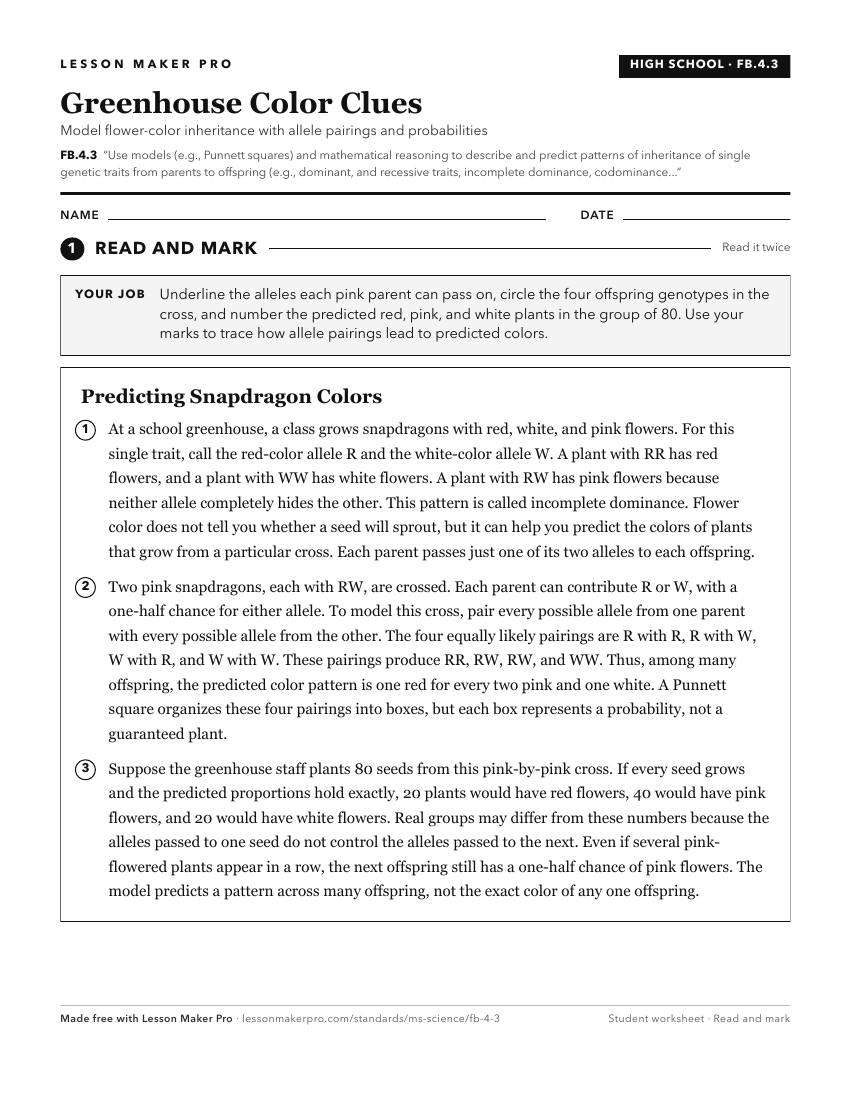
A ready-to-print activity worksheet aligned to FB.4.3, with an answer key for the teacher on its own page. No account needed.
PDF, US Letter, prints cleanly in black and white.
Download the worksheetKeep exploring
Related Standards
- GEN.4.4
Construct pedigrees from observed phenotypes. Analyze and interpret data to determine patterns of inheritance and disease risk.
- GEN.4.3
Investigate traits that follow non-Mendelian inheritance patterns (e.g., incomplete dominance, codominance, multiple alleles, autosomal linkage, sexlinkage, pol...
- L.8.2B.3
Use mathematical and computational thinking to analyze data and make predictions about the outcome of specific genetic crosses (monohybrid Punnett Squares) invo...
- L.8.2A.1
Use a model to show the relationship of genes, chromosomes, and DNA, and construct explanations comparing their relationship to inherited characteristics.
Turn this exact standard into a lesson
Grade, subject, topic, and the complete standard are prefilled. Create one free, no account needed.
Also for this standard:Make a WorksheetMake a QuizMake a Sub Lesson