Mississippi Science BIO.2.4
The Standard
- BIO.2
- Students will explain that cells transform energy through the processes of photosynthesis and cellular respiration to drive cellular functions.
Conduct scientific investigations or computer simulations to compare aerobic and anaerobic cellular respiration in plants and animals, using real world examples.
2026 Mississippi College- and Career-Readiness Standards for Science · Energy Transfer
Teacher's field guide
What This Standard Means
What Students Need to Do
- Students investigate or simulate what happens when plant and animal cells have oxygen or lack it. They compare ATP yield and the products made in each condition. They use their results to explain what happens in flooded roots and hard-working muscles.
What Mastery Looks Like
- A student can use results to show that cells make much more ATP with oxygen than without it. They name carbon dioxide and water as products when oxygen is available, ethanol and carbon dioxide from oxygen-starved roots, and lactate from oxygen-starved muscles.
Common Misconceptions
- Some students think plants only photosynthesize and do not respire. Others think cells make no ATP without oxygen, or that plant and animal cells make the same products when oxygen is scarce.
How to Assess It
- Exit ticket: Make a table for a root cell and a muscle cell, each with and without oxygen. For all four cases, mark ATP yield as high or low and name the products.
Lesson moves
Ways to Teach It
Build root and muscle cell pathways with glucose, oxygen, product, and ATP cards; remove the oxygen cards and rebuild each pathway.
Ask: Why do flooded roots and sprinting muscles make less ATP, and what does each produce without oxygen?
Sort eight root and muscle scenario cards by oxygen use, then match each with ATP yield and product cards.
Run a paper simulation of flooded crop roots and sprinting muscles using oxygen-rich and oxygen-poor cards; tally ATP and products.
Free download
Printable BIO.2.4 Worksheet
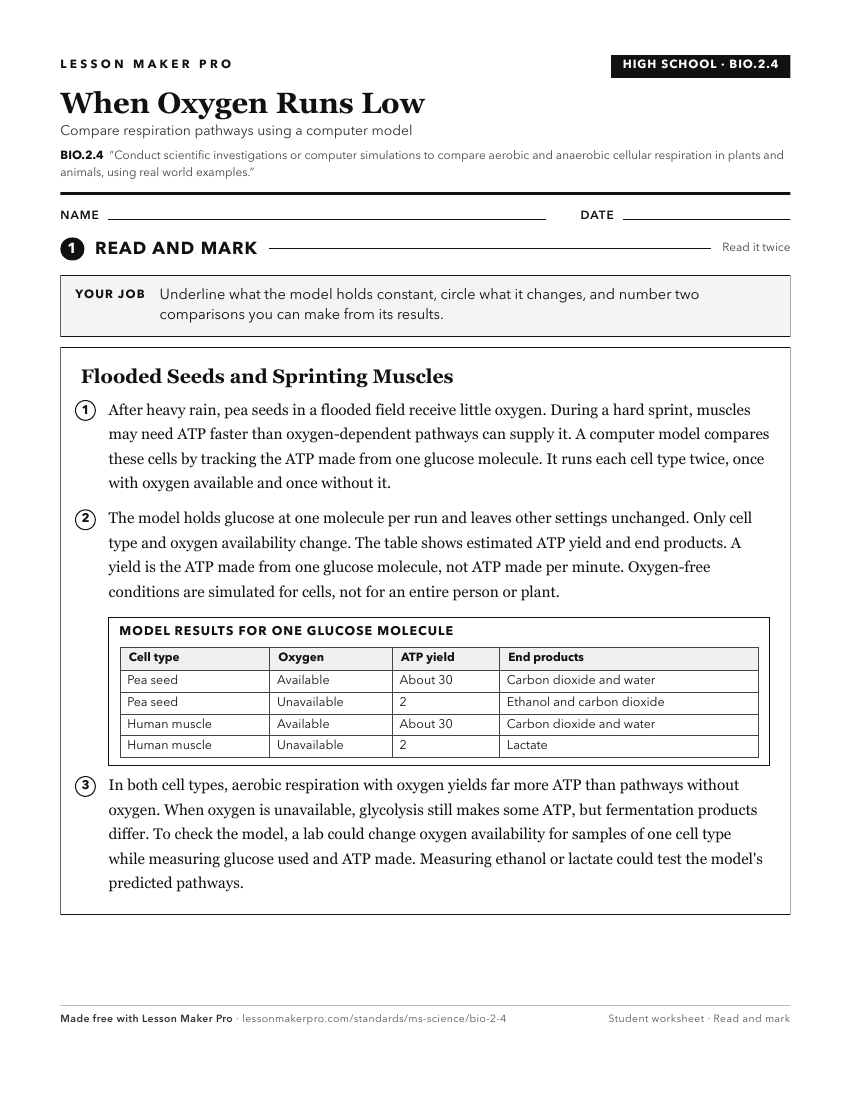
A ready-to-print activity worksheet aligned to BIO.2.4, with an answer key for the teacher on its own page. No account needed.
PDF, US Letter, prints cleanly in black and white.
Download the worksheetKeep exploring
Related Standards
- BOT.1.7
Conduct investigations, collect and analyze data, and communicate results that explain the processes of photosynthesis and cellular respiration (e.g., light int...
- L.1.3A.1
Conduct structured investigations to make and test predictions about what plants need to live, grow, and repair including water, nutrients, sunlight, and space....
- BIO.2.5
Enrichment: Investigate variables (e.g., nutrient availability, temperature) that affect anaerobic respiration and current real-world applications of fermentati...
- L.7.3.2
Analyze and interpret data to explain how the processes of photosynthesis, and cellular respiration (aerobic and anaerobic) work together to meet the needs of p...
Turn this exact standard into a lesson
Grade, subject, topic, and the complete standard are prefilled. Create one free, no account needed.
Also for this standard:Make a WorksheetMake a QuizMake a Sub Lesson