Mississippi Science BOT.1.7
The Standard
- BOT.1
- Students will investigate the morphology, anatomy, and physiology of plants.
Conduct investigations, collect and analyze data, and communicate results that explain the processes of photosynthesis and cellular respiration (e.g., light intensity, light color, light distance, temperature, altering pH, oxygen availability, and carbon dioxide concentration).
2026 Mississippi College- and Career-Readiness Standards for Science · Plant Morphology, Cell Structure, and Function
Teacher's field guide
What This Standard Means
What Students Need to Do
- Change one condition, such as lamp distance, while keeping plant size and test time the same. Measure changes in carbon dioxide or oxygen in light and dark plant samples. Use the data to explain photosynthesis and respiration.
What Mastery Looks Like
- A student sets up a fair test and graphs readings taken at fixed times. They explain that falling carbon dioxide in bright light can show photosynthesis outpacing respiration. They use numbers from their test to support that explanation.
Common Misconceptions
- Students may think plants stop respiring in the light. They may treat a carbon dioxide reading as a direct measure of photosynthesis, even though it reflects both processes. They may change lamp distance without checking whether the lamp also changes temperature.
How to Assess It
- Exit ticket: Two equal Elodea samples start at pH 7. After one hour, the lit sample is pH 8 and the dark sample is pH 6. Explain each change using carbon dioxide, photosynthesis, and respiration.
Lesson moves
Ways to Teach It
Put equal Elodea sprigs in separate CO2 indicator tubes beside one lamp; wrap one tube in foil and record colors at 0 and 45 minutes.
Show a graph of CO2 rising in darkness and falling under a lamp; ask students which processes occur during each period.
For a lamp-distance test, have pairs sort cards labeled 10 cm, 20 cm, water temperature, and oxygen bubbles into variable, control, or measurement.
Give students greenhouse CO2 readings of 600 ppm before sunrise and 420 ppm at noon; ask them to explain the change and check whether vents were open.
Free download
Printable BOT.1.7 Worksheet
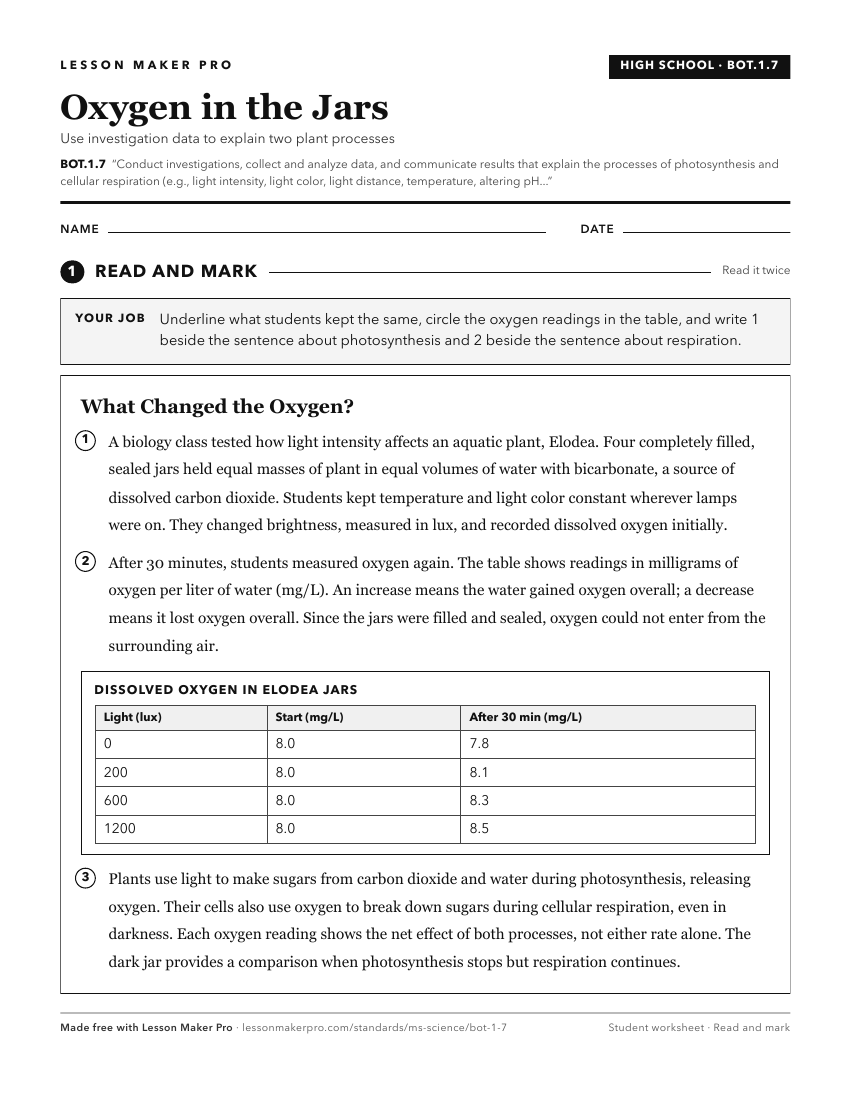
A ready-to-print activity worksheet aligned to BOT.1.7, with an answer key for the teacher on its own page. No account needed.
PDF, US Letter, prints cleanly in black and white.
Download the worksheetKeep exploring
Related Standards
- L.5.3A.2
Analyze environments that do not receive direct sunlight and devise explanations as to how photosynthesis occurs, either naturally or artificially.
- L.1.3A.1
Conduct structured investigations to make and test predictions about what plants need to live, grow, and repair including water, nutrients, sunlight, and space....
- BIO.2.4
Conduct scientific investigations or computer simulations to compare aerobic and anaerobic cellular respiration in plants and animals, using real world examples...
- L.7.3.2
Analyze and interpret data to explain how the processes of photosynthesis, and cellular respiration (aerobic and anaerobic) work together to meet the needs of p...
Turn this exact standard into a lesson
Grade, subject, topic, and the complete standard are prefilled. Create one free, no account needed.
Also for this standard:Make a WorksheetMake a QuizMake a Sub Lesson