Mississippi Science L.5.3A.2
The Standard
- L.5.3A
- Students will demonstrate an understanding of photosynthesis and the transfer of energy from the sun into chemical energy necessary for plant growth and survival.
Analyze environments that do not receive direct sunlight and devise explanations as to how photosynthesis occurs, either naturally or artificially.
2026 Mississippi College- and Career-Readiness Standards for Science · Ecology and Interdependence
Teacher's field guide
What This Standard Means
What Students Need to Do
- Students decide whether light reaches plants in places without direct sun. They explain how indirect sunlight or a lamp can provide light for photosynthesis, and why total darkness cannot.
What Mastery Looks Like
- Given a shaded forest floor, a lit indoor shelf, and a dark cave, a student identifies where plants can photosynthesize. They name the light source in each place that has one.
Common Misconceptions
- Some students think plants need direct sunlight, so a plant in shade cannot make food. Others think soil and water are enough for photosynthesis, even in total darkness.
How to Assess It
- Give students three cards: shaded forest floor, dark cave, and cave with a grow light. Ask them to mark where photosynthesis can happen and name the light source.
Lesson moves
Ways to Teach It
Use a flashlight and white paper to reflect light onto a leaf behind cardboard; compare it with a leaf in an unlit box.
Ask students to write: Can a plant photosynthesize in a cave if we add a grow light? Explain why.
Have pairs sort cards labeled shaded forest, deep cave, lit aquarium, and windowless room with a grow light by whether light reaches plants.
Show a photo of a windowless indoor farm; have students circle the grow lights and explain how the lettuce gets light.
Free download
Printable L.5.3A.2 Worksheet
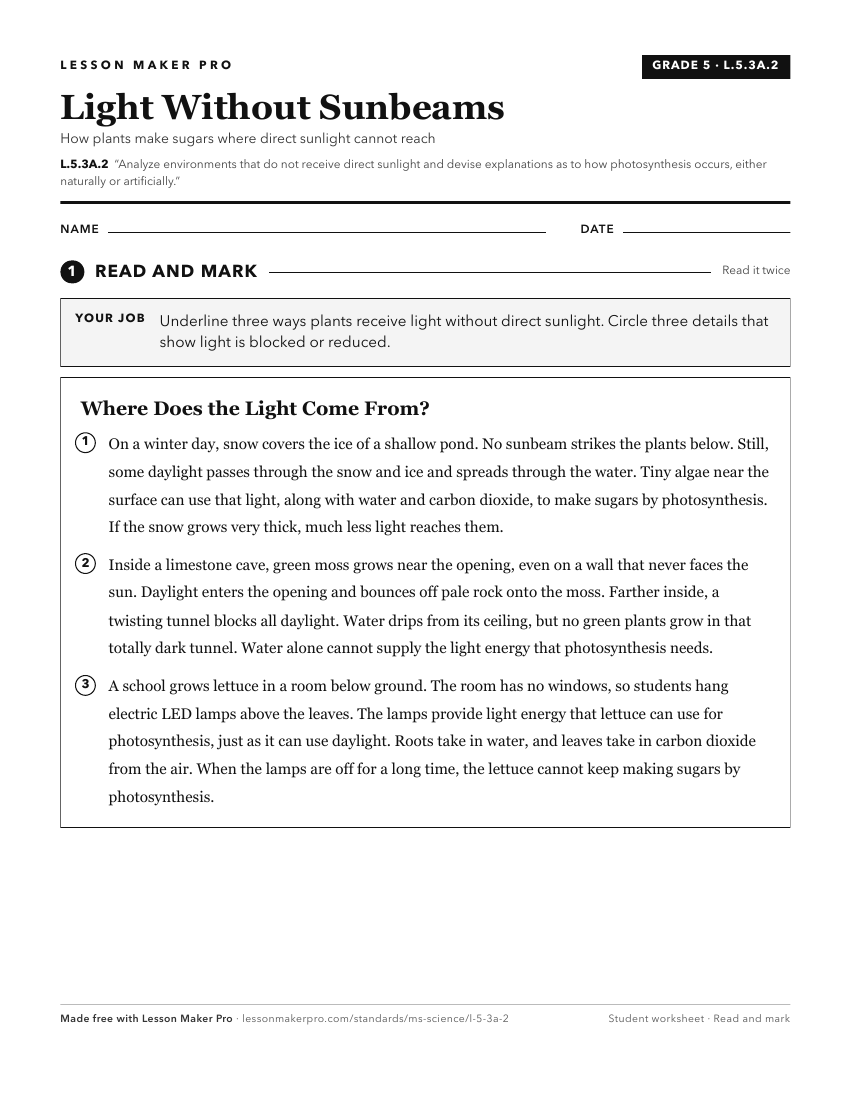
A ready-to-print activity worksheet aligned to L.5.3A.2, with an answer key for the teacher on its own page. No account needed.
PDF, US Letter, prints cleanly in black and white.
Download the worksheetKeep exploring
Related Standards
- BOT.1.7
Conduct investigations, collect and analyze data, and communicate results that explain the processes of photosynthesis and cellular respiration (e.g., light int...
- FB.3.4
Analyze the relationship between photosynthesis and cellular respiration and explain that relationship in terms of the need for all living things to acquire ene...
- L.1.3A.1
Conduct structured investigations to make and test predictions about what plants need to live, grow, and repair including water, nutrients, sunlight, and space....
- L.7.3.2
Analyze and interpret data to explain how the processes of photosynthesis, and cellular respiration (aerobic and anaerobic) work together to meet the needs of p...
Turn this exact standard into a lesson
Grade, subject, topic, and the complete standard are prefilled. Create one free, no account needed.
Also for this standard:Make a WorksheetMake a QuizMake a Sub Lesson