Mississippi Science BOT.1.3
The Standard
- BOT.1
- Students will investigate the morphology, anatomy, and physiology of plants.
Describe the relationship between the structure and purpose of plant organs (e.g., roots, stems, and leaves).
2026 Mississippi College- and Career-Readiness Standards for Science · Plant Morphology, Cell Structure, and Function
Teacher's field guide
What This Standard Means
What Students Need to Do
- Students connect features of roots, stems, and leaves to the jobs they do. They explain how water moves through a plant and how broad leaves help it collect light.
What Mastery Looks Like
- A student can explain how root hairs take in water, stem tubes carry it, and broad leaves catch light. They can predict why leaves wilt when roots are damaged.
Common Misconceptions
- Some students think roots eat soil, rather than absorb water and dissolved minerals. Others think stems only hold plants upright or that leaves take in most of a plant's water from rain.
How to Assess It
- Exit ticket: Sketch a root, stem, and leaf. Label one feature on each, explain its job, and predict what happens to the leaves if the stem is crushed.
Lesson moves
Ways to Teach It
Give pairs a bean seedling and hand lens; have them sketch branching roots, the stem, and broad leaves and label each part's job.
Ask: Why do leaves spread out aboveground while roots branch underground? Have students answer using light and water.
Put root hairs, stem tubes, and broad leaf blades on cards; teams match each feature to absorption, transport, or light capture.
Show a cut flower; ask students why florists trim its stem before placing it in water.
Free download
Printable BOT.1.3 Worksheet
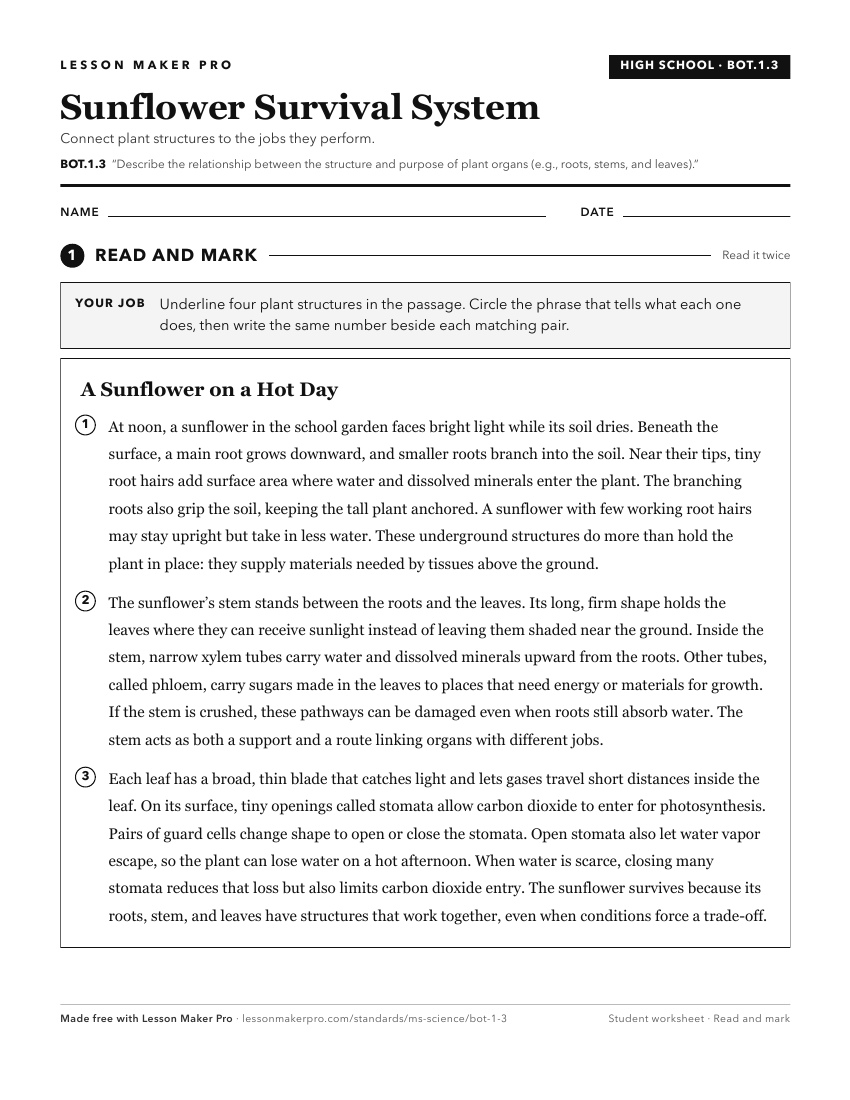
A ready-to-print activity worksheet aligned to BOT.1.3, with an answer key for the teacher on its own page. No account needed.
PDF, US Letter, prints cleanly in black and white.
Download the worksheetKeep exploring
Related Standards
- L.1.1.2
Obtain information from informational text and other media to describe the function of each plant part (roots absorb water and anchor the plant, leaves make foo...
- L.3.1.2
Examine evidence to communicate information that the internal and external structures of plants (e.g., thorns, leaves, stems, roots, or colored petals) function...
- L.1.1.4
Create a model which explains the function of each plant structure (roots, stem, leaves, petals, flowers, seeds).
- HAP.13.1
Analyze the structure-function relationship in organs of the digestive system.
Turn this exact standard into a lesson
Grade, subject, topic, and the complete standard are prefilled. Create one free, no account needed.
Also for this standard:Make a WorksheetMake a QuizMake a Sub Lesson