Mississippi Science L.1.1.4
The Standard
- L.1.1
- Students will demonstrate an understanding of the basic needs and structures of plants.
Create a model which explains the function of each plant structure (roots, stem, leaves, petals, flowers, seeds).
2026 Mississippi College- and Career-Readiness Standards for Science · Hierarchical Organization
Teacher's field guide
What This Standard Means
What Students Need to Do
- Make a model showing roots, a stem, leaves, petals, flowers, and seeds. Use labels, arrows, or spoken explanations to show what each part does.
What Mastery Looks Like
- Students show roots holding the plant and taking in water, stems holding it up and moving water, and leaves making food using sunlight. They show petals attracting pollinators to flowers. They explain that flowers make seeds and seeds can grow into new plants.
Common Misconceptions
- Students may treat petals and flowers as separate parts, rather than seeing petals as part of a flower. They may think leaves take water from the soil or seeds grow on the roots.
How to Assess It
- Give students a plant sketch with roots, a stem, leaves, a flower with petals, and seeds. Ask them to label each part and tell one job it does.
Lesson moves
Ways to Teach It
Use colored paper, tape, and a seed to build a plant model; label six parts and add picture clues for their jobs.
Show a photo of a bee on a flower and ask, “What do the petals help the bee find? What can the flower make?”
Give pairs six plant-part cards and six job cards to match; ask them why petals and flowers need different cards.
Cut open a tomato to show its seeds; students draw the flower that came before it and the plant a seed could become.
Free download
Printable L.1.1.4 Worksheet
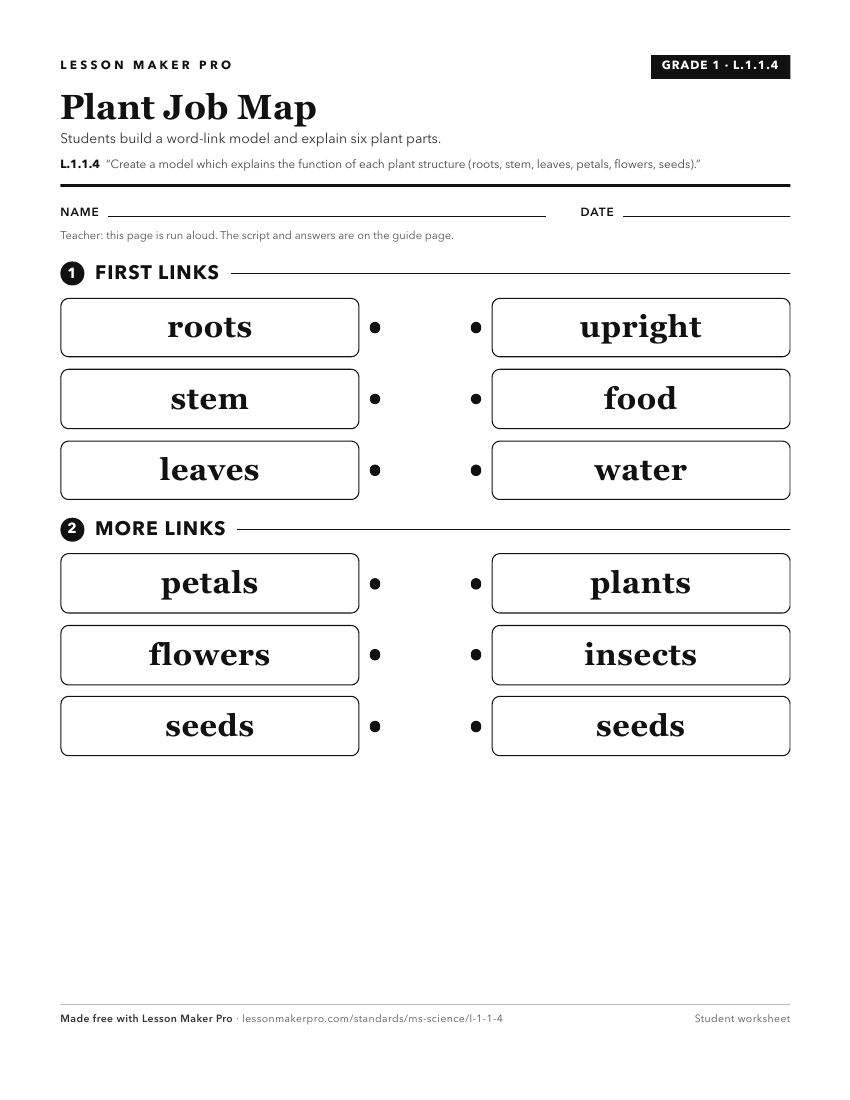
A ready-to-print activity worksheet aligned to L.1.1.4, with an answer key for the teacher on its own page. No account needed.
PDF, US Letter, prints cleanly in black and white.
Download the worksheetKeep exploring
Related Standards
- L.1.1.1
Construct explanations using first-hand observations or other media to describe the structures of different plants (i.e., root, stem, leaves, flowers, and fruit...
- L.4.2.2
Develop and use models to explain the unique and diverse life cycles of organisms other than humans (e.g., flowering plants, frogs, or butterflies) including co...
- L.1.1.2
Obtain information from informational text and other media to describe the function of each plant part (roots absorb water and anchor the plant, leaves make foo...
- BOT.1.10
Identify and compare various live plant examples to explore plant morphological diversity, including leaf number, structure, and arrangement; root modifications...
Turn this exact standard into a lesson
Grade, subject, topic, and the complete standard are prefilled. Create one free, no account needed.
Also for this standard:Make a WorksheetMake a QuizMake a Sub Lesson