Mississippi Science L.1.1
Standard Cluster
Students will demonstrate an understanding of the basic needs and structures of plants. Construct explanations using first-hand observations or other media to describe the structures of different plants (i.e., root, stem, leaves, flowers, and fruit). Report findings using drawings, writing, or models. Obtain information from informational text and other media to describe the function of each plant part (roots absorb water and anchor the plant, leaves make food, the stem transports water and food, petals attract pollinators, flowers produce seeds, and seeds produce new plants). Design and conduct an experiment that shows the absorption of water and how it is transported through the plant. Report observations using drawings, sketches, or models. Create a model which explains the function of each plant structure (roots, stem, leaves, petals, flowers, seeds). With teacher support, gain an understanding that scientists are humans who use observations and experiments to learn about the natural world. Obtain information from informational text or other media about scientists who have made important observations about plants (e.g., Theophrastus, Gregor Mendel, George Washington Carver, Katherine Esau).
2026 Mississippi College- and Career-Readiness Standards for Science · Hierarchical Organization
Cluster contents
Standards in This Cluster
L.1.1 is a cluster heading. These are the individual standards under it.
- L.1.1.1
Construct explanations using first-hand observations or other media to describe the structures of different plants (i.e., root, stem, leaves, flowers, and fruit...
- L.1.1.2
Obtain information from informational text and other media to describe the function of each plant part (roots absorb water and anchor the plant, leaves make foo...
- L.1.1.3
Design and conduct an experiment that shows the absorption of water and how it is transported through the plant. Report observations using drawings, sketches, o...
- L.1.1.4
Create a model which explains the function of each plant structure (roots, stem, leaves, petals, flowers, seeds).
- L.1.1.5
With teacher support, gain an understanding that scientists are humans who use observations and experiments to learn about the natural world. Obtain information...
Teacher's field guide
What This Cluster Means
What Students Need to Do
- Students observe plants and use a book to explain what each plant part does. They test how water enters and moves through a plant, then draw what they see. They name water, light, and air as plant needs and tell how a scientist learned by studying plants.
What Mastery Looks Like
- A student labels roots, stems, leaves, petals, flowers, fruit, and seeds on a drawing. They explain that roots take in water and hold the plant, stems move water and food, leaves make food, and petals attract pollinators. They show water moving up a stem and explain that flowers make seeds, fruit holds seeds, and seeds can grow into new plants.
Common Misconceptions
- Students may think plants take in water through their leaves or that stems make food. They may confuse fruit with seeds or think petals make seeds. Some expect water to stay in the roots rather than move up the stem.
How to Assess It
- Exit ticket: Label the roots, stem, leaves, flower, fruit, and seeds on a plant drawing. Draw arrows showing where water enters and where it goes next, then write what roots and leaves do.
Lesson moves
Ways to Teach It
Set rooted bean seedlings in dyed water; let pairs choose a check time and sketch any color changes in roots and stems.
Read a short page about George Washington Carver's plant work; ask, "What did he observe, and how did observation help him?"
Give pairs plant-part cards and function cards; have them match each pair, then explain one match using a potted plant.
Cut open a grocery-store apple, find its seeds, and draw how one seed could become a new apple tree.
Free download
Printable L.1.1 Worksheet
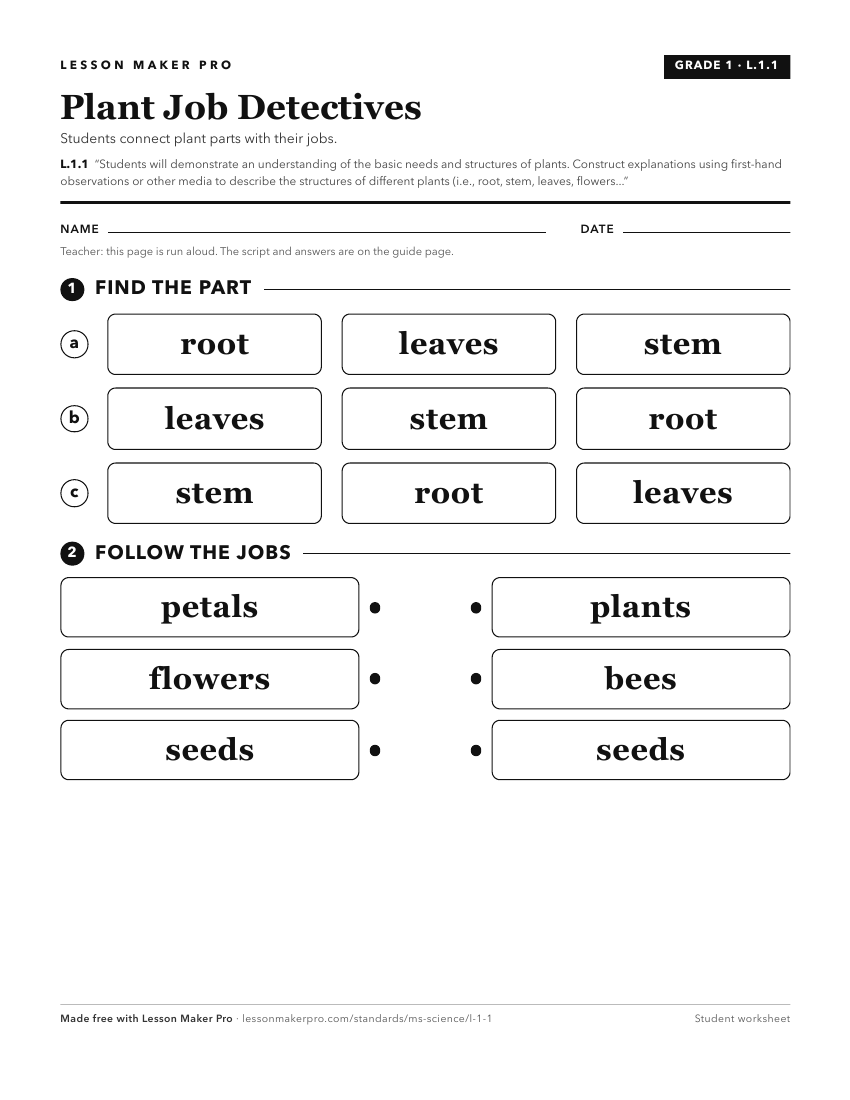
A ready-to-print activity worksheet aligned to L.1.1, with an answer key for the teacher on its own page. No account needed.
PDF, US Letter, prints cleanly in black and white.
Download the worksheetKeep exploring
Related Standards
- L.K.3A
Students will demonstrate an understanding of what animals and plants need to live and grow.
- L.1.4
Students will demonstrate an understanding of the ways plants adapt to their environment in order to survive.
- L.1.3A
Students will demonstrate an understanding of what plants need from the environment for growth and repair.
- L.3.1
Students will demonstrate an understanding of internal and external structures in plants and animals and how they relate to their growth, survival, behavior, an...
Turn this cluster into a lesson
Grade, subject, topic, and the complete cluster are prefilled. Create one free, no account needed.
Also for this cluster:Make a WorksheetMake a QuizMake a Sub Lesson