Mississippi Science BOT.1.6
The Standard
- BOT.1
- Students will investigate the morphology, anatomy, and physiology of plants.
Demonstrate through model development and manipulation an understanding of plant biochemistry.
2026 Mississippi College- and Career-Readiness Standards for Science · Plant Morphology, Cell Structure, and Function
Teacher's field guide
What This Standard Means
What Students Need to Do
- Students build a model showing how plants use light, water, and carbon dioxide to make sugar and oxygen. They change the model to predict what happens when light is removed.
What Mastery Looks Like
- A student traces carbon from carbon dioxide into sugar. They show that light supplies energy, not atoms, and explain why a plant can still use stored sugar in the dark.
Common Misconceptions
- Students may think plants get their food from soil or that sunlight becomes part of the sugar molecule. Some think plants stop using oxygen at night.
How to Assess It
- Give students cards labeled light, water, carbon dioxide, sugar, and oxygen. Ask them to arrange a model of photosynthesis, remove the light card, and explain what stops and what can continue.
Lesson moves
Ways to Teach It
Give pairs molecule cards to arrange around a drawn chloroplast, then move the cards to show sugar and oxygen leaving.
Ask students to write two sentences explaining why a plant kept in the dark still needs oxygen.
Play a card-sort race matching molecule cards to photosynthesis inputs and outputs, then have teams sort them for respiration.
Show photos of tomato plants under grow lights and in shade; have students adjust a photosynthesis model to predict sugar production.
Free download
Printable BOT.1.6 Worksheet
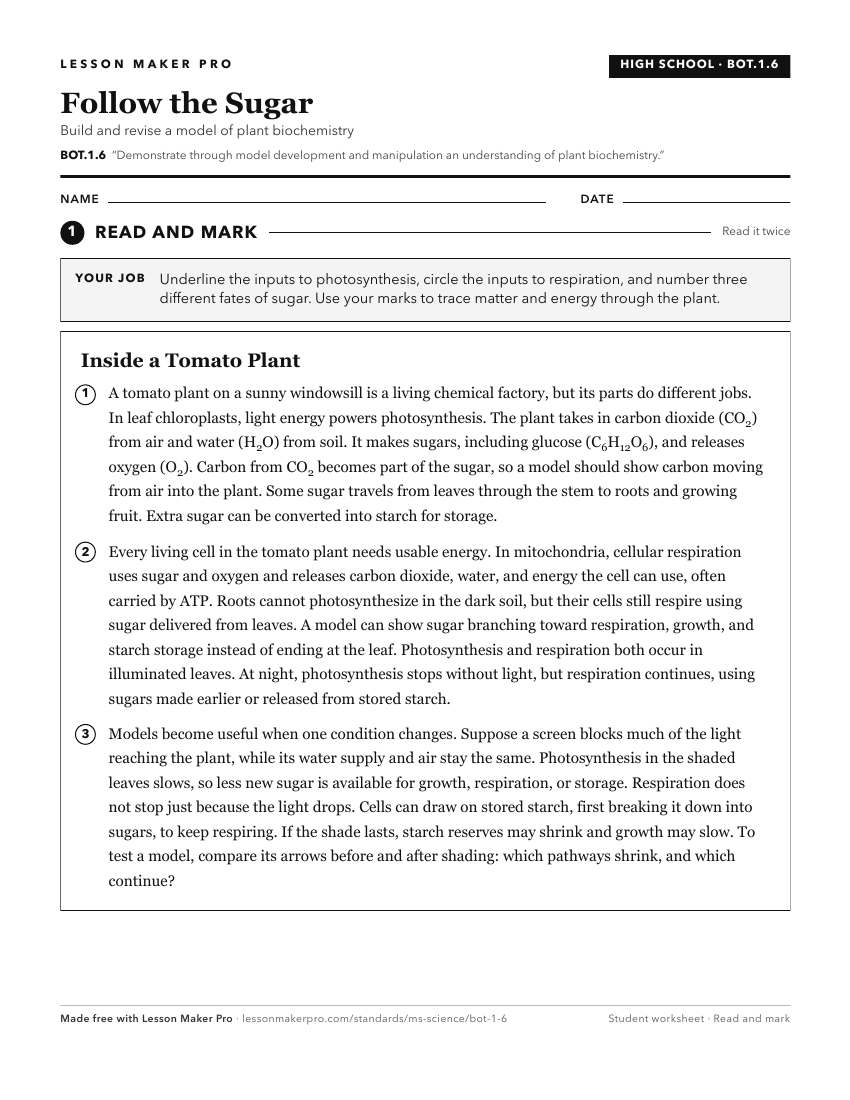
A ready-to-print activity worksheet aligned to BOT.1.6, with an answer key for the teacher on its own page. No account needed.
PDF, US Letter, prints cleanly in black and white.
Download the worksheetKeep exploring
Related Standards
- BIO.2.2
Develop models of the major reactants and products of photosynthesis to demonstrate the transformation of light energy into stored chemical energy in cells. Emp...
- L.1.1.4
Create a model which explains the function of each plant structure (roots, stem, leaves, petals, flowers, seeds).
- L.5.3A
Students will demonstrate an understanding of photosynthesis and the transfer of energy from the sun into chemical energy necessary for plant growth and surviva...
- L.7.3.3
Use models to describe how food molecules (carbohydrates, lipids, proteins) are processed through chemical reactions using oxygen (aerobic) to form new molecule...
Turn this exact standard into a lesson
Grade, subject, topic, and the complete standard are prefilled. Create one free, no account needed.
Also for this standard:Make a WorksheetMake a QuizMake a Sub Lesson