Mississippi Science BOT.1.9
The Standard
- BOT.1
- Students will investigate the morphology, anatomy, and physiology of plants.
Communicate the importance of carbon, hydrogen, oxygen, phosphorus, and nitrogen cycles to plant physiology through graphics such as poster or computer presentations.
2026 Mississippi College- and Career-Readiness Standards for Science · Plant Morphology, Cell Structure, and Function
Teacher's field guide
What This Standard Means
What Students Need to Do
- Make a poster or slide showing how carbon, hydrogen, oxygen, phosphorus, and nitrogen move through air, water, soil, and plants. Use arrows to show where each enters a plant, how the plant uses it, and how it returns to the environment.
What Mastery Looks Like
- Students trace carbon from air into sugar and back out as carbon dioxide. They show hydrogen from water entering sugars, oxygen released during photosynthesis, and oxygen used in respiration. They link soil nitrogen to proteins and phosphorus to DNA and ATP, then show decay returning both to soil.
Common Misconceptions
- Students may think plants get carbon from soil rather than from carbon dioxide in air. Some draw roots taking in nitrogen gas or phosphorus falling from the atmosphere. Others think the oxygen released during photosynthesis comes from carbon dioxide instead of water.
How to Assess It
- Give students a blank plant diagram with air and soil. Ask them to add labeled arrows for all five elements, one plant use for each, and one route each takes back to the environment.
Lesson moves
Ways to Teach It
Tape colored yarn onto a plant sketch to trace five elements from air, water, and soil into the plant and back.
Ask students to write two sentences explaining why sunlight and water cannot keep a plant growing without usable nitrogen or phosphorus.
Give pairs CO2, water, O2, nitrate, and phosphate cards; have them place each on a plant diagram and name its use.
Compare a fertilizer label with a compost bag; draw where nitrogen and phosphorus enter a garden plant and return to soil.
Free download
Printable BOT.1.9 Worksheet
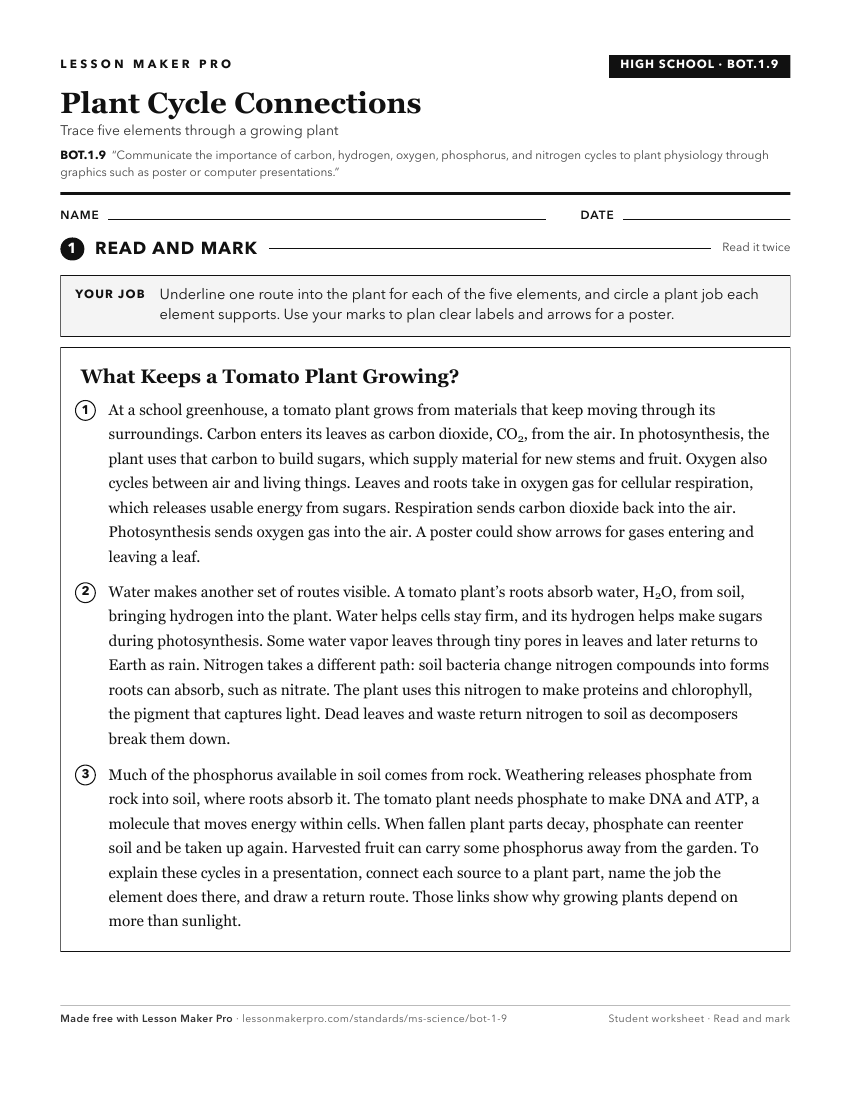
A ready-to-print activity worksheet aligned to BOT.1.9, with an answer key for the teacher on its own page. No account needed.
PDF, US Letter, prints cleanly in black and white.
Download the worksheetKeep exploring
Related Standards
- ENV.1.5
Develop and use models to diagram the flow of nitrogen, carbon, and phosphorus through the environment.
- E.3.9.1
Develop models to communicate the characteristics of the Earth's major systems, including the geosphere, hydrosphere, atmosphere, and biosphere (e.g., digital m...
- L.7.3.1
Analyze diagrams to provide evidence of the importance of the cycling of water, oxygen, carbon, and nitrogen through ecosystems to organisms.
- L.K.2.1
Use informational text or other media to make observations about plants as they change during the life cycle (e.g., germination, growth, reproduction, and death...
Turn this exact standard into a lesson
Grade, subject, topic, and the complete standard are prefilled. Create one free, no account needed.
Also for this standard:Make a WorksheetMake a QuizMake a Sub Lesson