Mississippi Science BOT.1.11
The Standard
- BOT.1
- Students will investigate the morphology, anatomy, and physiology of plants.
Compare and contrast functions of the various characteristics found in plant divisions and utilize dichotomous keys to identify plant species.
2026 Mississippi College- and Career-Readiness Standards for Science · Plant Morphology, Cell Structure, and Function
Teacher's field guide
What This Standard Means
What Students Need to Do
- Students compare how mosses, ferns, conifers, and flowering plants move water and reproduce. They explain what structures such as spores, cones, and flowers do. They use visible traits and a dichotomous key to identify a plant species.
What Mastery Looks Like
- A student explains that vascular tissue moves water and sugars, while seeds protect and feed a young plant. They distinguish fern spores from pine cones and flowering plant fruits. They name a species using a key and point to the trait behind each choice.
Common Misconceptions
- Students may think moss has true roots because it grows on soil. They may mistake fern spores for seeds or assume all seed plants make flowers. Some pick a species from its overall look without checking both choices at each step of the key.
How to Assess It
- Show a pine twig with five needles per bundle and give a two-choice key: five needles, eastern white pine; two needles, Scots pine. Ask students to name the species, cite the trait, and state what its cones hold.
Lesson moves
Ways to Teach It
Hand pairs photo cards showing moss capsules, fern sori, pine cones, and sunflower heads; sort them by spores or seeds and label each structure's job.
Ask: Why can a pine make seeds without flowers, while a fern cannot make seeds? Use cones and spores in your answer.
Give teams photos of eastern white pine, Scots pine, sunflower, and dandelion; key by needles versus flowers, then needle count or leaf position.
Use a nursery tag for eastern white pine and a twig photo; verify the species with a needle key before buying it.
Free download
Printable BOT.1.11 Worksheet
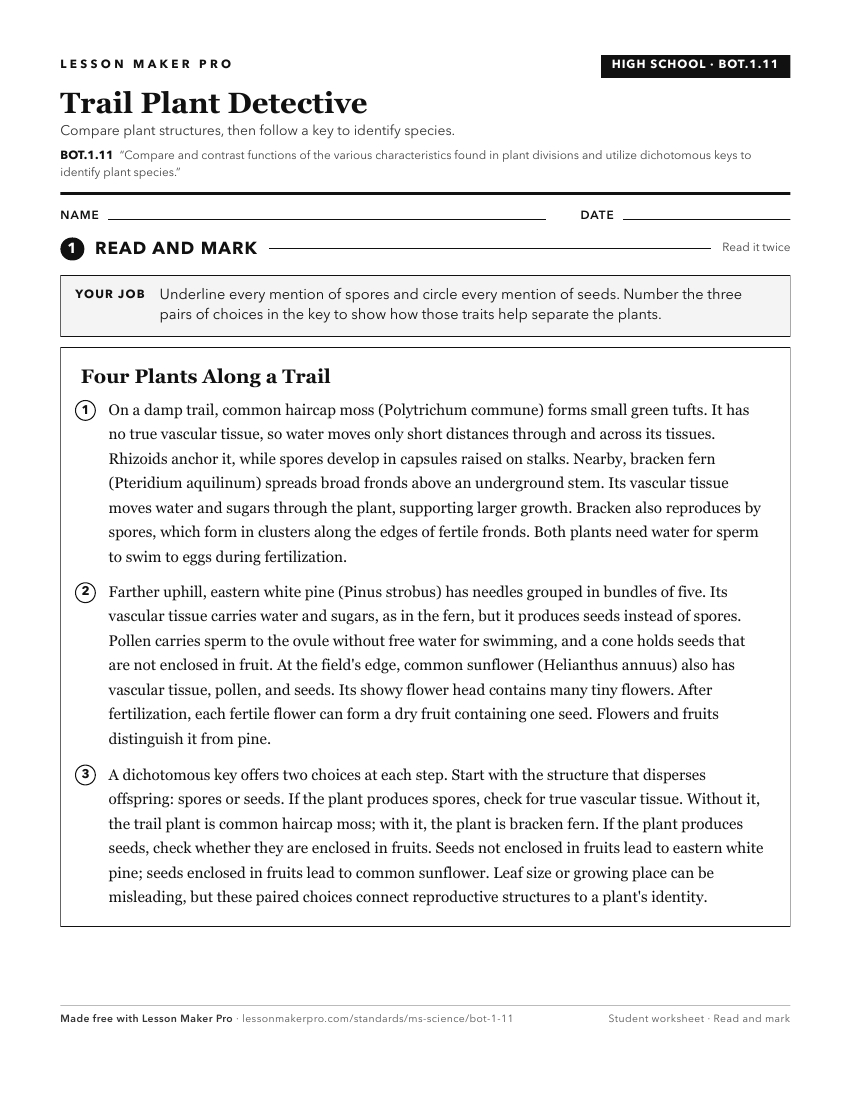
A ready-to-print activity worksheet aligned to BOT.1.11, with an answer key for the teacher on its own page. No account needed.
PDF, US Letter, prints cleanly in black and white.
Download the worksheetKeep exploring
Related Standards
- L.6.4
Students will demonstrate an understanding of classification tools and models such as dichotomous keys to classify representative organisms based on the charact...
- BOT.1.10
Identify and compare various live plant examples to explore plant morphological diversity, including leaf number, structure, and arrangement; root modifications...
- ZOO.1.1
Develop and use dichotomous keys to distinguish animals from protists, plants, and fungi.
- BOT.3.5
Compare the similarities between corresponding plant reproductive structures from a variety of species. Record via drawings of observed dissection specimens and...
Turn this exact standard into a lesson
Grade, subject, topic, and the complete standard are prefilled. Create one free, no account needed.
Also for this standard:Make a WorksheetMake a QuizMake a Sub Lesson