Mississippi Science BOT.1.5
The Standard
- BOT.1
- Students will investigate the morphology, anatomy, and physiology of plants.
Calculate surface area of leaves/roots and compare surface areas of various plant specimens to explain adaptations of the various plant types.
2026 Mississippi College- and Career-Readiness Standards for Science · Plant Morphology, Cell Structure, and Function
Teacher's field guide
What This Standard Means
What Students Need to Do
- Students estimate leaf area from tracings and root surface area by treating roots as cylinders. They compare plants and explain how surface area affects light capture, water uptake, and water loss.
What Mastery Looks Like
- A student reports areas in cm², shows the calculation, and adds the areas of several root branches. They use the measurements to explain why a broad leaf or a branched root system may suit a plant's habitat.
Common Misconceptions
- Students may measure a leaf's edge instead of the space inside it, or report area in cm instead of cm². They may ignore thin root branches or assume a larger leaf is always better, without considering water loss.
How to Assess It
- Exit ticket: Plant A has a 6 cm by 4 cm leaf and a cylindrical root 10 cm long and 0.2 cm wide. Plant B has a 3 cm by 2 cm leaf and a root 10 cm long and 0.1 cm wide. Estimate each leaf's one-sided area and each root's outer area using π × diameter × length, then explain one advantage of A's larger surfaces.
Lesson moves
Ways to Teach It
Trace bean and grass leaves on grid paper, count squares, then measure three roots per seedling and estimate their cylindrical areas.
Ask students to write which leaf might lose more water, a broad bean leaf or a narrow grass leaf, using their measurements as evidence.
Give pairs cards with leaf dimensions and root lengths and diameters; have them calculate areas, swap cards, and check units.
Trace leaves from a grocery-store basil plant and a potted succulent, then compare their areas and discuss water loss.
Free download
Printable BOT.1.5 Worksheet
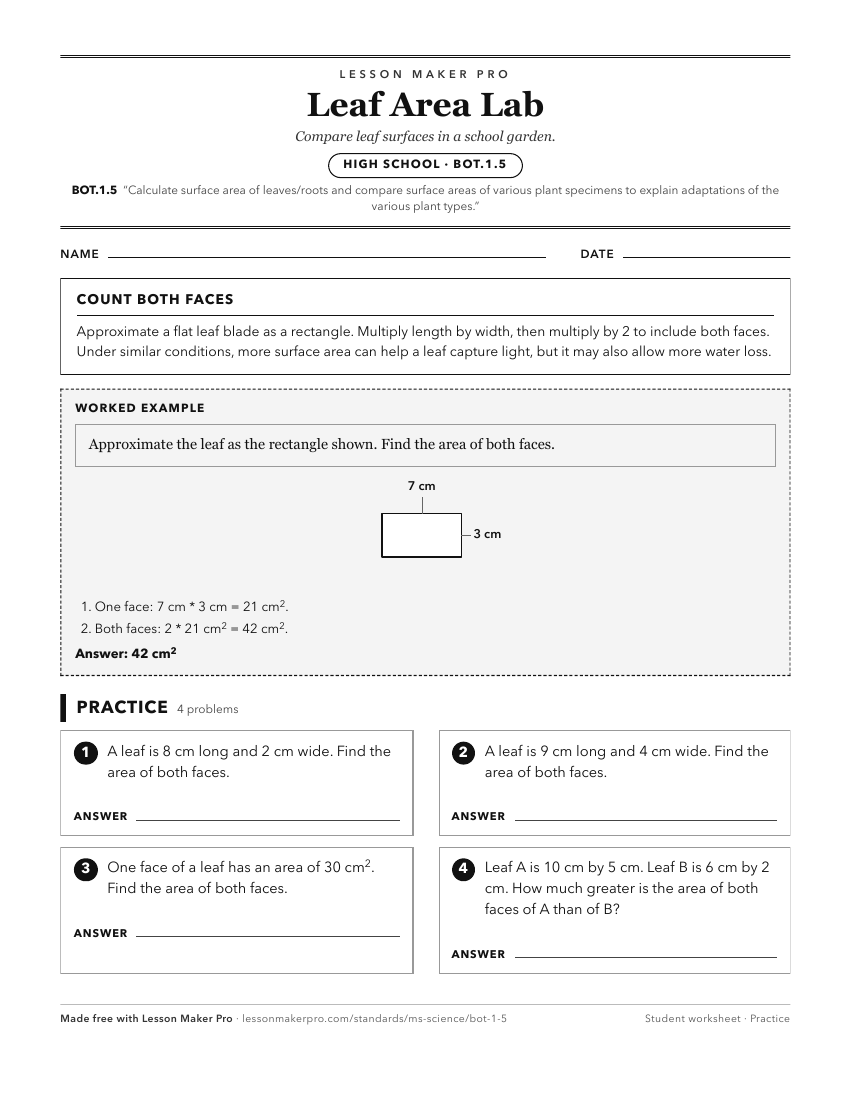
A ready-to-print activity worksheet aligned to BOT.1.5, with an answer key for the teacher on its own page. No account needed.
PDF, US Letter, prints cleanly in black and white.
Download the worksheetKeep exploring
Related Standards
- L.1.4.1
Explore the cause-and-effect relationship between plant adaptations and environmental changes (i.e., leaves turning toward the sun, leaves changing color, leave...
- BOT.5.1
Research plants found in various habitats. Analyze how plants use adaptations for survival in these habitats including extreme habitats.
- BOT.1.10
Identify and compare various live plant examples to explore plant morphological diversity, including leaf number, structure, and arrangement; root modifications...
- BOT.5
Students will explore adaptations that allow plants to survive in various habitats.
Turn this exact standard into a lesson
Grade, subject, topic, and the complete standard are prefilled. Create one free, no account needed.
Also for this standard:Make a WorksheetMake a QuizMake a Sub Lesson