Mississippi Science BOT.1.1
The Standard
- BOT.1
- Students will investigate the morphology, anatomy, and physiology of plants.
Analyze models (3-D, paper, and/or computer-based) to distinguish the basic morphology of the plant kingdom, with attention to structures and their related functions. Use cladograms or phylogenetic trees to identify evolutionary features that distinguish the plant kingdom from other kingdoms.
2026 Mississippi College- and Career-Readiness Standards for Science · Plant Morphology, Cell Structure, and Function
Teacher's field guide
What This Standard Means
What Students Need to Do
- Use plant and cell models to name parts and explain their jobs. Trace traits on a cladogram to compare mosses, ferns, seed plants, green algae, and fungi.
What Mastery Looks Like
- Students identify chloroplasts as sites of photosynthesis and cellulose cell walls as support. They explain the jobs of roots, stems, and leaves where those parts occur. On a cladogram, they place protected embryos before mosses and seeds after ferns branch off.
Common Misconceptions
- Students may call moss rhizoids roots or assume every plant makes seeds and flowers. They may read a cladogram as a ladder, or think chloroplasts alone separate land plants from green algae.
How to Assess It
- Give students sketches of a moss and sunflower beside a cladogram of green algae, mosses, ferns, and sunflowers. Ask them to label one structure and its job on each plant, then mark where protected embryos first appear.
Lesson moves
Ways to Teach It
Build paper models of moss and bean plants; label rhizoids or roots, photosynthetic parts, and reproductive structures with their jobs.
Show a cladogram of fungi, green algae, mosses, ferns, and sunflowers; ask why mosses and sunflowers share embryos but not seeds.
Play a trait-card sort: place cuticle, vascular tissue, seeds, and flowers on the first matching branch of a plant cladogram.
Compare a pinecone and a cut apple, then identify where seeds form and why only the apple has fruit.
Free download
Printable BOT.1.1 Worksheet
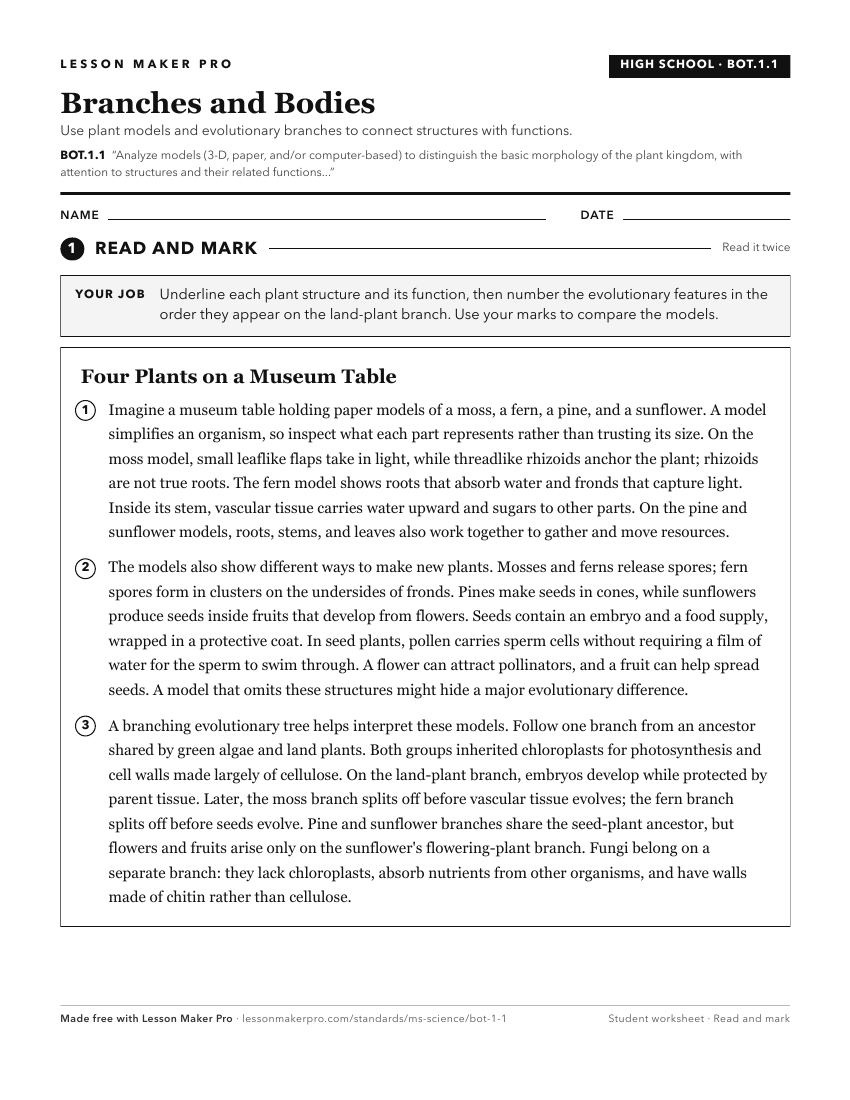
A ready-to-print activity worksheet aligned to BOT.1.1, with an answer key for the teacher on its own page. No account needed.
PDF, US Letter, prints cleanly in black and white.
Download the worksheetKeep exploring
Related Standards
- BIO.4.3
Analyze cladograms/phylogenetic trees to illustrate relatedness between species.
- FB.5.5
Enrichment: Create and analyze models that illustrate the relatedness between all living things (cladograms/phylogenic trees).
- BOT.1.10
Identify and compare various live plant examples to explore plant morphological diversity, including leaf number, structure, and arrangement; root modifications...
- MAQ.6.2
Identify characteristics that are shared and derived using graphical representations of animal evolution (i.e., cladograms and phylogenetic trees) and develop c...
Turn this exact standard into a lesson
Grade, subject, topic, and the complete standard are prefilled. Create one free, no account needed.
Also for this standard:Make a WorksheetMake a QuizMake a Sub Lesson