Mississippi Science BOT.6
Standard Cluster
Students will ask questions, plan, and conduct field investigations on local plant communities. Conduct transects/plot studies to determine species, biodiversity, or health of a plant community. (Plots may be linear or a quadrat (square or circular) depending on the habitat. (Typically, relative density, relative dominance, and relative frequency of each species are calculated to infer an important value of the species in the plot.) Compare and contrast genomes using plant genetic databases (e.g., BLAST or plant GDB). Enrichment: Use an engineering design process to define a problem, design, construct, evaluate, and improve a societal concern with the aid of plants (e.g., irrigation, water conservation, urban shading, green-space development, food deserts, or other local needs or issues). *
2026 Mississippi College- and Career-Readiness Standards for Science · Local Plant Investigations
Cluster contents
Standards in This Cluster
BOT.6 is a cluster heading. These are the individual standards under it.
- BOT.6.1
Conduct transects/plot studies to determine species, biodiversity, or health of a plant community. (Plots may be linear or a quadrat (square or circular) depend...
- BOT.6.2
Compare and contrast genomes using plant genetic databases (e.g., BLAST or plant GDB).
- BOT.6.3
Enrichment: Use an engineering design process to define a problem, design, construct, evaluate, and improve a societal concern with the aid of plants (e.g., irr...
Teacher's field guide
What This Cluster Means
What Students Need to Do
- Students ask a question about plants at two local sites. They sample with quadrats or a transect, record species counts and plant cover, and compare the sites. They also compare plant DNA records in a database.
What Mastery Looks Like
- Students use repeated samples to calculate relative density, frequency, and dominance. They support a claim about a site with field data. They report what a BLAST match shows without claiming two plants have identical genomes.
Common Misconceptions
- A crowded plot can still have only one species, and one plot may not represent the site. Students may mix up how often a plant appears across plots with how much ground it covers. A close DNA match does not mean two plants have identical genomes.
How to Assess It
- Exit ticket: A quadrat has 6 clover plants, 3 grass plants, and 1 dandelion. What is clover’s relative density, and why should you sample more than one quadrat?
Lesson moves
Ways to Teach It
Place a 1-meter square of string in two schoolyard spots, then tally each plant species and estimate its ground cover.
Ask: Which site is more diverse, one with ten dandelions or one with five different plants? Defend your answer.
Give pairs two plant DNA sequences and a BLAST link; have them compare percent identity and explain what a high match means.
Use courtyard plant counts to sketch a shade planting plan, then check where trees would block paths or need extra water.
Free download
Printable BOT.6 Worksheet
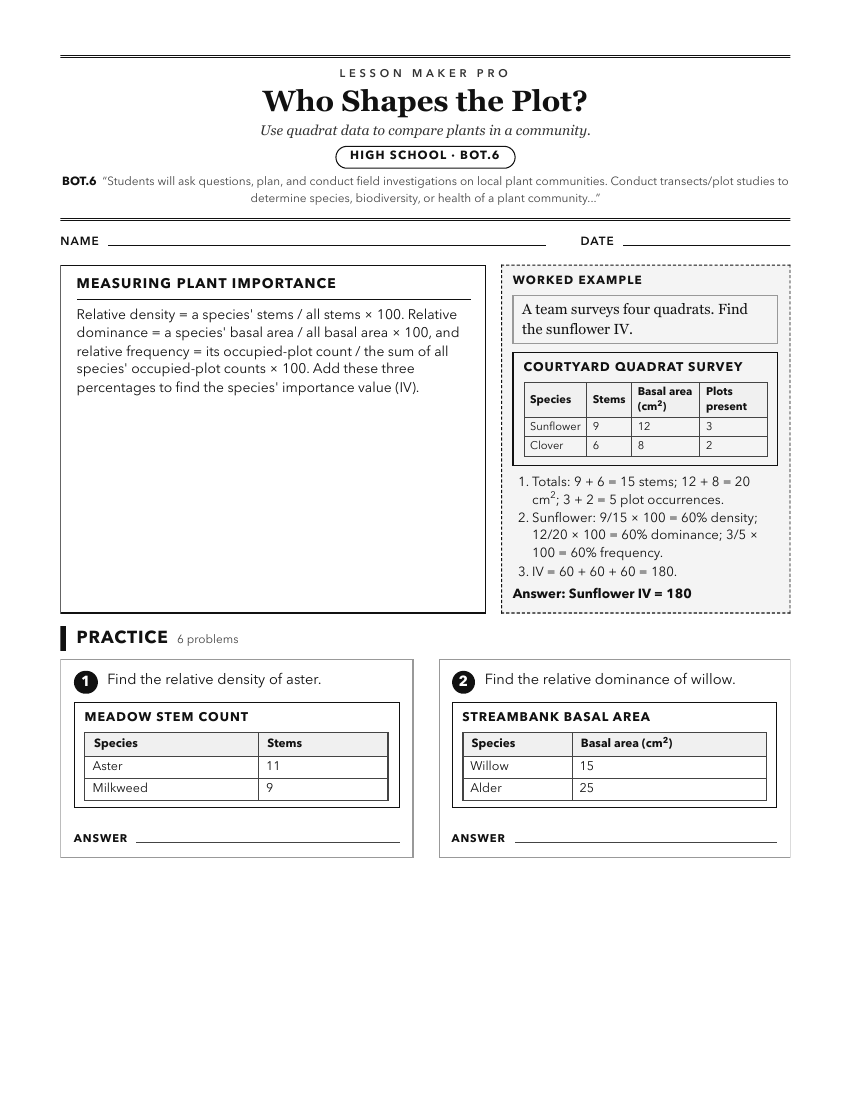
A ready-to-print activity worksheet aligned to BOT.6, with an answer key for the teacher on its own page. No account needed.
PDF, US Letter, prints cleanly in black and white.
Download the worksheetKeep exploring
Related Standards
- BOT.1
Students will investigate the morphology, anatomy, and physiology of plants.
- BIO.5
Students will Investigate and evaluate the interdependence of living organisms and their environment.
- BOT.5
Students will explore adaptations that allow plants to survive in various habitats.
- BOT.4
Students will explore the global value of plants and the interaction between humans and plants.
Turn this cluster into a lesson
Grade, subject, topic, and the complete cluster are prefilled. Create one free, no account needed.
Also for this cluster:Make a WorksheetMake a QuizMake a Sub Lesson