Mississippi Science BOT.4
Standard Cluster
Students will explore the global value of plants and the interaction between humans and plants. Identify plants used in the bioremediation of an area due to natural processes (e.g., fire), industrial pollution, or wars, and develop and communicate a plan to remediate a habitat impacted by human interactions (e.g., carbon sinks, phytoremediation, or heavy metal detoxification). Use an engineering design process to define a problem, design, construct, evaluate, and improve a habitat impacted by human interactions. * Investigate historical and modern medicinal uses of plants. Investigate the industrial use of plants. Explore the impacts (both positive and negative) of plant biotechnology/GMOs on human society. Present findings using digital media or technology and include evidence using graphs or charts. Enrichment: Use an engineering design process to design and conduct an investigation that uses biomimicry to provide a plant-based solution to an environmental challenge. *
2026 Mississippi College- and Career-Readiness Standards for Science · Society’s Reliance on Plants
Cluster contents
Standards in This Cluster
BOT.4 is a cluster heading. These are the individual standards under it.
- BOT.4.1
Identify plants used in the bioremediation of an area due to natural processes (e.g., fire), industrial pollution, or wars, and develop and communicate a plan t...
- BOT.4.2
Use an engineering design process to define a problem, design, construct, evaluate, and improve a habitat impacted by human interactions. *
- BOT.4.3
Investigate historical and modern medicinal uses of plants.
- BOT.4.4
Investigate the industrial use of plants.
- BOT.4.5
Explore the impacts (both positive and negative) of plant biotechnology/GMOs on human society. Present findings using digital media or technology and include ev...
- BOT.4.6
Enrichment: Use an engineering design process to design and conduct an investigation that uses biomimicry to provide a plant-based solution to an environmental ...
Teacher's field guide
What This Cluster Means
What Students Need to Do
- Students choose plants that could help repair a damaged habitat. They build, test, and improve a model of their plan. They use charts to explain plant uses in medicine and industry and weigh benefits and risks of GM crops.
What Mastery Looks Like
- A student explains why a chosen plant fits a site, using evidence about soil protection or pollutant uptake. They graph test results and use them to improve their model. They cite sources for a medicinal and an industrial plant use, and describe a benefit and a risk of a GM crop.
Common Misconceptions
- Students may think any plant can remove any pollutant, or that a plant makes heavy metals harmless by taking them up. They may treat traditional medicinal use as proof of safety or assume all GM crops have the same effects.
How to Assess It
- Exit ticket: A bare-soil model produced 80 mL of runoff, and a grass-covered model produced 30 mL. Sketch a two-bar graph, explain which model reduced runoff, and name one change to test next.
Lesson moves
Ways to Teach It
Build bare and grass-covered soil trays, pour equal amounts of water over each, measure runoff, then revise the tray with more runoff.
Give students GM corn yield and herbicide-use data; ask them to write one supported benefit and one concern.
Sort site cards for an eroded hill, polluted soil, and a cleared streambank; match each to a plant and defend the choice.
Inspect a cotton shirt label and a bottle of aloe gel, then trace how each plant becomes a product.
Free download
Printable BOT.4 Worksheet
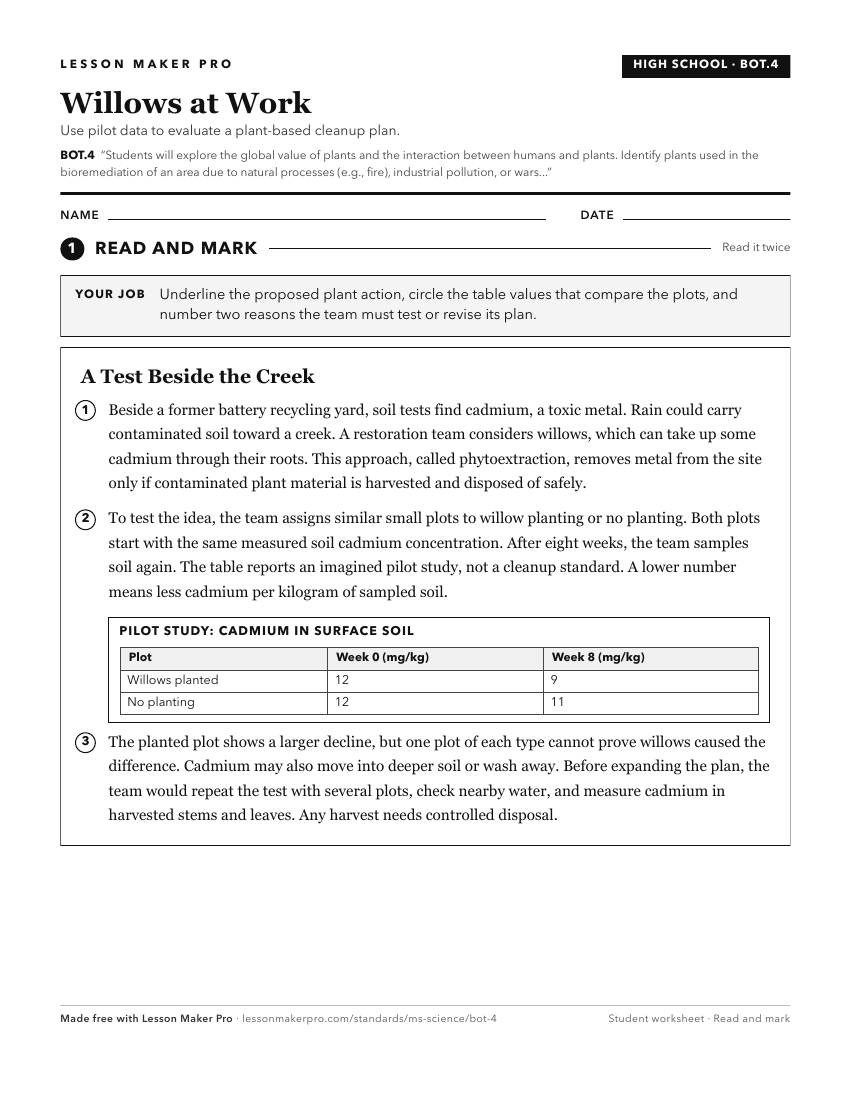
A ready-to-print activity worksheet aligned to BOT.4, with an answer key for the teacher on its own page. No account needed.
PDF, US Letter, prints cleanly in black and white.
Download the worksheetKeep exploring
Related Standards
- L.2.3A
Students will demonstrate an understanding of the interdependence of living things and the environment in which they live.
- L.1.4
Students will demonstrate an understanding of the ways plants adapt to their environment in order to survive.
- BIO.5
Students will Investigate and evaluate the interdependence of living organisms and their environment.
- BOT.5
Students will explore adaptations that allow plants to survive in various habitats.
Turn this cluster into a lesson
Grade, subject, topic, and the complete cluster are prefilled. Create one free, no account needed.
Also for this cluster:Make a WorksheetMake a QuizMake a Sub Lesson