Mississippi Science BOT.3.4
The Standard
- BOT.3
- Students will characterize the reproductive strategies of plants.
Plan and conduct comparative flower dissection to identify reproductive structures within the flower.
2026 Mississippi College- and Career-Readiness Standards for Science · Plant Reproduction
Teacher's field guide
What This Standard Means
What Students Need to Do
- Students plan how to open two different flowers without losing small parts. They dissect each flower, identify its reproductive structures, and compare what they find.
What Mastery Looks Like
- A student can locate and label the anthers, filaments, stigma, style, and ovary in both flowers. They can describe a difference in the parts’ number or position and explain where the pollen and ovules are found.
Common Misconceptions
- Students may call every part in the center a stamen or mistake petals for reproductive parts. They may expect the ovary to be visible without opening the base of the flower.
How to Assess It
- Exit ticket: On diagrams of a lily and a carnation, circle where you would cut to expose each ovary. Label the anthers and stigmas, then write one difference between the flowers.
Lesson moves
Ways to Teach It
With scissors and hand lenses, pairs plan where to find the ovaries, then dissect a lily and a carnation and sketch matching parts.
Ask students to use their sketches to explain which flower's ovary was harder to find and what they removed to see it.
Give pairs close-up flower photos, including a cut ovary, and have them match each photo to a part name and function.
Show a florist's lily with its anthers removed, then ask students to identify the missing parts and explain how removal prevents pollen stains.
Free download
Printable BOT.3.4 Worksheet
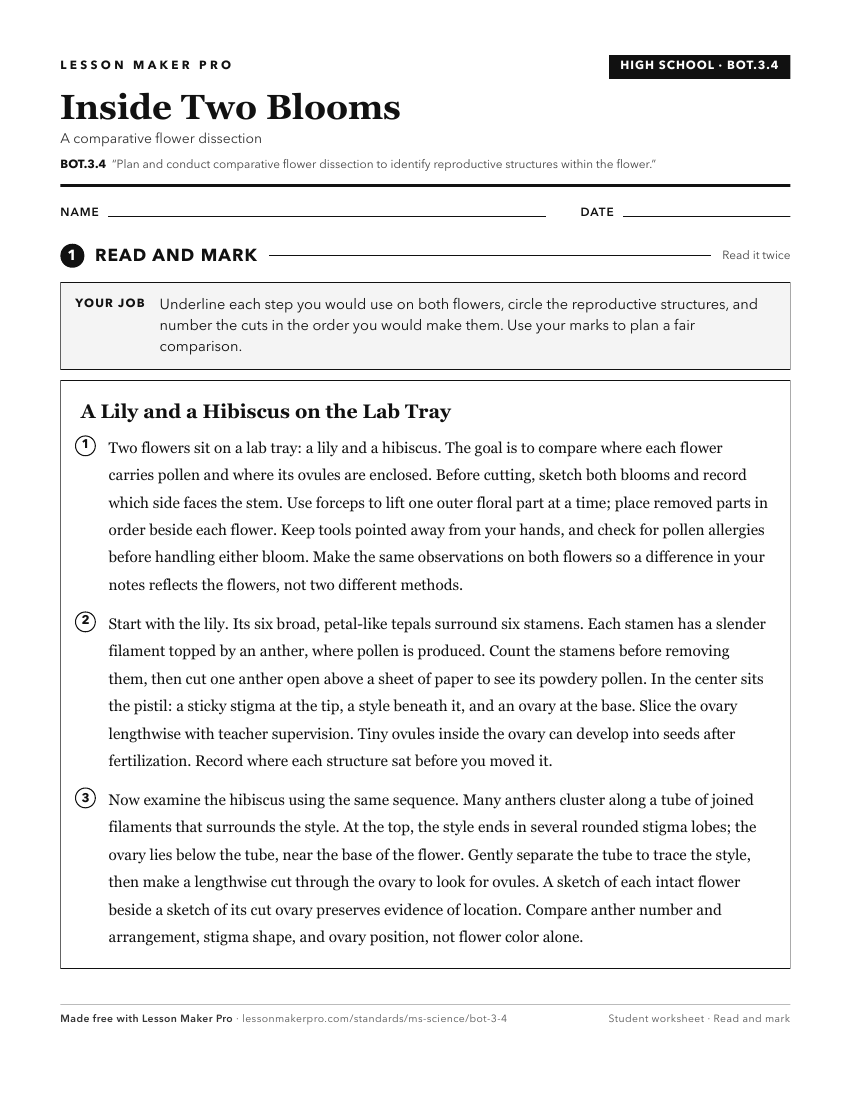
A ready-to-print activity worksheet aligned to BOT.3.4, with an answer key for the teacher on its own page. No account needed.
PDF, US Letter, prints cleanly in black and white.
Download the worksheetKeep exploring
Related Standards
- BOT.1.10
Identify and compare various live plant examples to explore plant morphological diversity, including leaf number, structure, and arrangement; root modifications...
- BOT.3.6
Identify differences in flower structure and shape. Provide a rationale that explains the value of these differences in flower structure to reproductive success...
- BOT.1.11
Compare and contrast functions of the various characteristics found in plant divisions and utilize dichotomous keys to identify plant species.
- BOT.3.5
Compare the similarities between corresponding plant reproductive structures from a variety of species. Record via drawings of observed dissection specimens and...
Turn this exact standard into a lesson
Grade, subject, topic, and the complete standard are prefilled. Create one free, no account needed.
Also for this standard:Make a WorksheetMake a QuizMake a Sub Lesson