Mississippi Science BOT.3.6
The Standard
- BOT.3
- Students will characterize the reproductive strategies of plants.
Identify differences in flower structure and shape. Provide a rationale that explains the value of these differences in flower structure to reproductive success (e.g., pollinators, flower shape, smell, color, size, orientation).
2026 Mississippi College- and Career-Readiness Standards for Science · Plant Reproduction
Teacher's field guide
What This Standard Means
What Students Need to Do
- Students compare flowers by shape, color, size, scent, and which way they face. They explain how those traits affect visits and pollen transfer, which can help a plant make seeds.
What Mastery Looks Like
- A student can compare an open flower with a narrow, tube-shaped flower and name traits that suit different visitors. They can explain how a visitor picks up pollen and deposits it on another flower's stigma.
Common Misconceptions
- Students may think bright color always means bees are the pollinator. They may also think any visit leads to seeds, even when no pollen reaches a stigma.
How to Assess It
- Show an open yellow flower and a red tubular flower. Ask: Which would a hummingbird visit more easily, and how might it carry pollen to another flower's stigma?
Lesson moves
Ways to Teach It
Build open and tube-shaped paper flowers, dab washable paint on paper stamens, then use cotton swabs to mark paper stigmas.
Show a red tube-shaped flower and an open yellow flower; ask students which visitors could carry pollen from each and why.
Give groups bee, moth, and hummingbird cards plus flower-trait cards; have them match pairs and explain how each visitor would contact pollen.
Show a photo of apple blossoms beside orchard beehives, then ask how bee visits can change the number of apples harvested.
Free download
Printable BOT.3.6 Worksheet
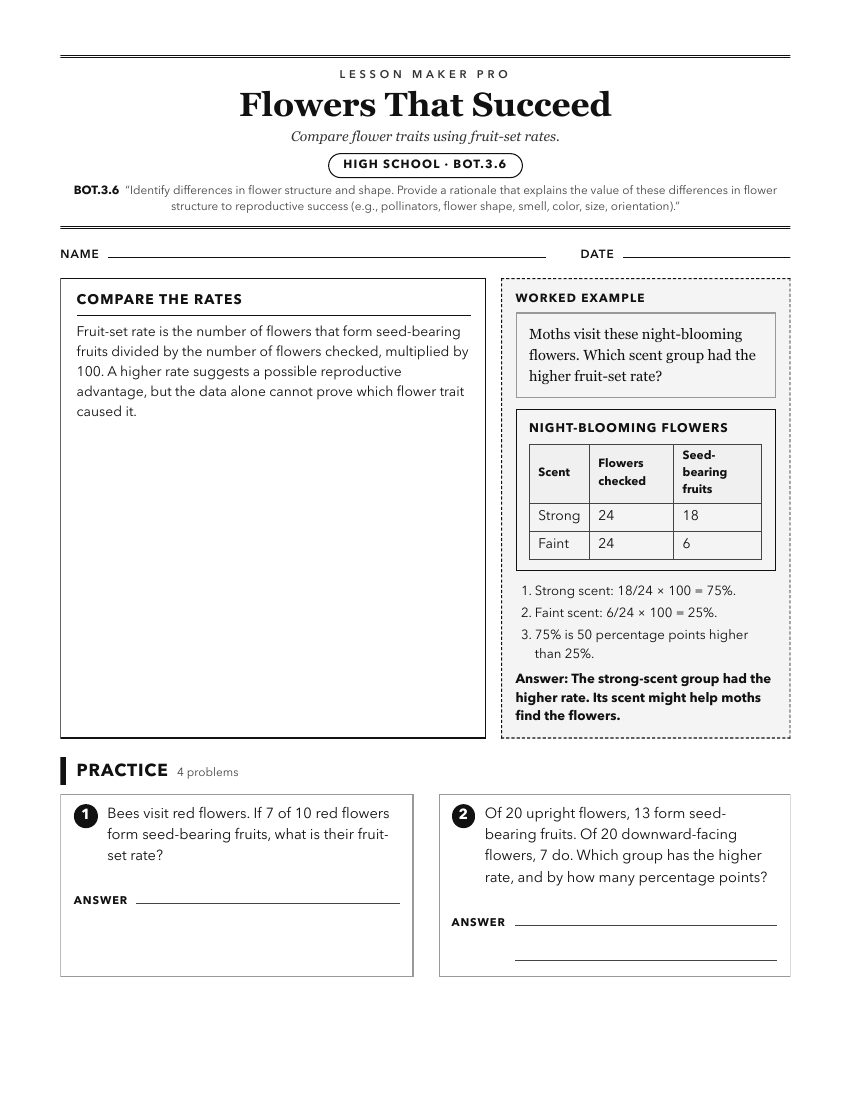
A ready-to-print activity worksheet aligned to BOT.3.6, with an answer key for the teacher on its own page. No account needed.
PDF, US Letter, prints cleanly in black and white.
Download the worksheetKeep exploring
Related Standards
- BOT.3.4
Plan and conduct comparative flower dissection to identify reproductive structures within the flower.
- L.3.4.3
Analyze and interpret data to explain how variations in characteristics among organisms of the same species may provide advantages in surviving, finding mates, ...
- BOT.1.10
Identify and compare various live plant examples to explore plant morphological diversity, including leaf number, structure, and arrangement; root modifications...
- BOT.3.5
Compare the similarities between corresponding plant reproductive structures from a variety of species. Record via drawings of observed dissection specimens and...
Turn this exact standard into a lesson
Grade, subject, topic, and the complete standard are prefilled. Create one free, no account needed.
Also for this standard:Make a WorksheetMake a QuizMake a Sub Lesson