Mississippi Science BOT.3.2
The Standard
- BOT.3
- Students will characterize the reproductive strategies of plants.
Enrichment: Research and present an agronomically important crop (e.g., potato, sweet potato, pineapple, or strawberry) that is produced via vegetative propagation (non-GMOs) for human consumption. Include evidence-based arguments that identify the potential benefits and negative effects of this method of crop production.
2026 Mississippi College- and Career-Readiness Standards for Science · Plant Reproduction
Teacher's field guide
What This Standard Means
What Students Need to Do
- Students research a food crop grown from plant parts rather than seeds, without genetic engineering. They explain how growers make new plants and present evidence for one benefit and one drawback.
What Mastery Looks Like
- A student can show how a potato eye grows into a new plant. They can present a benefit, such as keeping desired traits, and a risk, such as passing viruses through tubers, with a source for each claim.
Common Misconceptions
- Students may think a seed potato is a true seed or that growing plants from tubers makes them GMOs. They may also think plants with the same traits are all disease-free.
How to Assess It
- Give students these facts: potato eyes sprout into new plants; the new plants keep parent traits; infected tubers can pass viruses. Ask for a 30-second pitch that names one benefit, one risk, and the fact supporting each.
Lesson moves
Ways to Teach It
Place a sprouted potato on a tray, have students mark its eyes, and sketch where new shoots grow.
Ask students to write: Why might a farmer want identical potato plants, and why might that be risky? Use one source for each claim.
Give pairs cards labeled tuber, runner, true seed, and virus; have them sort potato and strawberry propagation paths and explain each choice.
Show a seed potato certification label and ask students to write a two-sentence buying recommendation for a farmer worried about plant viruses.
Free download
Printable BOT.3.2 Worksheet
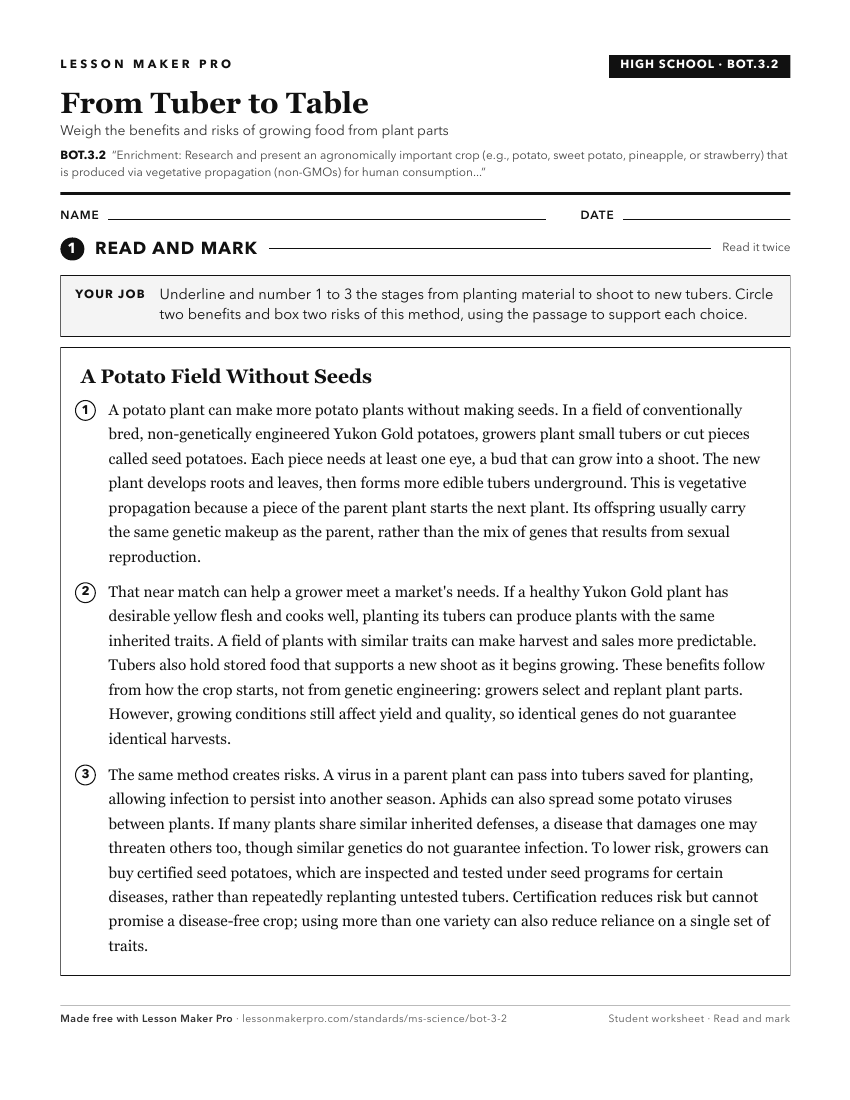
A ready-to-print activity worksheet aligned to BOT.3.2, with an answer key for the teacher on its own page. No account needed.
PDF, US Letter, prints cleanly in black and white.
Download the worksheetKeep exploring
Related Standards
- BOT.4.5
Explore the impacts (both positive and negative) of plant biotechnology/GMOs on human society. Present findings using digital media or technology and include ev...
- GEN.3.4
Enrichment: Develop logical arguments based on scientific evidence for and against ethical concerns regarding biotechnology/bioengineering.
- BOT.2.4
Research information to develop, produce, and communicate a scientifically justifiable argument for the rapid amplification and success of angiosperm compared t...
- ENV.1.10
Enrichment: Engage in scientific argument from evidence the benefits versus harm of genetically modified organisms.
Turn this exact standard into a lesson
Grade, subject, topic, and the complete standard are prefilled. Create one free, no account needed.
Also for this standard:Make a WorksheetMake a QuizMake a Sub Lesson