Mississippi Science BOT.2.4
The Standard
- BOT.2
- Students will identify evolutionary modifications necessary for the terrestrial survival of plants.
Research information to develop, produce, and communicate a scientifically justifiable argument for the rapid amplification and success of angiosperm compared to other plant divisions.
2026 Mississippi College- and Career-Readiness Standards for Science · Plant Evolution
Teacher's field guide
What This Standard Means
What Students Need to Do
- Students research how flowering plants spread and became diverse compared with ferns and conifers. They use evidence from fossils and plant traits to make an argument, then explain what the evidence cannot prove.
What Mastery Looks Like
- A student uses a fossil timeline to show when flowering plants became widespread. They explain how flowers and fruits may have helped pollination and seed dispersal, while noting that those traits alone do not prove the cause.
Common Misconceptions
- Some students think rapid diversification means individual plants grew quickly. Others assume that today's species counts show how fast plants diversified, or that pine cones are fruits.
How to Assess It
- Show students a fossil timeline and a chart comparing flowering plant and gymnosperm species counts. Ask: "Use one fact from each source to argue that flowering plants diversified rapidly, then name one question the sources cannot answer."
Lesson moves
Ways to Teach It
Give pairs a flower, a pine cone, and a cut tomato; have them sketch where each plant's seeds develop.
After reading a fossil pollen timeline, ask: "Does a rise in pollen types prove flowers caused diversification? What else would you need?"
Use trait cards for ferns, conifers, and flowering plants; teams match spores, exposed seeds, or enclosed seeds to each group.
Show grocery flyer photos of apples, blackberries, and cherries; ask students how animals eating each fruit might spread its seeds.
Free download
Printable BOT.2.4 Worksheet
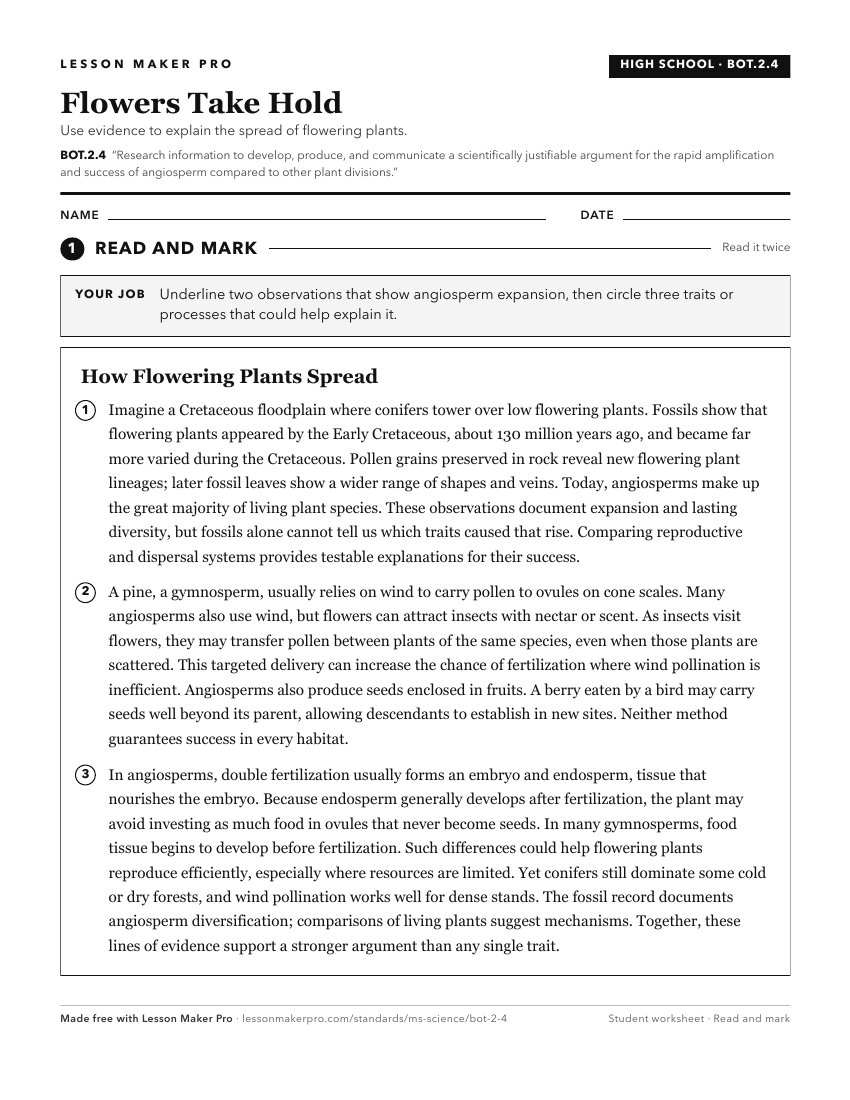
A ready-to-print activity worksheet aligned to BOT.2.4, with an answer key for the teacher on its own page. No account needed.
PDF, US Letter, prints cleanly in black and white.
Download the worksheetKeep exploring
Related Standards
- BOT.3.2
Enrichment: Research and present an agronomically important crop (e.g., potato, sweet potato, pineapple, or strawberry) that is produced via vegetative propagat...
- BOT.2.5
Enrichment: Referencing the National Center for Biotechnology Information’s gene/protein databases, propose and design a scientifically supportable cladogram or...
- BOT.2.3
Summarize and justify the characteristics of angiosperms and gymnosperms that lead to their success as terrestrial plants.
- ENV.1.10
Enrichment: Engage in scientific argument from evidence the benefits versus harm of genetically modified organisms.
Turn this exact standard into a lesson
Grade, subject, topic, and the complete standard are prefilled. Create one free, no account needed.
Also for this standard:Make a WorksheetMake a QuizMake a Sub Lesson