Mississippi Science L.1.3B
Standard Cluster
Students will demonstrate an understanding of the interdependence of flowering plants and pollinating insects. Identify the body parts of a pollinating insect (e.g., bee, butterfly) and describe how insects use these parts to gather nectar or disburse pollen. Report findings using drawings, writing, or models.
2026 Mississippi College- and Career-Readiness Standards for Science · Ecology and Interdependence
Cluster contents
Standards in This Cluster
L.1.3B is a cluster heading. These are the individual standards under it.
Teacher's field guide
What This Cluster Means
What Students Need to Do
- Students identify a bee's mouthparts, legs, wings, and body in a picture or model. They explain how the bee drinks nectar and carries pollen to another flower. They show what happens in a drawing, writing, or model.
What Mastery Looks Like
- A student labels a bee's mouthparts and legs. Their drawing shows the bee drinking nectar, then carrying pollen on its body to a second flower.
Common Misconceptions
- Some students think nectar and pollen are the same thing. Others think pollen stays on the bee instead of rubbing off when it visits another flower.
How to Assess It
- Give students a picture of a bee between two flowers. Ask them to label the part that drinks nectar, mark where pollen sticks, and draw an arrow showing where the pollen goes next.
Lesson moves
Ways to Teach It
Build a bee with a cotton-ball body, pipe-cleaner legs, and a paper mouthpart; use yellow paper dots to show pollen moving between flowers.
Show a bee photo and ask, 'What does its mouth collect? How could pollen on its body reach another flower?'
Give pairs bee-part and job cards; have them match mouthparts to nectar and hairy legs to pollen, then explain their matches.
Show bees on apple blossoms in a photo; have students draw a route between two flowers and mark where pollen might rub off.
Free download
Printable L.1.3B Worksheet
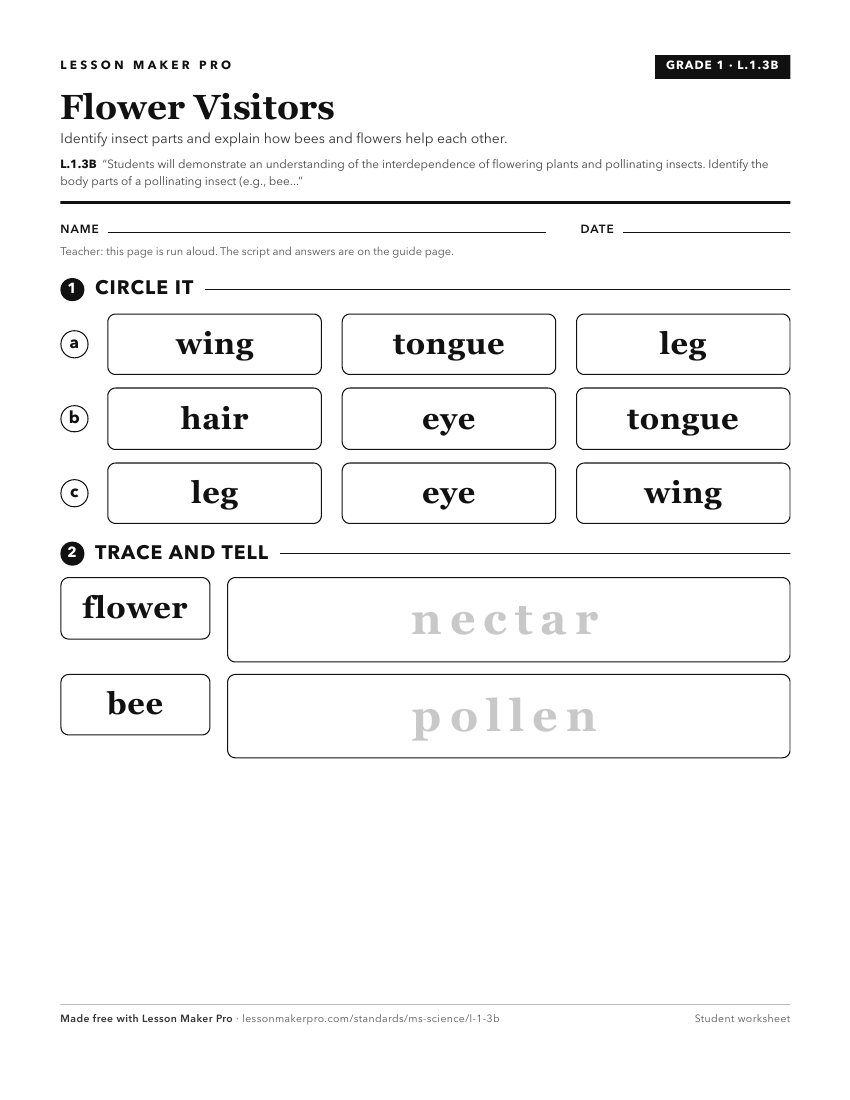
A ready-to-print activity worksheet aligned to L.1.3B, with an answer key for the teacher on its own page. No account needed.
PDF, US Letter, prints cleanly in black and white.
Download the worksheetKeep exploring
Related Standards
- L.2.3A
Students will demonstrate an understanding of the interdependence of living things and the environment in which they live.
- L.1.1
Students will demonstrate an understanding of the basic needs and structures of plants.
- FB.6
Students will understand the interdependence of living organisms and their environment.
- L.2.3B
Students will demonstrate an understanding of the interdependence of living things.
Turn this cluster into a lesson
Grade, subject, topic, and the complete cluster are prefilled. Create one free, no account needed.
Also for this cluster:Make a WorksheetMake a QuizMake a Sub Lesson