Mississippi Science BOT.3.8
The Standard
- BOT.3
- Students will characterize the reproductive strategies of plants.
Using laboratory data, correctly categorize fruits, vegetables, nuts, modified stems, or other plant parts. Compare the scientific definitions of these terms to those used by the general public/society and the USDA to categorize food.
2026 Mississippi College- and Career-Readiness Standards for Science · Plant Reproduction
Teacher's field guide
What This Standard Means
What Students Need to Do
- Students use observations from cut foods to identify which plant parts people eat. They compare those labels with everyday food names and USDA MyPlate groups.
What Mastery Looks Like
- A student uses seeds inside a tomato to identify it as a fruit and buds on a potato to identify it as a stem tuber. They explain why MyPlate groups the tomato with vegetables and a peanut, which is a seed, with protein foods.
Common Misconceptions
- Students often call potatoes roots because they grow underground, even though potato eyes are stem buds. They may also assume peanuts are botanical nuts or that a food called a vegetable cannot be a fruit.
How to Assess It
- Show photos of a cut tomato, a potato with eyes, and a peanut in its pod. Ask students to name the plant part eaten, give one visible clue, and name its everyday or MyPlate category.
Lesson moves
Ways to Teach It
Cut a tomato, potato, and carrot; have students sketch the seeds, eyes, and root, then label each plant part.
Ask, 'How can a tomato be a fruit and a vegetable?' Have students cite a cut tomato and a MyPlate chart.
Give pairs picture cards of peanuts in pods, hazelnuts, tomatoes, and potatoes; have them sort the foods by plant part, then MyPlate group.
Use a grocery flyer to compare labels for tomatoes and peanuts with MyPlate groups, then write the plant part beside each price.
Free download
Printable BOT.3.8 Worksheet
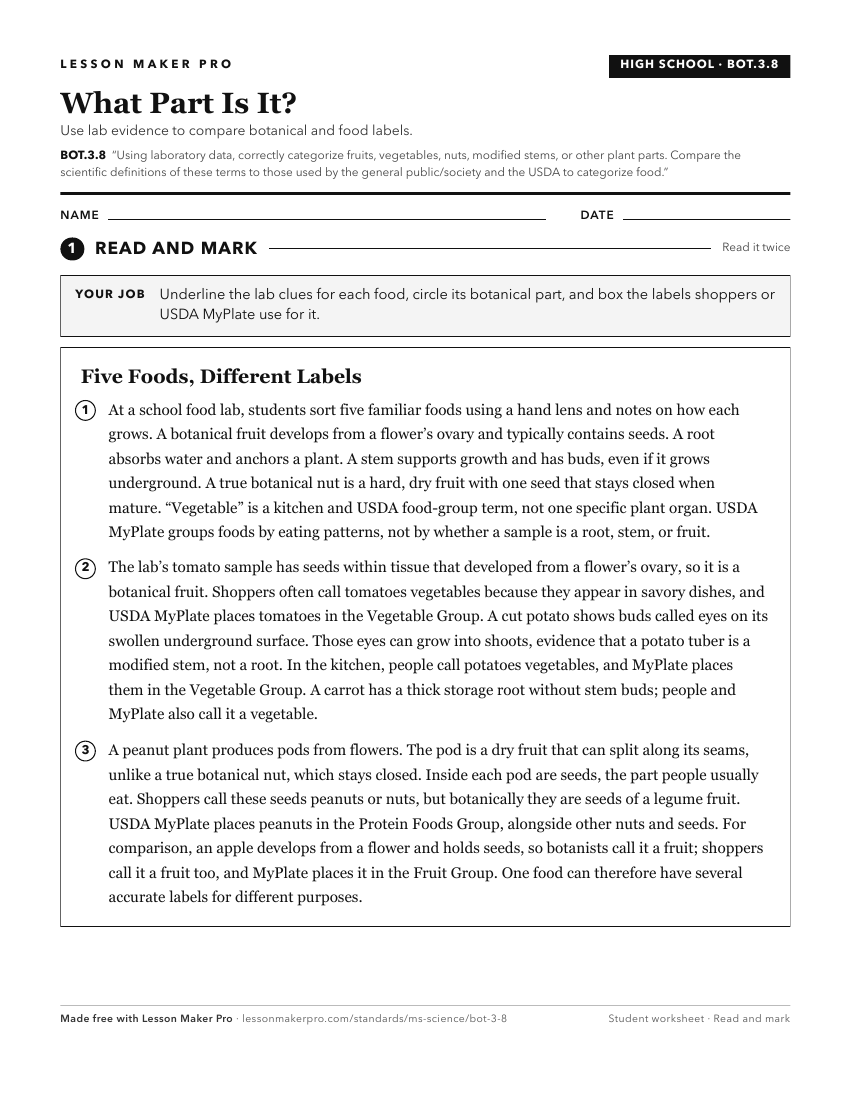
A ready-to-print activity worksheet aligned to BOT.3.8, with an answer key for the teacher on its own page. No account needed.
PDF, US Letter, prints cleanly in black and white.
Download the worksheetKeep exploring
Related Standards
- BOT.3.7
Plan, conduct, and communicate the results of a comparative laboratory investigation of differing fruit types.
- BOT.2.2
Referencing the USDA plants database, identify, compare, and contrast seedless, naked seed, and enclosed-seed modifications for reproduction. Calculate the occu...
- BOT.1.10
Identify and compare various live plant examples to explore plant morphological diversity, including leaf number, structure, and arrangement; root modifications...
- BOT.1.11
Compare and contrast functions of the various characteristics found in plant divisions and utilize dichotomous keys to identify plant species.
Turn this exact standard into a lesson
Grade, subject, topic, and the complete standard are prefilled. Create one free, no account needed.
Also for this standard:Make a WorksheetMake a QuizMake a Sub Lesson