Mississippi Science BOT.2.2
The Standard
- BOT.2
- Students will identify evolutionary modifications necessary for the terrestrial survival of plants.
Referencing the USDA plants database, identify, compare, and contrast seedless, naked seed, and enclosed-seed modifications for reproduction. Calculate the occurrence of seed types in given habitats.
2026 Mississippi College- and Career-Readiness Standards for Science · Plant Evolution
Teacher's field guide
What This Standard Means
What Students Need to Do
- Students use USDA PLANTS to identify plants and sort them into spore-producing, exposed-seed, and fruit-enclosed-seed groups. They compare the reproductive structures and calculate each group’s share of a habitat sample.
What Mastery Looks Like
- Given a fern, pine, and maple, a student identifies spores on the fern, seeds on pine cone scales, and seeds inside maple fruits. They can sort a habitat tally into those groups and calculate each percentage using the total number of plants counted.
Common Misconceptions
- Students may call fern spores seeds or pine cones fruits. They may think exposed seeds have no cone scales, rather than no enclosing fruit. Some divide by the number of species instead of the total plants counted.
How to Assess It
- Use USDA PLANTS to check the names bracken fern, eastern white pine, and red maple. Label each by its reproductive structure, then find the percentage of exposed-seed plants in a woodland count of 10 plants that includes 3 pines.
Lesson moves
Ways to Teach It
Students inspect a fern frond, pine cone, and maple samara with hand lenses, then label spores, exposed seeds, and seeds inside fruit.
Ask students to write two sentences comparing where a pine and maple hold seeds, then explain how a fern reproduces.
Give pairs 10 woodland plant cards and a USDA PLANTS name list; have them sort the cards and calculate each group’s percentage.
Walk the school grounds with a printed USDA PLANTS checklist of local species; tally ten plants and calculate each reproductive group’s share.
Free download
Printable BOT.2.2 Worksheet
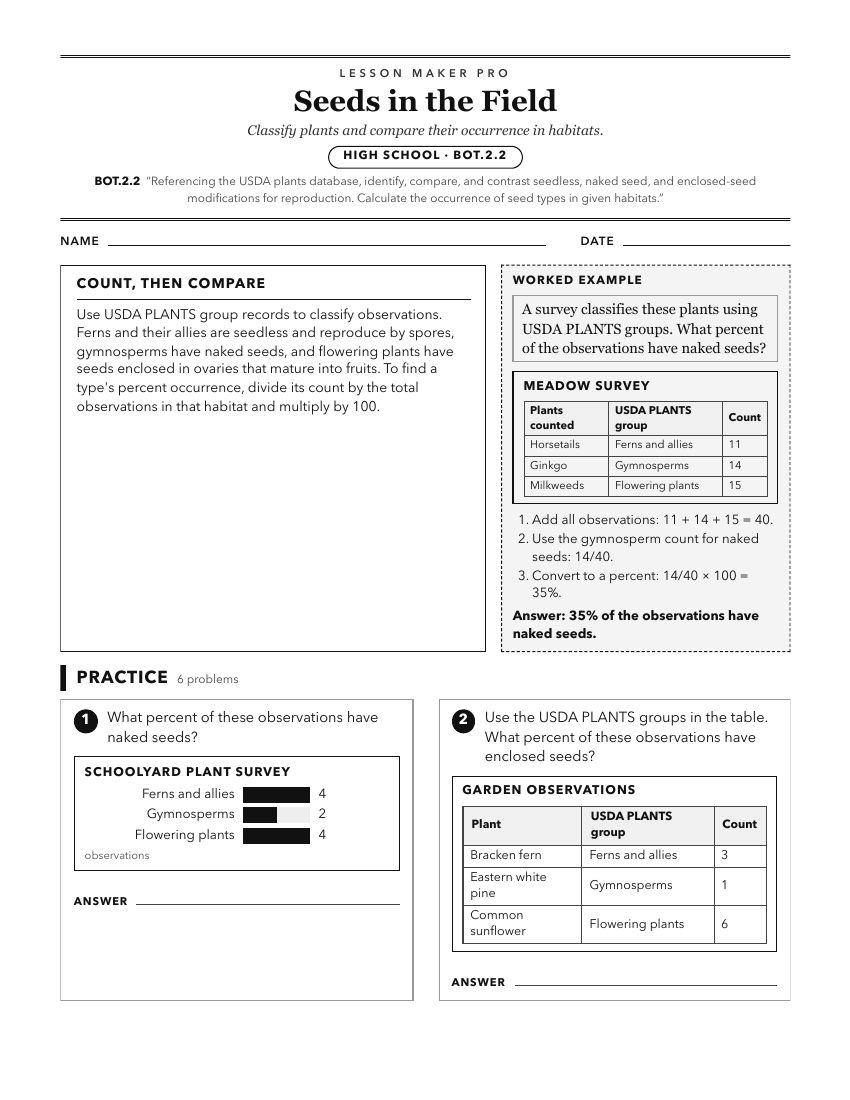
A ready-to-print activity worksheet aligned to BOT.2.2, with an answer key for the teacher on its own page. No account needed.
PDF, US Letter, prints cleanly in black and white.
Download the worksheetKeep exploring
Related Standards
- BOT.3.8
Using laboratory data, correctly categorize fruits, vegetables, nuts, modified stems, or other plant parts. Compare the scientific definitions of these terms to...
- BOT.3.5
Compare the similarities between corresponding plant reproductive structures from a variety of species. Record via drawings of observed dissection specimens and...
- L.1.2.1
Investigate, using observations and measurements (non-standard units), flowering plants (pumpkins, peas, marigolds, or sunflowers) as they change during the lif...
- BOT.3
Students will characterize the reproductive strategies of plants.
Turn this exact standard into a lesson
Grade, subject, topic, and the complete standard are prefilled. Create one free, no account needed.
Also for this standard:Make a WorksheetMake a QuizMake a Sub Lesson