Mississippi Science BIO.3A.3
The Standard
- BIO.3A
- Students will develop and use models to explain the role of meiosis in the production of haploid gametes required for sexual reproduction.
Investigate chromosomal abnormalities (e.g., Down syndrome, Turner’s syndrome, and Klinefelter syndrome) that might arise from errors in meiosis (nondisjunction) and how these abnormalities are identified (karyotypes).
2026 Mississippi College- and Career-Readiness Standards for Science · Reproduction and Heredity
Teacher's field guide
What This Standard Means
What Students Need to Do
- Students model how chromosomes can fail to separate when eggs or sperm form. They read karyotypes to find extra or missing chromosomes and identify the resulting condition.
What Mastery Looks Like
- Given an unlabeled karyotype, a student can spot three copies of chromosome 21, a single X, or an XXY set. They can explain how an egg or sperm could end up with an extra or missing chromosome.
Common Misconceptions
- Students may think nondisjunction always adds a chromosome, rather than sometimes leaving one out. They may confuse 45,X with 47,XXY or assume a karyotype predicts a person's abilities.
How to Assess It
- Exit ticket: A karyotype shows 47 chromosomes, including three copies of chromosome 21. Name the condition and explain one error during meiosis that could produce it.
Lesson moves
Ways to Teach It
Use paper copies of chromosome 21 to model failed separation during egg formation, add a normal sperm copy, and sketch the resulting trio.
Show a karyotype with three copies of chromosome 21 and ask, 'What can you tell from this image, and what can't you tell?'
Give pairs printed karyotype cards showing trisomy 21, 45,X, and 47,XXY; have them sort and label each by chromosome count.
Give students a fictional lab report marked 47,XXY; ask them to explain the chromosome count to a family without predicting symptoms.
Free download
Printable BIO.3A.3 Worksheet
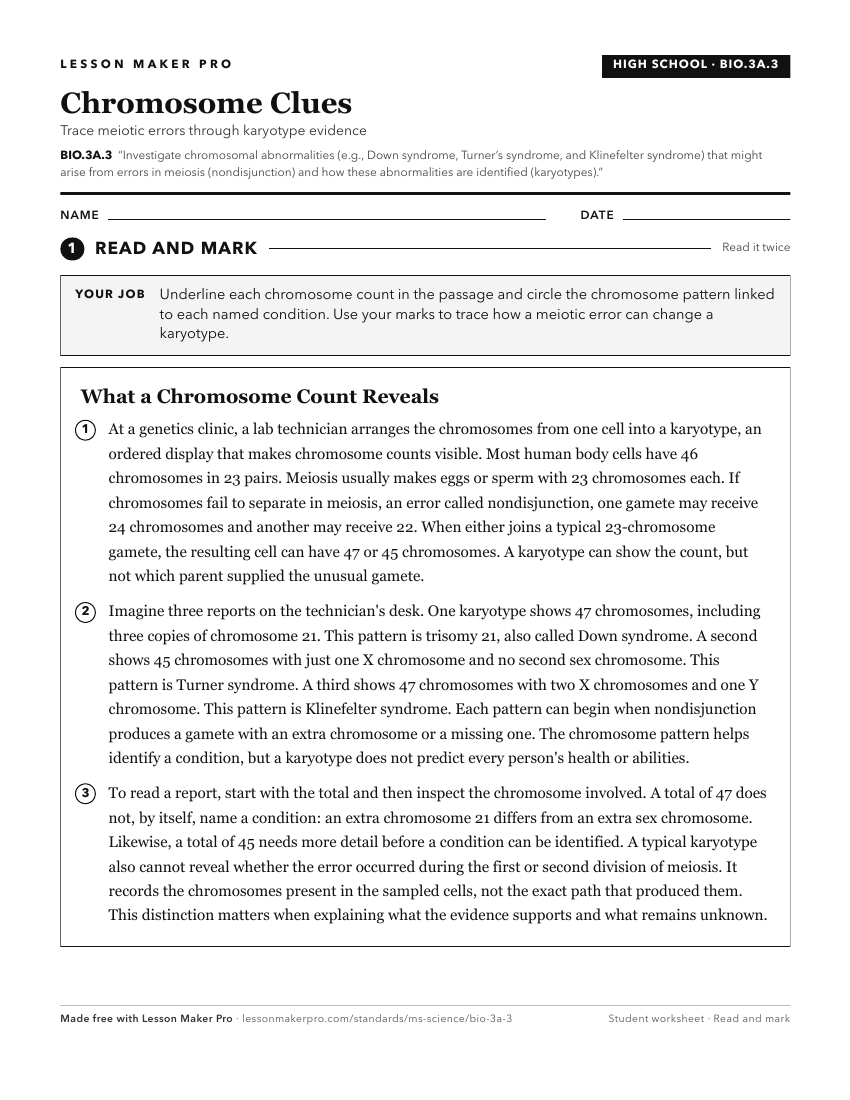
A ready-to-print activity worksheet aligned to BIO.3A.3, with an answer key for the teacher on its own page. No account needed.
PDF, US Letter, prints cleanly in black and white.
Download the worksheetKeep exploring
Related Standards
- FB.3.7
Enrichment: Research and orally communicate the possible outcomes of a failure of mitosis (cancer) or meiosis (nondisjunction).
- GEN.4.3
Investigate traits that follow non-Mendelian inheritance patterns (e.g., incomplete dominance, codominance, multiple alleles, autosomal linkage, sexlinkage, pol...
- BIO.3B.3
Investigate traits that follow non-Mendelian inheritance patterns (e.g., incomplete dominance, codominance, multiple alleles in human blood types, and sex-linka...
- BIO.3B.4
Analyze and interpret data (e.g., pedigrees, family, and population studies) regarding Mendelian and complex genetic traits (e.g., sickle-cell anemia, cystic fi...
Turn this exact standard into a lesson
Grade, subject, topic, and the complete standard are prefilled. Create one free, no account needed.
Also for this standard:Make a WorksheetMake a QuizMake a Sub Lesson