Mississippi Science L.8.4A
Standard Cluster
Students will demonstrate an understanding of the process of natural selection, in which variations in a population increase some individuals’ likelihood of surviving and reproducing in a changing environment. Use various scientific resources to analyze the historical findings of Charles Darwin to explain basic principles of natural selection. Construct explanations about how genetic factors and environmental factors (e.g., food intake, interactions with other organisms, etc.) lead to the growth, survival, and reproduction of organisms in natural selection.
2026 Mississippi College- and Career-Readiness Standards for Science · Adaptation and Diversity
Cluster contents
Standards in This Cluster
L.8.4A is a cluster heading. These are the individual standards under it.
- L.8.4A.1
Use various scientific resources to analyze the historical findings of Charles Darwin to explain basic principles of natural selection.
- L.8.4A.2
Construct explanations about how genetic factors and environmental factors (e.g., food intake, interactions with other organisms, etc.) lead to the growth, surv...
Teacher's field guide
What This Cluster Means
What Students Need to Do
- Students compare Darwin’s field notes with island maps to study differences among organisms. They explain how inherited traits and conditions such as food supply affect survival and reproduction.
What Mastery Looks Like
- Given birds with different inherited beaks, a student predicts which can eat the available seeds and have offspring. They explain why that beak type may become more common over generations.
Common Misconceptions
- Students may think a bird grows a new beak because its food changes, then passes that change to its young. They may count survival alone as natural selection, even if the bird has no offspring.
How to Assess It
- Exit ticket: A drought leaves only hard seeds. Birds have inherited thin or thick beaks. Which birds are more likely to leave offspring, and what happens after several generations?
Lesson moves
Ways to Teach It
Give pairs wide and narrow tweezers to pick up mixed seeds, then tally which beak type reaches a food target.
Read a short excerpt from Darwin’s Galápagos mockingbird notes beside an island map; ask how island conditions could favor inherited differences.
Deal inherited beak cards, change the available seed cards after two rounds, and graph which birds leave offspring.
Use a sample pest-count table from before and after spraying to explain why inherited pesticide resistance becomes more common.
Free download
Printable L.8.4A Worksheet
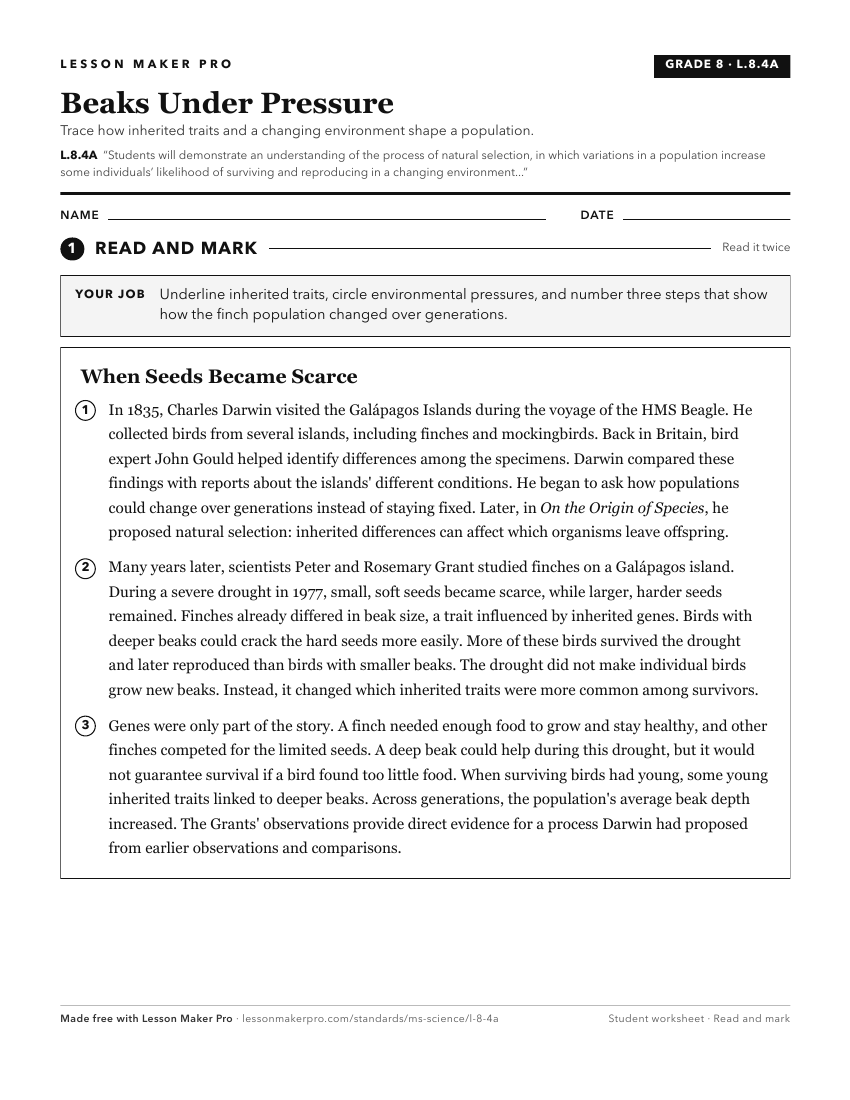
A ready-to-print activity worksheet aligned to L.8.4A, with an answer key for the teacher on its own page. No account needed.
PDF, US Letter, prints cleanly in black and white.
Download the worksheetKeep exploring
Related Standards
- L.6.3
Students will demonstrate an understanding of the relationships between survival, environmental changes, and diversity as they relate to the interactions of org...
- L.2.4
Students will demonstrate an understanding of the ways animals adapt to their environment in order to survive.
- L.8.2B
Students will demonstrate an understanding of the differences in inherited and acquired characteristics and how environmental factors (natural selection) and th...
- L.3.2
Students will demonstrate an understanding that through reproduction, the survival and physical features of plants and animals are inherited traits from parent ...
Turn this cluster into a lesson
Grade, subject, topic, and the complete cluster are prefilled. Create one free, no account needed.
Also for this cluster:Make a WorksheetMake a QuizMake a Sub Lesson