Mississippi Science FB.4.4
The Standard
- FB.4
- Students will demonstrate an understanding of how genetic information is transferred from parent to offspring.
Obtain and communicate information to describe how mutations may affect genetic expression and provide examples.
2026 Mississippi College- and Career-Readiness Standards for Science · Molecular Basis of Heredity
Teacher's field guide
What This Standard Means
What Students Need to Do
- Students use a source to explain how a DNA change can affect when a gene is active or the protein it makes. They give an example and recognize that some mutations have no detectable effect.
What Mastery Looks Like
- They can explain how a regulatory variant lets some adults keep making lactase. They can also explain how a change in the HBB gene alters hemoglobin without necessarily changing how much is made.
Common Misconceptions
- Students often assume every mutation is harmful or turns a gene off. They may think a change in protein shape means more protein was made, or that every DNA change alters a protein's sequence.
How to Assess It
- Exit ticket: A DNA change outside the lactase gene keeps it active in adults. Explain what happens to lactase production and whether the protein's sequence must change.
Lesson moves
Ways to Teach It
Give pairs paper enhancer cards marked 'usual' and 'adult lactase variant'; have them use RNA counters to model lower or higher lactase production.
Ask students to write: How can a DNA change outside a gene affect its activity without changing the protein's sequence?
Hand out cards describing six DNA changes and outcomes; pairs match each change to an effect on RNA amount, protein form, or neither.
Read a milk carton label listing added lactase, then compare that enzyme with the lactase some adults continue to make.
Free download
Printable FB.4.4 Worksheet
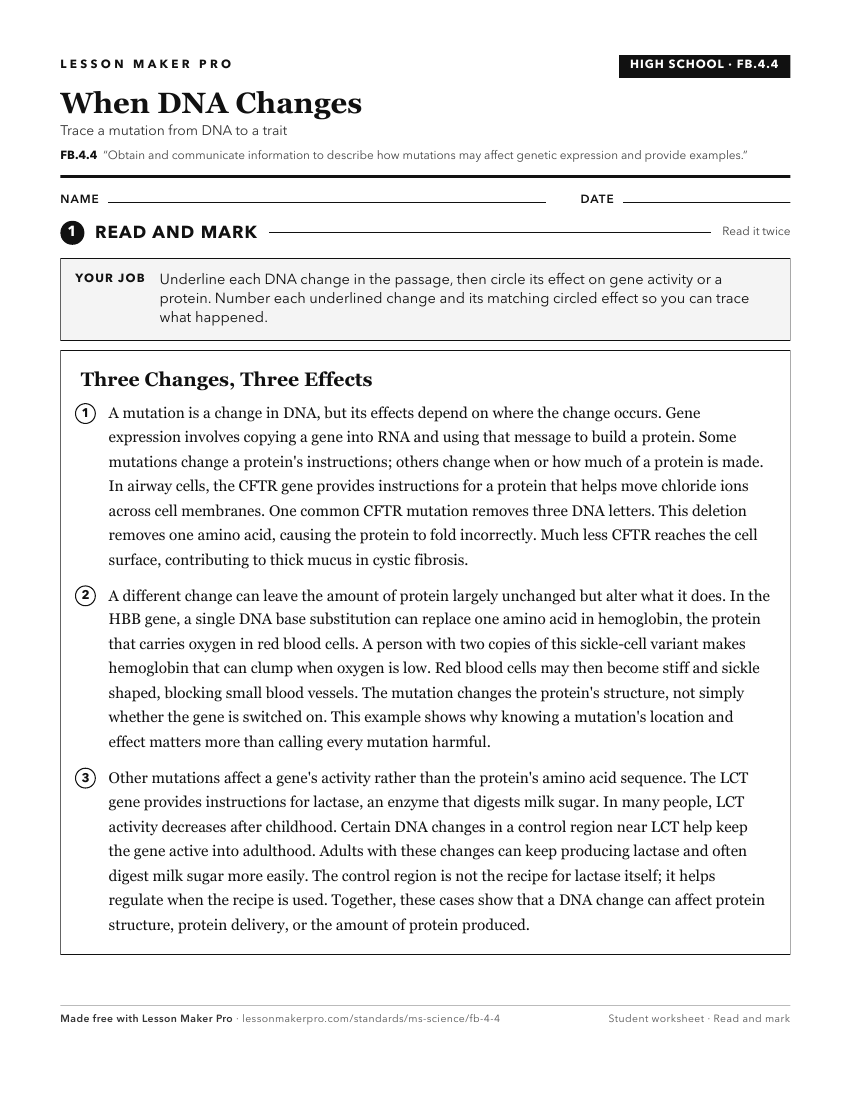
A ready-to-print activity worksheet aligned to FB.4.4, with an answer key for the teacher on its own page. No account needed.
PDF, US Letter, prints cleanly in black and white.
Download the worksheetKeep exploring
Related Standards
- GEN.2B.1
Identify factors that cause mutations (e.g., environmental, errors in replication, and viral infections).
- L.8.2C.2
Construct scientific arguments from evidence to support claims about the potentially harmful, beneficial, or neutral effects of genetic mutations on organisms.
- BIO.3C.3
Use models to predict how various changes in the nucleotide sequence (e.g., point mutations, and frameshift mutations) will affect the resulting protein product...
- FB.4.2
Obtain and communicate information illustrating the relationships among DNA, genes, chromosomes, and proteins to the basis of life.
Turn this exact standard into a lesson
Grade, subject, topic, and the complete standard are prefilled. Create one free, no account needed.
Also for this standard:Make a WorksheetMake a QuizMake a Sub Lesson