Mississippi Science FB.4.2
The Standard
- FB.4
- Students will demonstrate an understanding of how genetic information is transferred from parent to offspring.
Obtain and communicate information illustrating the relationships among DNA, genes, chromosomes, and proteins to the basis of life.
2026 Mississippi College- and Career-Readiness Standards for Science · Molecular Basis of Heredity
Teacher's field guide
What This Standard Means
What Students Need to Do
- Students identify genes as sections of DNA packaged in chromosomes. They use a diagram or short reading to explain how cells use gene instructions to make proteins.
What Mastery Looks Like
- A student can label DNA and a gene within a chromosome. They can use a case card to explain how a change in a gene can change a protein.
Common Misconceptions
- Students may think genes and chromosomes are separate from DNA. They may think DNA turns into protein or that one gene always controls one visible trait.
How to Assess It
- Give students a chromosome diagram with a DNA strand and one shaded segment. Ask: 'Label the gene and DNA, then explain how the shaded segment relates to a protein.'
Lesson moves
Ways to Teach It
Coil a paper DNA strip into a chromosome model, mark a gene, then use a gene instruction card to build a bead protein.
Show a chromosome diagram and a protein-making diagram; ask partners to cite one detail from each to explain how genes relate to proteins.
Give pairs cards labeled chromosome, DNA, gene, and protein; have them arrange the cards and defend each link in one sentence.
Hand out a sickle cell case card showing a changed hemoglobin gene and ask students to trace its effect on hemoglobin and red blood cells.
Free download
Printable FB.4.2 Worksheet
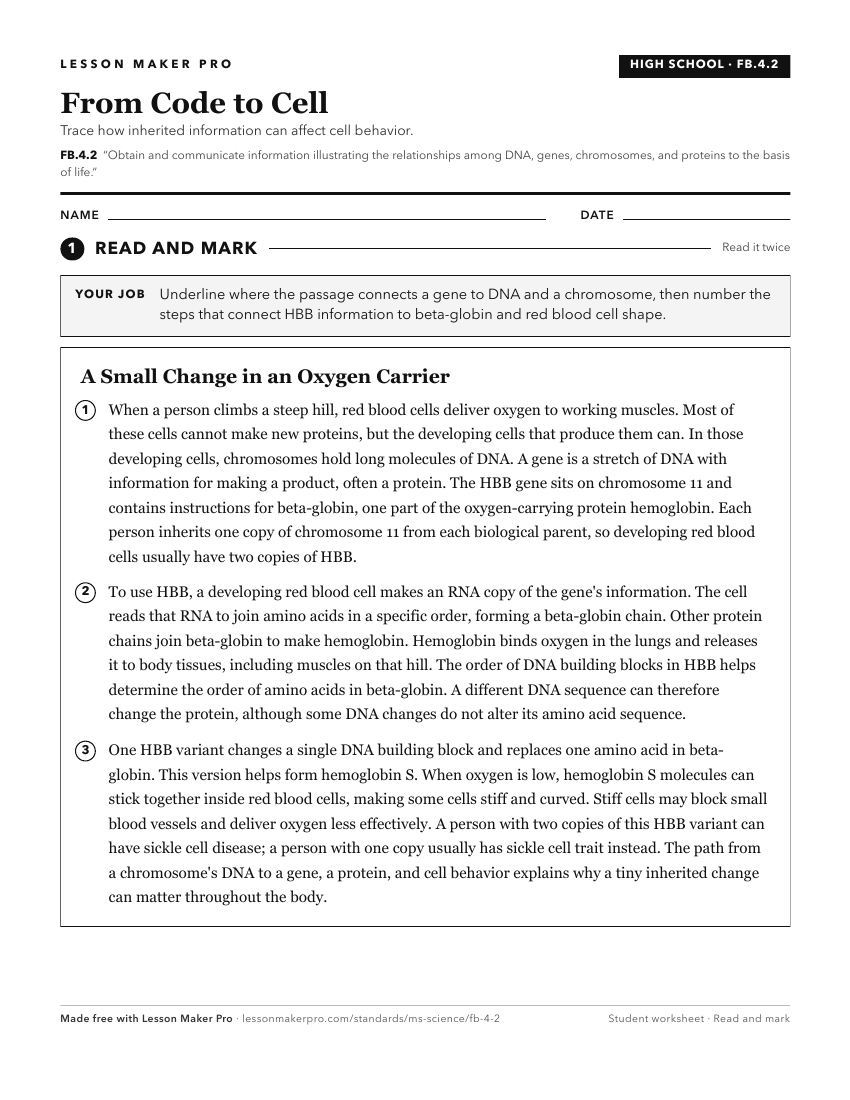
A ready-to-print activity worksheet aligned to FB.4.2, with an answer key for the teacher on its own page. No account needed.
PDF, US Letter, prints cleanly in black and white.
Download the worksheetKeep exploring
Related Standards
- L.8.2C.1
Communicate through diagrams that chromosomes contain many distinct genes and that each gene holds the instructions for the production of specific proteins, whi...
- BIO.3C.1
Develop and use models to explain the relationship between DNA, genes, and chromosomes in coding the instructions for the traits transferred from parent to offs...
- L.8.2A.1
Use a model to show the relationship of genes, chromosomes, and DNA, and construct explanations comparing their relationship to inherited characteristics.
- FB.5.3
Obtain and communicate information to explain how DNA evidence and fossil records support Darwin’s theory of evolution.
Turn this exact standard into a lesson
Grade, subject, topic, and the complete standard are prefilled. Create one free, no account needed.
Also for this standard:Make a WorksheetMake a QuizMake a Sub Lesson