Mississippi Science GEN.2B.1
The Standard
- GEN.2B
- Students will determine the causes and effects of mutations in DNA.
Identify factors that cause mutations (e.g., environmental, errors in replication, and viral infections).
2026 Mississippi College- and Career-Readiness Standards for Science · Transcription, Translation, and Mutations
Teacher's field guide
What This Standard Means
What Students Need to Do
- Students identify DNA copying errors, environmental exposures, and some viral infections as possible causes of mutations. They explain how each might change a DNA sequence.
What Mastery Looks Like
- A student can identify the cause in examples of a copying error, UV damage, and viral DNA insertion. They can explain that DNA damage does not become a mutation if it is repaired correctly.
Common Misconceptions
- Students may think mutations happen only after radiation exposure, not during ordinary DNA copying. They may assume every virus changes a cell's DNA or that all DNA damage becomes a mutation.
How to Assess It
- Exit ticket: A cell copies A as G, UV damages skin-cell DNA, and a virus inserts genetic material into a cell's DNA. Name the possible source of mutation in each case.
Lesson moves
Ways to Teach It
Give pairs paper DNA strips to copy, then have them swap one base and label the replication error.
Ask students to write why a day outside does not guarantee a mutation, even though UV exposure raises the risk.
Play a three-pile card sort with examples of UV damage, copying errors, and viral DNA insertion; have students explain their choices.
Read a sunscreen label, then ask students how UV protection could lower the chance of DNA damage in skin cells.
Free download
Printable GEN.2B.1 Worksheet
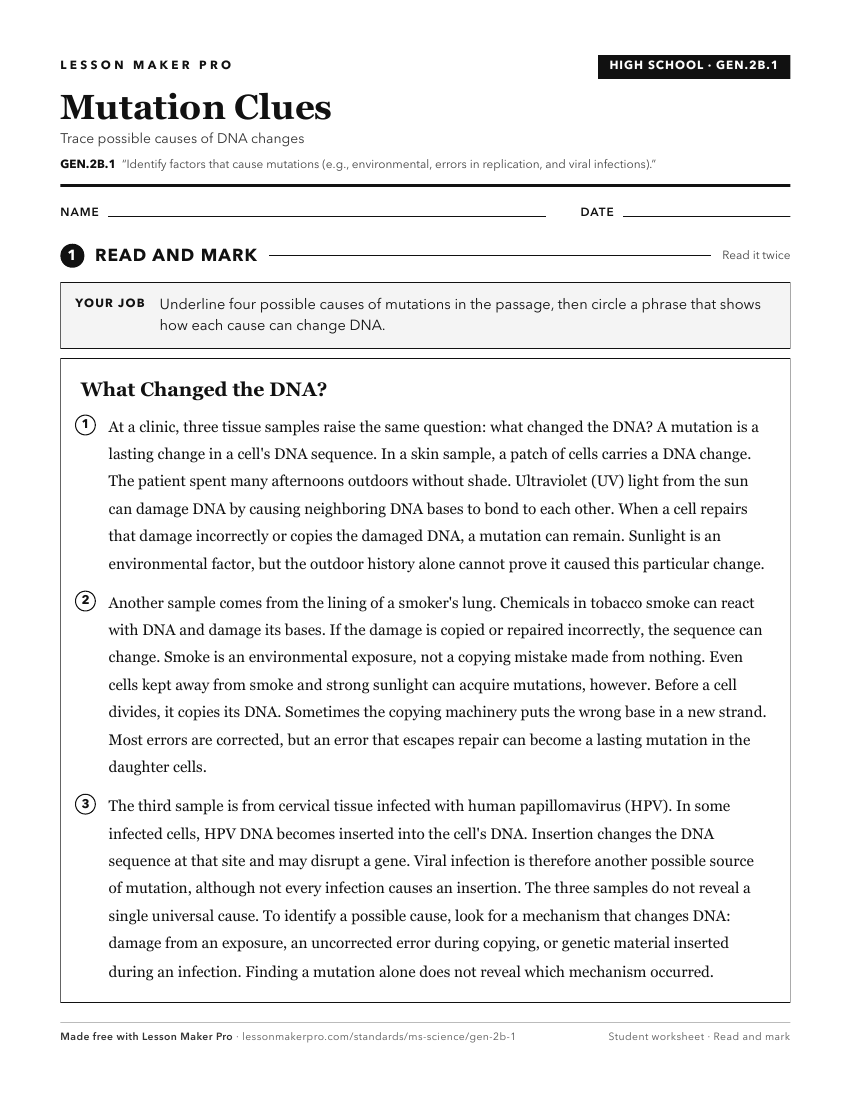
A ready-to-print activity worksheet aligned to GEN.2B.1, with an answer key for the teacher on its own page. No account needed.
PDF, US Letter, prints cleanly in black and white.
Download the worksheetKeep exploring
Related Standards
- GEN.2B.4
Investigate the role of mutations and the loss of cell cycle regulation in the development of cancers.
- GEN.2B.3
Describe cellular mechanisms that can help to minimize mutations (e.g., cell cycle checkpoints, DNA polymerase proofreading, and DNA repair enzymes).
- GEN.2B
Students will determine the causes and effects of mutations in DNA.
- FB.4.4
Obtain and communicate information to describe how mutations may affect genetic expression and provide examples.
Turn this exact standard into a lesson
Grade, subject, topic, and the complete standard are prefilled. Create one free, no account needed.
Also for this standard:Make a WorksheetMake a QuizMake a Sub Lesson