Mississippi Science GEN.1A.1
The Standard
- GEN.1A
- Students will demonstrate that all cells contain genetic material in the form of DNA.
Model the biochemical structure, either 3-D or computer-based, of DNA based on the experimental evidence available to Watson and Crick (Chargaff, 1950; Franklin, 1951).
2026 Mississippi College- and Career-Readiness Standards for Science · Structure and Function of DNA
Teacher's field guide
What This Standard Means
What Students Need to Do
- Students build a 3-D or digital model of DNA with two sugar-phosphate backbones and paired bases. They use Chargaff's base counts to support A-T and G-C pairing, and Franklin's X-ray data to support the helical shape.
What Mastery Looks Like
- Their model has two twisted strands, backbones on the outside, and correctly paired bases on the inside. They can point to the evidence that supports the pairing and the helix.
Common Misconceptions
- Students may pair bases at random or put the sugar-phosphate backbone between the bases. They may mistake Franklin's X-ray pattern for a picture of individual bases.
How to Assess It
- Exit ticket: Given base counts of A 30%, T 30%, G 20%, and C 20%, plus an X-shaped X-ray pattern, draw a labeled DNA model and explain what each clue supports.
Lesson moves
Ways to Teach It
Use pipe cleaners for backbones and colored paper for bases; have students build a paired ladder, then twist it into a helix.
Show Franklin's X-ray pattern and Chargaff's base counts; ask students to write which feature of their model each clue supports.
Run a card sort where teams pair A, T, G, and C, then correct three errors in a printed DNA model.
Give students a mock genetic test sequence and ask them to write its complementary strand and locate those bases inside a helix.
Free download
Printable GEN.1A.1 Worksheet
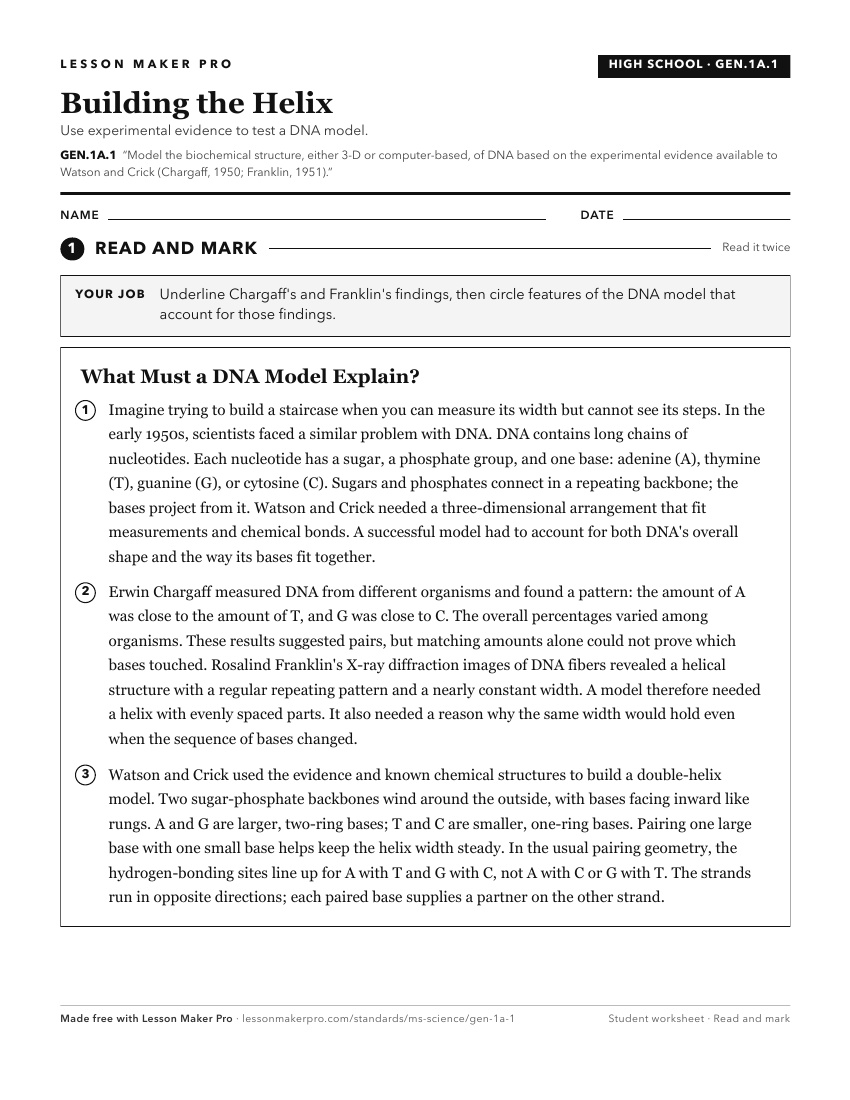
A ready-to-print activity worksheet aligned to GEN.1A.1, with an answer key for the teacher on its own page. No account needed.
PDF, US Letter, prints cleanly in black and white.
Download the worksheetKeep exploring
Related Standards
- BIO.1B.1
Develop and use models to compare and contrast the structure and function of carbohydrates, lipids, proteins, and nucleic acids (DNA and RNA) in organisms.
- GEN.1B.2
Develop and use models to illustrate the mechanics of DNA replication.
- BIO.3C.1
Develop and use models to explain the relationship between DNA, genes, and chromosomes in coding the instructions for the traits transferred from parent to offs...
- L.8.2A.1
Use a model to show the relationship of genes, chromosomes, and DNA, and construct explanations comparing their relationship to inherited characteristics.
Turn this exact standard into a lesson
Grade, subject, topic, and the complete standard are prefilled. Create one free, no account needed.
Also for this standard:Make a WorksheetMake a QuizMake a Sub Lesson