Mississippi Science GEN.1B.2
The Standard
- GEN.1B
- Students will analyze how the DNA sequence is copied and transmitted to new cells.
Develop and use models to illustrate the mechanics of DNA replication.
2026 Mississippi College- and Career-Readiness Standards for Science · Structure and Function of DNA
Teacher's field guide
What This Standard Means
What Students Need to Do
- Students model the two DNA strands separating. They add complementary bases to each original strand. They show that each finished molecule has one original strand and one new strand.
What Mastery Looks Like
- Given a short DNA sequence, a student pairs A with T and C with G on both new strands. Their model shows the original strands in separate finished molecules.
Common Misconceptions
- Students may copy the same letters onto a new strand instead of using complementary bases. Some show the original molecule staying together while an entirely new molecule forms.
How to Assess It
- Give students a six-base-pair DNA diagram. Ask them to draw the two finished molecules and mark each strand as original or new.
Lesson moves
Ways to Teach It
Have students separate two paired paper DNA strands, then tape different-colored base pieces to each strand to build two molecules.
Show a finished DNA model and ask, 'Why does each molecule contain one original strand?' Have students write a two-sentence answer.
Play Replication Repair: show three diagrams with wrong base pairs or misplaced original strands, and have teams fix them.
Give students a drawing of a healing cut and ask them to mark when skin cells copy DNA before dividing.
Free download
Printable GEN.1B.2 Worksheet
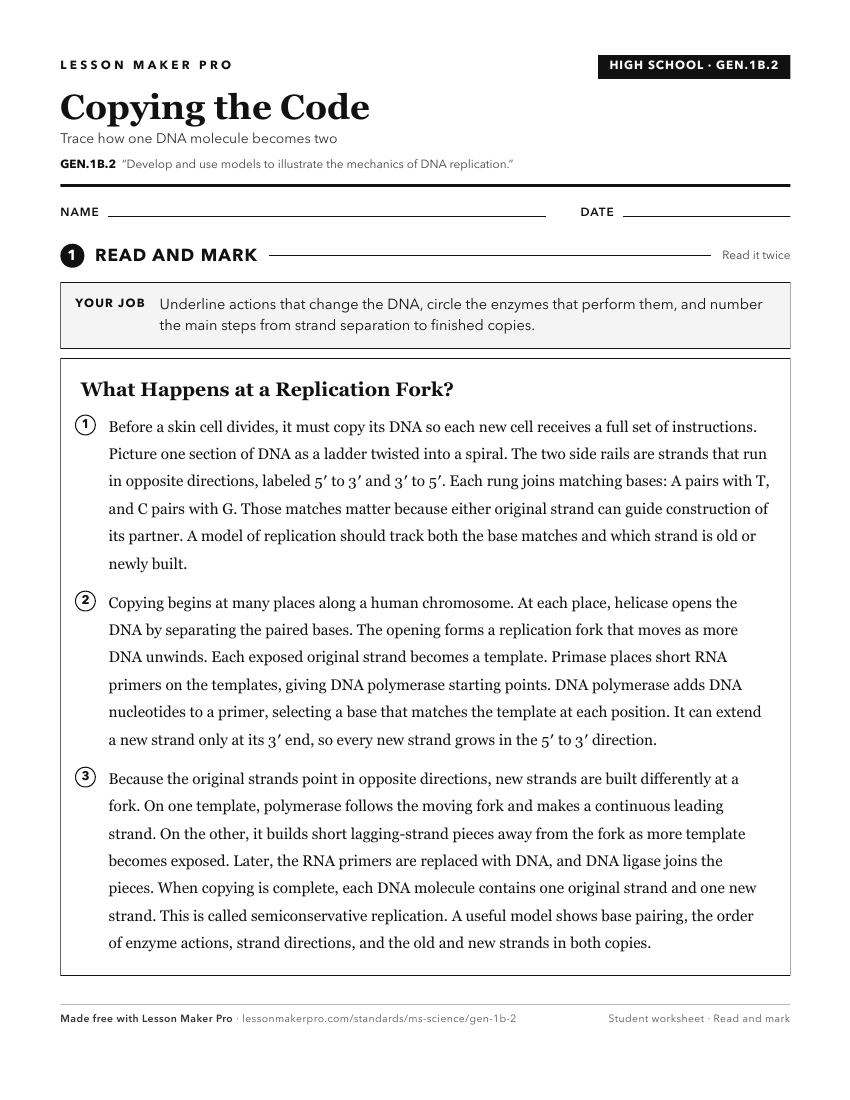
A ready-to-print activity worksheet aligned to GEN.1B.2, with an answer key for the teacher on its own page. No account needed.
PDF, US Letter, prints cleanly in black and white.
Download the worksheetKeep exploring
Related Standards
- BIO.3C.1
Develop and use models to explain the relationship between DNA, genes, and chromosomes in coding the instructions for the traits transferred from parent to offs...
- L.8.2A.1
Use a model to show the relationship of genes, chromosomes, and DNA, and construct explanations comparing their relationship to inherited characteristics.
- GEN.1A.1
Model the biochemical structure, either 3-D or computer-based, of DNA based on the experimental evidence available to Watson and Crick (Chargaff, 1950; Franklin...
- GEN.1B.1
Compare and contrast various proposed models of DNA replication (i.e., conservative, semi-conservative, and disruptive). Evaluate the evidence used to determine...
Turn this exact standard into a lesson
Grade, subject, topic, and the complete standard are prefilled. Create one free, no account needed.
Also for this standard:Make a WorksheetMake a QuizMake a Sub Lesson