Mississippi Science CHE.12
Standard Cluster
Enrichment: Students will understand that the bonding characteristics of carbon allow the formation of many different organic molecules with various sizes, shapes, and chemical properties. Enrichment: Construct explanations to explain the bonding characteristics of carbon that result in the formation of basic organic molecules. Enrichment: Obtain information to communicate the system used for naming the basic linear hydrocarbons and isomers that contain single bonds, simple hydrocarbons with double and triple bonds, and simple molecules that contain a benzene ring. Enrichment: Develop and use models to identify the functional groups that form the basis of alcohols, ketones, ethers, amines, esters, aldehydes, and organic acids.
2026 Mississippi College- and Career-Readiness Standards for Science · Organic Nomenclature (Enrichment)
Cluster contents
Standards in This Cluster
CHE.12 is a cluster heading. These are the individual standards under it.
- CHE.12.1
Enrichment: Construct explanations to explain the bonding characteristics of carbon that result in the formation of basic organic molecules.
- CHE.12.2
Enrichment: Obtain information to communicate the system used for naming the basic linear hydrocarbons and isomers that contain single bonds, simple hydrocarbon...
- CHE.12.3
Enrichment: Develop and use models to identify the functional groups that form the basis of alcohols, ketones, ethers, amines, esters, aldehydes, and organic ac...
Teacher's field guide
What This Cluster Means
What Students Need to Do
- Students use carbon’s four bonds to explain how molecules form chains, branches, and rings. They name simple hydrocarbons and identify seven common functional groups in structural drawings.
What Mastery Looks Like
- A student can draw two different structures with the formula C4H10 and name both. They can spot a double or triple bond, identify a benzene ring, and tell an aldehyde from a ketone by where the carbonyl group sits.
Common Misconceptions
- Students may give a carbon five bonds when drawing a double bond. They may think molecules with the same formula must have the same structure. They may call any molecule with OH an alcohol, including a carboxylic acid.
How to Assess It
- Put structures of butane, 2-methylpropane, but-1-ene, benzene, ethanol, and ethanoic acid on an exit slip. Ask students to name the first four, label the last two functional groups, and explain why the first two share a formula.
Lesson moves
Ways to Teach It
Build butane and 2-methylpropane with model kits, then count the bonds on each carbon and compare the formulas.
Show ethanol and ethanoic acid structures and ask pairs, “Why is one an alcohol and the other an acid?”
Run a naming relay with structure cards for butane, 2-methylpropane, but-1-ene, and propyne; teams write names and check carbon bonds.
Show labels and structure cards for rubbing alcohol, vinegar, and acetone nail polish remover; students match each product to its functional group.
Free download
Printable CHE.12 Worksheet
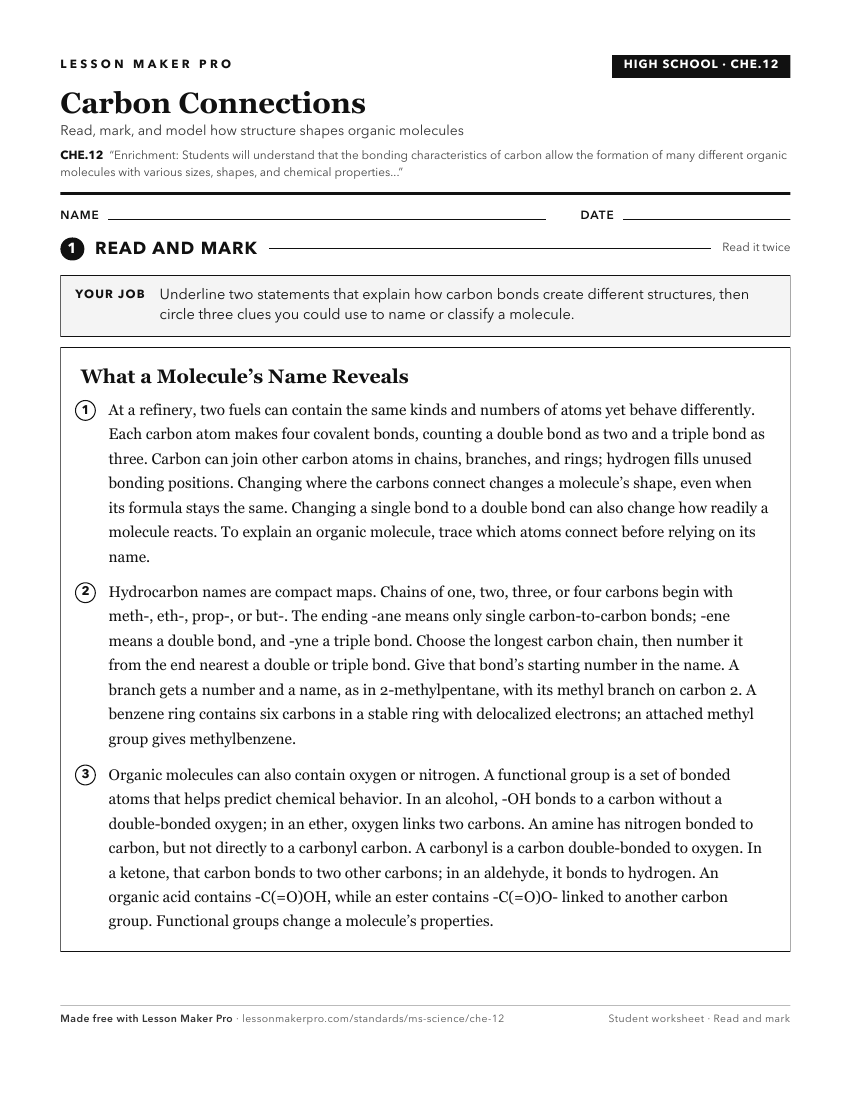
A ready-to-print activity worksheet aligned to CHE.12, with an answer key for the teacher on its own page. No account needed.
PDF, US Letter, prints cleanly in black and white.
Download the worksheetKeep exploring
Related Standards
Turn this cluster into a lesson
Grade, subject, topic, and the complete cluster are prefilled. Create one free, no account needed.
Also for this cluster:Make a WorksheetMake a QuizMake a Sub Lesson