Mississippi Science CHE.12.2
The Standard
- CHE.12
- Enrichment: Students will understand that the bonding characteristics of carbon allow the formation of many different organic molecules with various sizes, shapes, and chemical properties.
Enrichment: Obtain information to communicate the system used for naming the basic linear hydrocarbons and isomers that contain single bonds, simple hydrocarbons with double and triple bonds, and simple molecules that contain a benzene ring.
2026 Mississippi College- and Career-Readiness Standards for Science · Organic Nomenclature (Enrichment)
Teacher's field guide
What This Standard Means
What Students Need to Do
- Students use a naming chart to name straight and branched hydrocarbons, including ones with double or triple bonds. They name simple molecules with a benzene ring and explain why structures with the same formula can have different names.
What Mastery Looks Like
- Given a drawing, students find the longest carbon chain and number it from the correct end. They can tell butane from 2-methylpropane, name propene and propyne, and recognize methylbenzene.
Common Misconceptions
- Students often follow the straightest line on the page instead of the longest connected carbon chain. They may number from the end nearest a branch rather than a double or triple bond. Some think isomers share a name or treat a benzene ring as a straight chain.
How to Assess It
- On an exit slip, name CH3CH(CH3)CH3, CH2=CHCH3, CH3C≡CH, and a benzene ring with one CH3 group. Circle the feature that guided each name.
Lesson moves
Ways to Teach It
Build butane and 2-methylpropane with ball-and-stick models, then have students count carbons and mark the longest chain in each.
Ask pairs to write two sentences answering, "Why do butane and 2-methylpropane have the same formula but different names?"
Match name cards to structure cards for butane, 2-methylpropane, propene, propyne, and methylbenzene.
Bring a camping fuel can labeled propane and butane; have students sketch each molecule and check its carbon count against its name.
Free download
Printable CHE.12.2 Worksheet
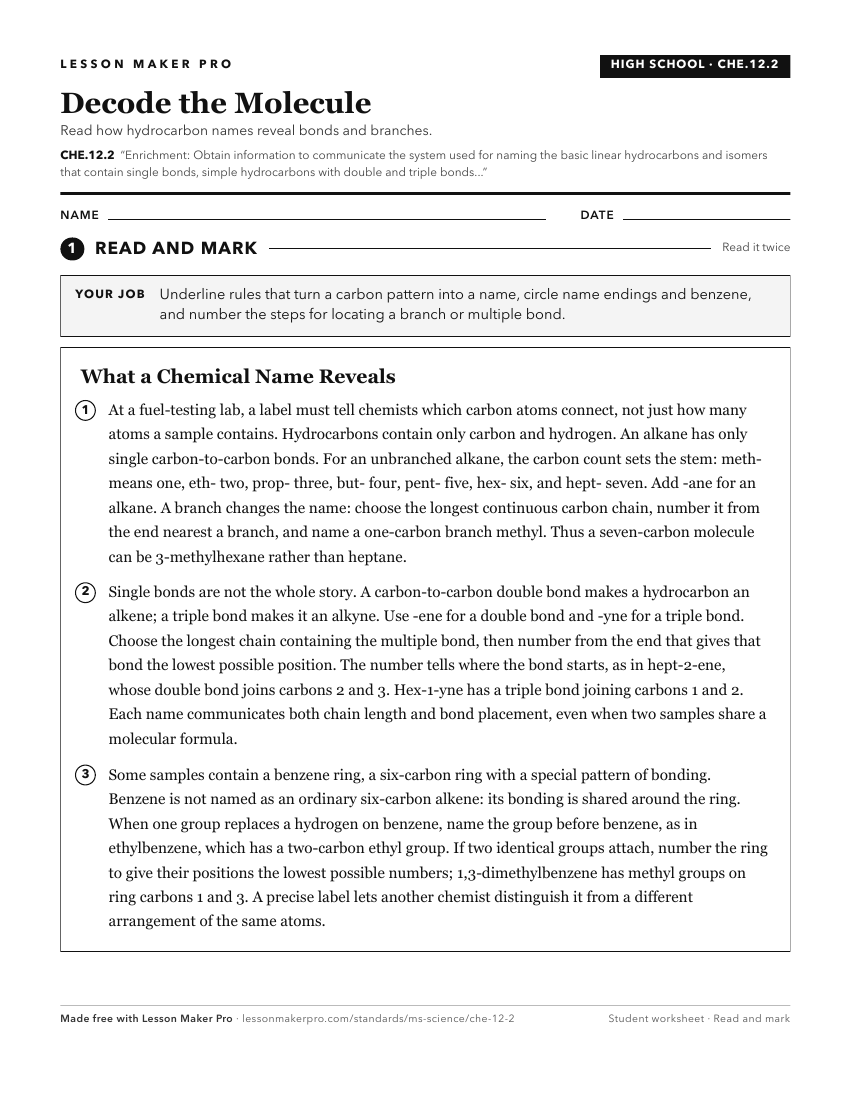
A ready-to-print activity worksheet aligned to CHE.12.2, with an answer key for the teacher on its own page. No account needed.
PDF, US Letter, prints cleanly in black and white.
Download the worksheetKeep exploring
Related Standards
- CHE.4.5
Use models of simple hydrocarbons to exemplify structural isomerism.
- CHE.12.3
Enrichment: Develop and use models to identify the functional groups that form the basis of alcohols, ketones, ethers, amines, esters, aldehydes, and organic ac...
- CHE.12
Enrichment: Students will understand that the bonding characteristics of carbon allow the formation of many different organic molecules with various sizes, shap...
- CHE.12.1
Enrichment: Construct explanations to explain the bonding characteristics of carbon that result in the formation of basic organic molecules.
Turn this exact standard into a lesson
Grade, subject, topic, and the complete standard are prefilled. Create one free, no account needed.
Also for this standard:Make a WorksheetMake a QuizMake a Sub Lesson