Mississippi Science L.6.1.5
The Standard
- L.6.1
- Students will demonstrate an understanding that living things range from simple to complex organisms, are organized hierarchically, and function as whole living systems.
Provide evidence that organisms are unicellular or multicellular.
2026 Mississippi College- and Career-Readiness Standards for Science · Hierarchical Organization
Teacher's field guide
What This Standard Means
What Students Need to Do
- Students examine microscope images to decide whether an organism is one cell or made of many cells. They use cell boundaries and the source of the sample as evidence.
What Mastery Looks Like
- A student identifies a paramecium as one cell and an onion as many cells. They explain why several paramecia in one image are still separate organisms.
Common Misconceptions
- Students may call a group of yeast cells multicellular because the cells are close together. They may assume every organism too small to see without a microscope has only one cell.
How to Assess It
- Show images of one paramecium, several paramecia, and onion skin. Ask students to classify each organism by cell count and point to evidence in the images.
Lesson moves
Ways to Teach It
Give pairs printed microscope images of a paramecium and onion skin; have them trace cell boundaries and label each organism by cell count.
Ask: Why are five paramecia in one drop of water not one multicellular organism? Have students write a claim using the image as evidence.
Have students sort photo cards of amoebas, groups of amoebas, onion tissue, and cheek tissue by organism cell count, then defend each choice.
Show microscope images of baker's yeast and mushroom tissue; ask which cooking fungus is multicellular and what evidence supports that answer.
Free download
Printable L.6.1.5 Worksheet
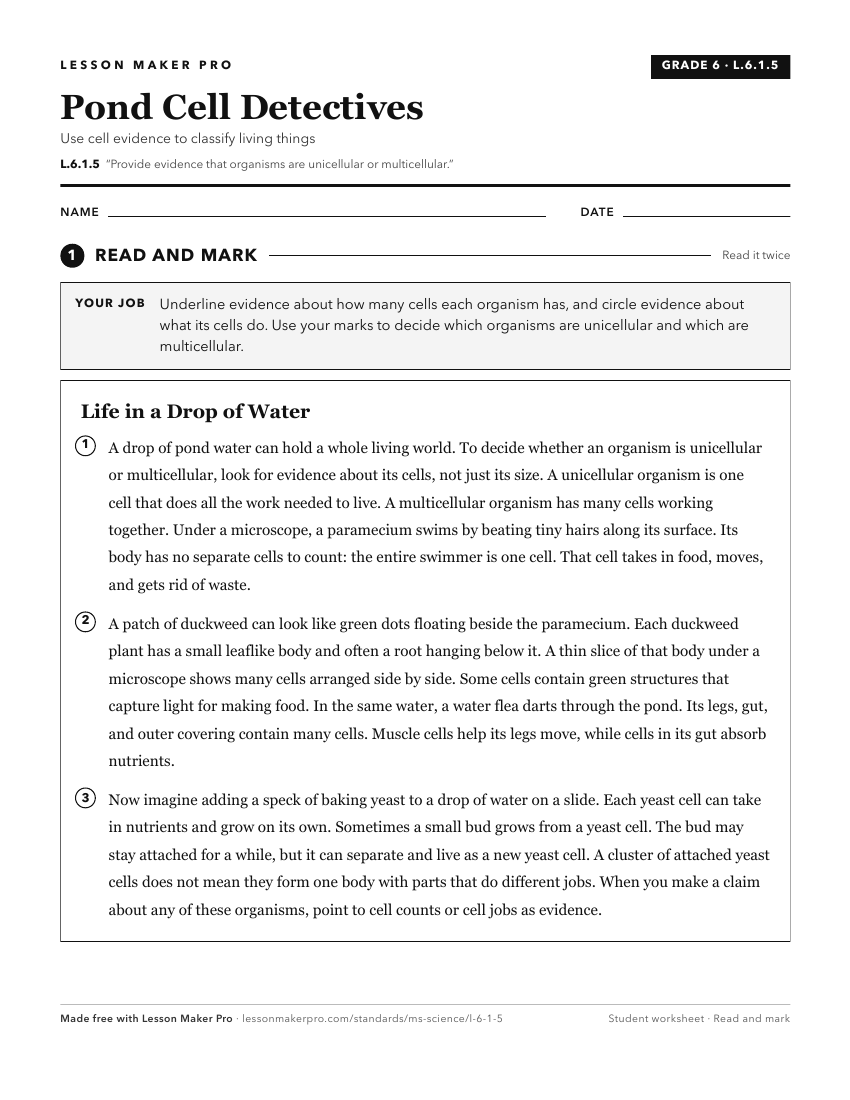
A ready-to-print activity worksheet aligned to L.6.1.5, with an answer key for the teacher on its own page. No account needed.
PDF, US Letter, prints cleanly in black and white.
Download the worksheetKeep exploring
Related Standards
- L.6.1.2
Obtain and communicate evidence to support the cell theory.
- BIO.1E.1
Construct models to explain how the processes of cell division and cell differentiation produce and maintain complex multicellular organisms.
- L.6.1.1
Use argument supported by evidence in order to distinguish between living and non-living things, including viruses and bacteria.
- BIO.1A.3
Using specific examples, explain how cells can be organized into complex tissues, organs, and organ systems in multicellular organisms.
Turn this exact standard into a lesson
Grade, subject, topic, and the complete standard are prefilled. Create one free, no account needed.
Also for this standard:Make a WorksheetMake a QuizMake a Sub Lesson