Mississippi Science L.6.3.5
The Standard
- L.6.3
- Students will demonstrate an understanding of the relationships between survival, environmental changes, and diversity as they relate to the interactions of organisms, populations, and the environment.
Develop and use food chains, webs, and pyramids to analyze how energy is transferred through an ecosystem from producers (autotrophs) to consumers (heterotrophs, including humans) to decomposers.
2026 Mississippi College- and Career-Readiness Standards for Science · Ecology and Interdependence
Teacher's field guide
What This Standard Means
What Students Need to Do
- Students make food chains, webs, and energy pyramids for an ecosystem. They trace energy from sunlight to plants, then to animals, including humans, and to decomposers that break down waste and dead organisms. They explain why less energy is available at each higher pyramid level.
What Mastery Looks Like
- Given grass, grasshoppers, frogs, snakes, and fungi, a student draws arrows toward each eater and shows fungi getting energy from dead organisms. Their pyramid puts grass at the base and shows less available energy at each higher level. They can explain why a field supports fewer snakes than grasshoppers.
Common Misconceptions
- Students may point arrows toward the organism being eaten instead of the one getting energy. They may put decomposers only after top predators or think energy cycles back to plants. Some draw equal energy at every pyramid level.
How to Assess It
- Give students grass, rabbits, hawks, people who eat rabbits, and mushrooms. Have them draw an arrowed food web and energy pyramid, then show what mushrooms break down and explain why less energy reaches hawks than rabbits.
Lesson moves
Ways to Teach It
Give groups grass, rabbit, fox, and fungi cards; use yarn and arrow stickers to show energy flow and decomposer links.
Ask, 'Why can a meadow support more rabbits than foxes?' Have students use a sketched energy pyramid to defend an answer.
Play arrow check: display a grass, rabbit, fox food chain with one arrow reversed; pairs fix it and explain why.
Show a lunch tray with lettuce and corn-fed chicken; students sketch the two energy paths to the person eating it.
Free download
Printable L.6.3.5 Worksheet
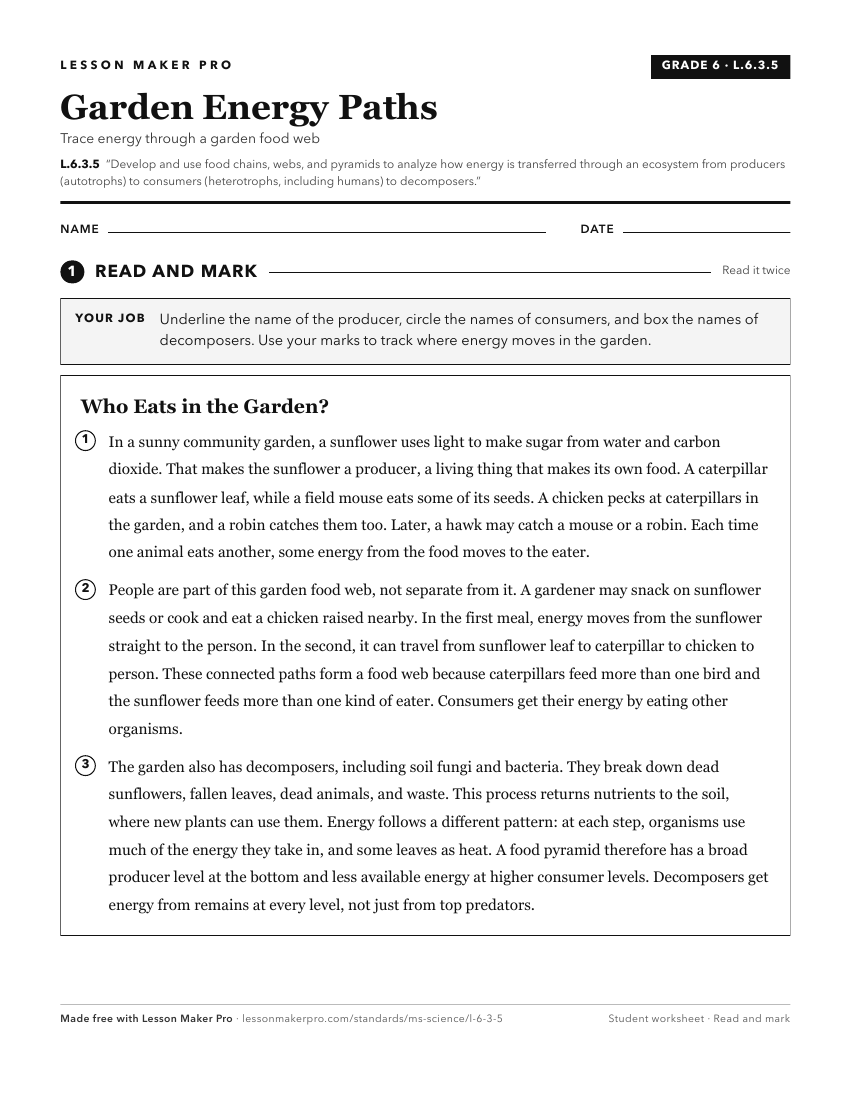
A ready-to-print activity worksheet aligned to L.6.3.5, with an answer key for the teacher on its own page. No account needed.
PDF, US Letter, prints cleanly in black and white.
Download the worksheetKeep exploring
Related Standards
- L.5.3B
Students will demonstrate an understanding of a healthy ecosystem with a stable web of life and the roles of living things within a food chain and/or food web, ...
- BIO.5.4
Develop and use models to describe the flow of energy and amount of biomass through food chains, food webs, and food pyramids.
- L.5.3B.2
Develop and use a food chain model to classify organisms as producers, consumers, or decomposers. Trace the energy flow to explain how each group of organisms o...
- FB.6.5
Use models to analyze the flow of energy through food chains, webs, and pyramids.
Turn this exact standard into a lesson
Grade, subject, topic, and the complete standard are prefilled. Create one free, no account needed.
Also for this standard:Make a WorksheetMake a QuizMake a Sub Lesson