Mississippi Science L.5.3B
Standard Cluster
Students will demonstrate an understanding of a healthy ecosystem with a stable web of life and the roles of living things within a food chain and/or food web, including producers, primary and secondary consumers, and decomposers. Obtain and evaluate scientific information regarding the characteristics of different ecosystems and the organisms they support (e.g., salt, and fresh water, deserts, grasslands, forests, rain forests, or polar tundra lands). Develop and use a food chain model to classify organisms as producers, consumers, or decomposers. Trace the energy flow to explain how each group of organisms obtains energy. Design and interpret models of food webs to justify what effects the removal or the addition of a species (i.e., introduced, or invasive) would have on a specific population and/or the ecosystem as a whole. Communicate scientific or technical information that explains human positions in food webs and our potential impacts on these systems.
2026 Mississippi College- and Career-Readiness Standards for Science · Ecology and Interdependence
Cluster contents
Standards in This Cluster
L.5.3B is a cluster heading. These are the individual standards under it.
- L.5.3B.1
Obtain and evaluate scientific information regarding the characteristics of different ecosystems and the organisms they support (e.g., salt and fresh water, des...
- L.5.3B.2
Develop and use a food chain model to classify organisms as producers, consumers, or decomposers. Trace the energy flow to explain how each group of organisms o...
- L.5.3B.3
Design and interpret models of food webs to justify what effects the removal or the addition of a species (i.e., introduced or invasive) would have on a specifi...
- L.5.3B.4
Communicate scientific or technical information that explains human positions in food webs and our potential impacts on these systems.
Teacher's field guide
What This Cluster Means
What Students Need to Do
- Students compare sources about the organisms that live in different ecosystems. They label producers, primary and secondary consumers, and decomposers, then trace how each gets energy. They build food webs to predict how added species, lost species, and human actions affect populations.
What Mastery Looks Like
- Students can label pond algae, snails, fish, and bacteria as producer, primary consumer, secondary consumer, and decomposer. They draw arrows from sunlight to algae, food to eater, and dead matter to bacteria. They use those links to explain why removing fish could increase snails and reduce algae.
Common Misconceptions
- Students often draw arrows from predator to prey, as if arrows show who attacks whom. They may call fungi producers because fungi grow like plants, or think removing a predator affects only its prey.
How to Assess It
- Exit ticket: Draw energy arrows among sunlight, algae, snails, bass, dead remains, and bacteria. Label each living thing's role, then predict what happens to snails if bass disappear and cite one link in your drawing.
Lesson moves
Ways to Teach It
Give groups pond organism cards, yarn, and arrow stickers to build a food web and label each organism's role.
Compare a National Park Service desert wildlife page with an unsigned blog, then write which better supports a claim about lizard habitat.
Play food-web switch: remove the frog card from a pond web, then have teams predict two population changes using the remaining links.
Show a state fishing-limit notice, then have students draw how catching too many fish could affect prey and predators in a nearby lake.
Free download
Printable L.5.3B Worksheet
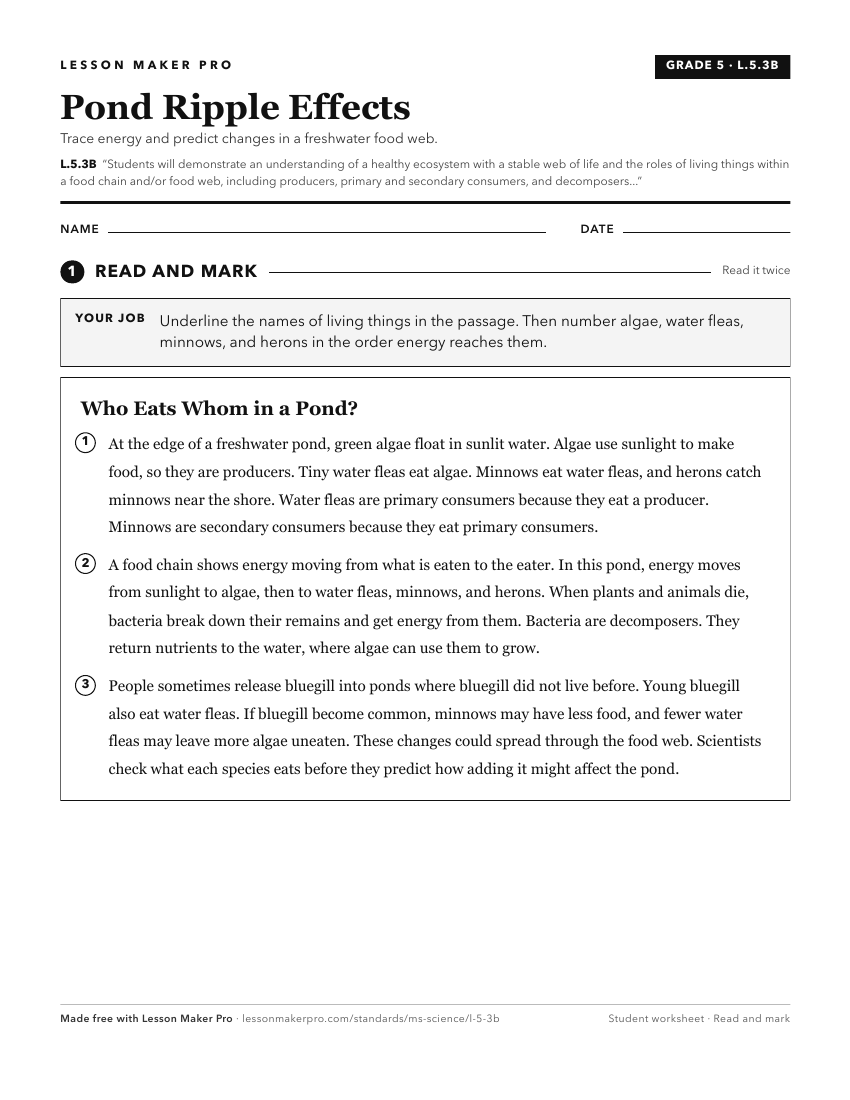
A ready-to-print activity worksheet aligned to L.5.3B, with an answer key for the teacher on its own page. No account needed.
PDF, US Letter, prints cleanly in black and white.
Download the worksheetKeep exploring
Related Standards
- L.2.3A
Students will demonstrate an understanding of the interdependence of living things and the environment in which they live.
- L.K.1A
Students will demonstrate an understanding of living and non-living things.
- L.7.3
Students will demonstrate an understanding of the importance that matter cycles between living and non-living parts of the ecosystem to sustain life on Earth.
- L.2.3B
Students will demonstrate an understanding of the interdependence of living things.
Turn this cluster into a lesson
Grade, subject, topic, and the complete cluster are prefilled. Create one free, no account needed.
Also for this cluster:Make a WorksheetMake a QuizMake a Sub Lesson