Mississippi Science L.5.3B.4
The Standard
- L.5.3B
- Students will demonstrate an understanding of a healthy ecosystem with a stable web of life and the roles of living things within a food chain and/or food web, including producers, primary and secondary consumers, and decomposers.
Communicate scientific or technical information that explains human positions in food webs and our potential impacts on these systems.
2026 Mississippi College- and Career-Readiness Standards for Science · Ecology and Interdependence
Teacher's field guide
What This Standard Means
What Students Need to Do
- Students use a food web to show what people eat. They explain how a human action, such as heavy fishing, can change the food available to other animals.
What Mastery Looks Like
- A student draws arrows from food to eater, including arrows that show people eating anchovies and tuna. They explain that catching many anchovies leaves less food for tuna and seabirds.
Common Misconceptions
- Students may point arrows from eater to food. Some place humans outside the web or assume people eat only animals at the top. Others think removing anchovies affects only anchovies.
How to Assess It
- Give students five labels: plankton, anchovies, tuna, seabirds, and humans. Ask them to draw a food web, then write two sentences explaining what could happen if people catch most of the anchovies.
Lesson moves
Ways to Teach It
Give pairs organism cards and yarn to build a food web, then remove the anchovy card and trace which animals lose food.
Ask: If people catch most anchovies, what happens to tuna and seabirds? Use two arrows from the web to explain.
Play a card game where students draw two organism cards, add a food-to-eater arrow when it fits, and explain their choice.
Show a can of anchovies, then ask students to write how catching too many could affect tuna and seabirds.
Free download
Printable L.5.3B.4 Worksheet
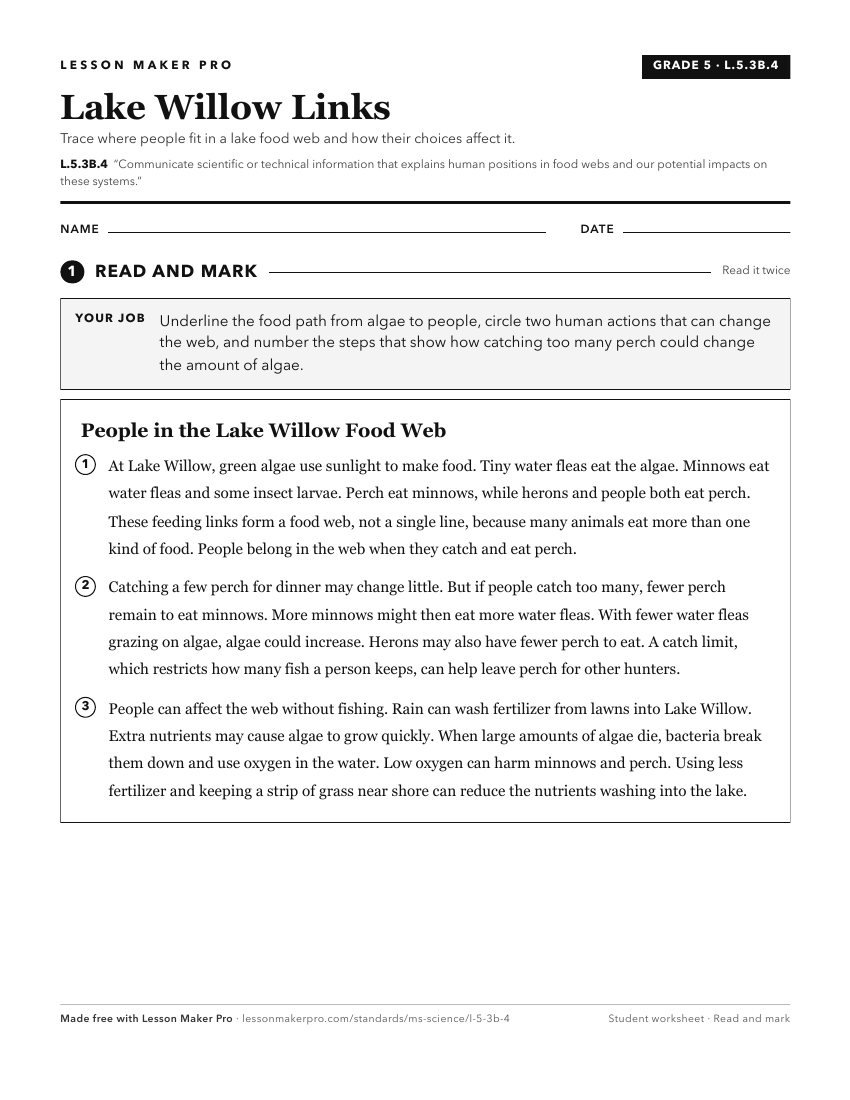
A ready-to-print activity worksheet aligned to L.5.3B.4, with an answer key for the teacher on its own page. No account needed.
PDF, US Letter, prints cleanly in black and white.
Download the worksheetKeep exploring
Related Standards
- L.2.3A.2
Construct scientific arguments to explain how animals can make major changes (e.g., beaver dams obstruct streams, or large deer populations destroying crops) an...
- L.2.3B.1
Evaluate and communicate findings from informational text or other media to describe and to compare how animals interact with other animals and plants in the en...
- L.5.3B.3
Design and interpret models of food webs to justify what effects the removal or the addition of a species (i.e., introduced or invasive) would have on a specifi...
- ENV.1.9
Evaluate and communicate data that explains how human activity may impact biodiversity (e.g., introduction, removal, and reintroduction of an organism within an...
Turn this exact standard into a lesson
Grade, subject, topic, and the complete standard are prefilled. Create one free, no account needed.
Also for this standard:Make a WorksheetMake a QuizMake a Sub Lesson