Mississippi Science L.5.3B.3
The Standard
- L.5.3B
- Students will demonstrate an understanding of a healthy ecosystem with a stable web of life and the roles of living things within a food chain and/or food web, including producers, primary and secondary consumers, and decomposers.
Design and interpret models of food webs to justify what effects the removal or the addition of a species (i.e., introduced, or invasive) would have on a specific population and/or the ecosystem as a whole.
2026 Mississippi College- and Career-Readiness Standards for Science · Ecology and Interdependence
Teacher's field guide
What This Standard Means
What Students Need to Do
- Students draw food webs with arrows from food to eater. They use the links to predict how adding or removing a species could change other populations.
What Mastery Looks Like
- A student can draw several connected feeding paths with arrows pointing the right way. They can explain why removing fish might increase snails but decrease herons.
Common Misconceptions
- Students often point arrows toward the food instead of the eater. They may assume every population changes in the same direction, or that only animals directly connected to the changed species are affected.
How to Assess It
- Exit ticket: Algae feed snails and tadpoles. Fish eat both, and herons eat fish. Draw the food web, then predict what happens to snails and herons if fish disappear.
Lesson moves
Ways to Teach It
Give pairs algae, snail, tadpole, fish, and heron cards; have them connect food to eater with yarn, then remove fish.
Ask, 'If fish vanish from this pond, what happens to snails, tadpoles, and herons? Point to the links behind your answer.'
Play change-a-card: students draw 'add snails' or 'remove herons,' then sketch two population changes on a pond web.
Give students a card reading 'Lionfish eat small reef fish'; have them add lionfish to a reef web and predict what happens to groupers.
Free download
Printable L.5.3B.3 Worksheet
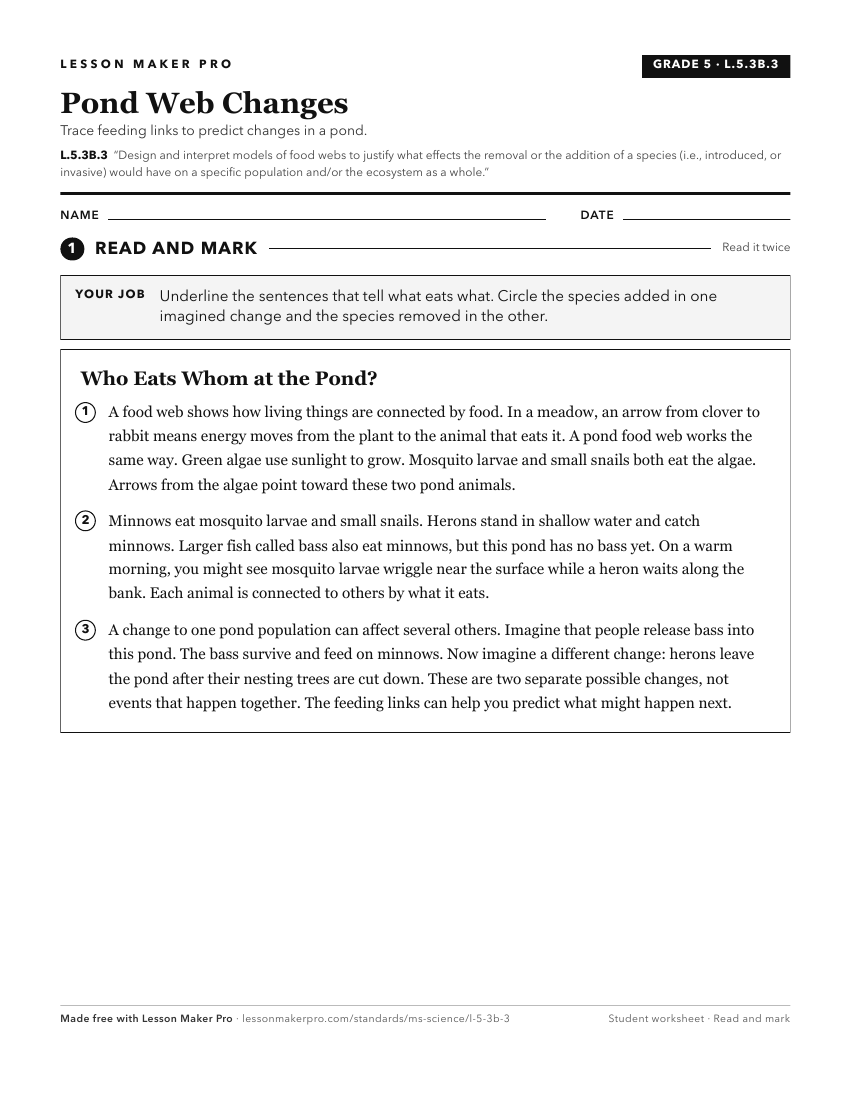
A ready-to-print activity worksheet aligned to L.5.3B.3, with an answer key for the teacher on its own page. No account needed.
PDF, US Letter, prints cleanly in black and white.
Download the worksheetKeep exploring
Related Standards
- L.5.3B.4
Communicate scientific or technical information that explains human positions in food webs and our potential impacts on these systems.
- BIO.5.4
Develop and use models to describe the flow of energy and amount of biomass through food chains, food webs, and food pyramids.
- ZOO.7.6
Research, analyze, and communicate the effects of urbanization and continued expansion by humans on the biodiversity of fish species (e.g., overfishing, and inv...
- ENV.1.9
Evaluate and communicate data that explains how human activity may impact biodiversity (e.g., introduction, removal, and reintroduction of an organism within an...
Turn this exact standard into a lesson
Grade, subject, topic, and the complete standard are prefilled. Create one free, no account needed.
Also for this standard:Make a WorksheetMake a QuizMake a Sub Lesson