Mississippi Science L.5.3B.1
The Standard
- L.5.3B
- Students will demonstrate an understanding of a healthy ecosystem with a stable web of life and the roles of living things within a food chain and/or food web, including producers, primary and secondary consumers, and decomposers.
Obtain and evaluate scientific information regarding the characteristics of different ecosystems and the organisms they support (e.g., salt, and fresh water, deserts, grasslands, forests, rain forests, or polar tundra lands).
2026 Mississippi College- and Career-Readiness Standards for Science · Ecology and Interdependence
Teacher's field guide
What This Standard Means
What Students Need to Do
- Students gather information about conditions in different ecosystems, such as rainfall, temperature, and water type. They check where the information came from and use it to explain which organisms can live there.
What Mastery Looks Like
- A student uses a labeled rainfall chart to compare deserts and rainforests. They explain why a cactus is suited to a dry desert and point out when an unsupported claim conflicts with the chart.
Common Misconceptions
- Students may think deserts are always hot or that freshwater and saltwater habitats support the same animals. They may accept a claim about where an animal lives without checking its source.
How to Assess It
- Give students a rainfall chart credited to a science textbook and an unsigned card claiming deserts are wetter than rainforests. Ask which source is better supported and where a cactus and a fern would most likely grow, using evidence from the chart.
Lesson moves
Ways to Teach It
Give pairs rainfall cards and organism pictures; have them build desert and rainforest displays and label one clue for each match.
Show a National Park Service fact sheet and an unsigned post about desert animals; ask which claims students can verify and how.
Play ecosystem match: teams pair organism cards with habitat cards and earn a point only when they cite a condition from the card.
Show a photo of a nearby pond and a cattail field-guide page; ask which pond conditions support cattails.
Free download
Printable L.5.3B.1 Worksheet
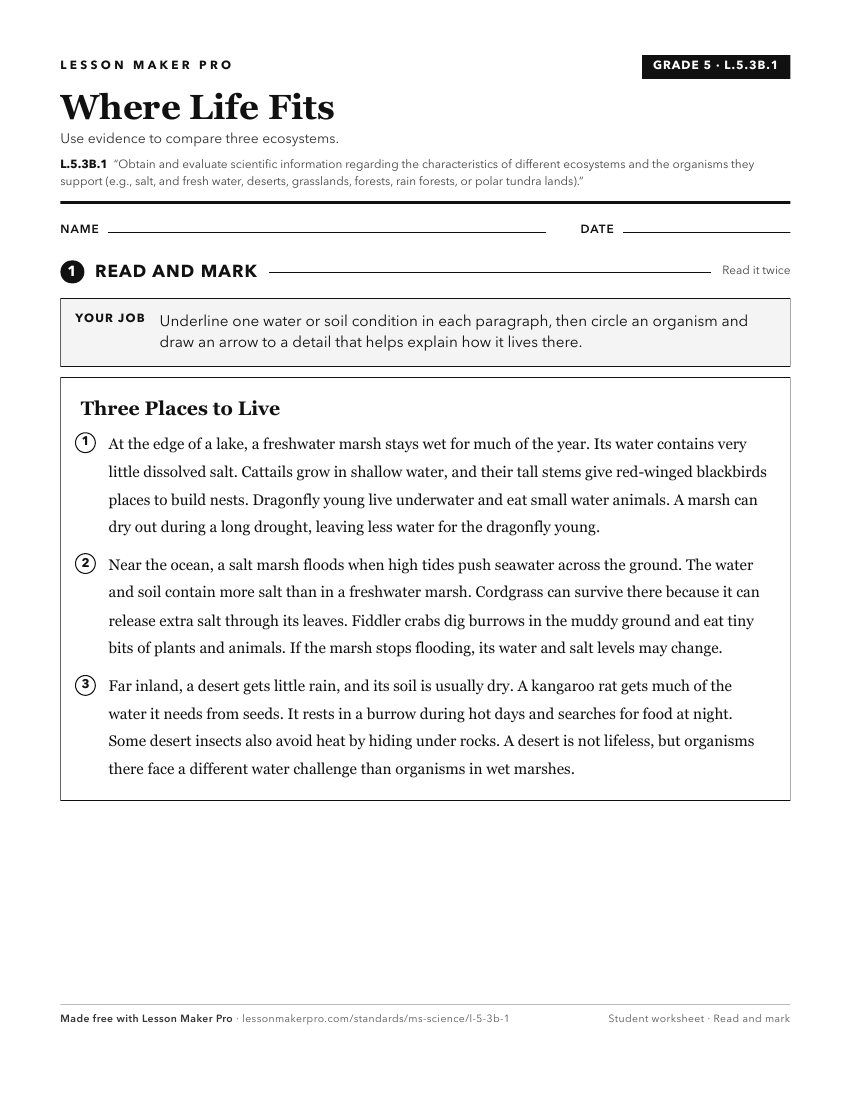
A ready-to-print activity worksheet aligned to L.5.3B.1, with an answer key for the teacher on its own page. No account needed.
PDF, US Letter, prints cleanly in black and white.
Download the worksheetKeep exploring
Related Standards
- MAQ.4.1
Compare and contrast the unique biotic and abiotic characteristics of the following selected aquatic ecosystems: intertidal zone, wetlands/estuaries, coral reef...
- ENV.1.1
Identify, investigate, and evaluate the interactions of the abiotic and biotic factors that determine the types of organisms that live in major biomes.
- L.2.3B.1
Evaluate and communicate findings from informational text or other media to describe and to compare how animals interact with other animals and plants in the en...
- L.2.4.1
Evaluate and communicate findings from informational text or other media to describe how plants and animals use adaptations to survive (e.g., ducks use webbed f...
Turn this exact standard into a lesson
Grade, subject, topic, and the complete standard are prefilled. Create one free, no account needed.
Also for this standard:Make a WorksheetMake a QuizMake a Sub Lesson