Mississippi Science FB.6.4
The Standard
- FB.6
- Students will understand the interdependence of living organisms and their environment.
Develop and use models to discuss the climate, flora, and fauna of the terrestrial and aquatic biomes of the world.
2026 Mississippi College- and Career-Readiness Standards for Science · Ecological Principals
Teacher's field guide
What This Standard Means
What Students Need to Do
- Students make and use models of land and water biomes. They show how long-term temperature, rainfall, salinity, and light affect which plants and animals live there.
What Mastery Looks Like
- A student can model a hot desert and a coral reef with accurate conditions and organisms. They can use the models to explain why a cactus fits the desert and coral fits the reef.
Common Misconceptions
- Students may think every desert is hot or that one week's weather defines a biome. They may put coral in freshwater or assume all aquatic habitats have the same light and salinity.
How to Assess It
- Exit ticket: Sketch a hot desert and a freshwater pond. Label temperature, water availability, one plant, and one animal for each, then explain why one organism fits its habitat.
Lesson moves
Ways to Teach It
Build two paper habitat models with organism cutouts: a hot desert labeled with rainfall and temperature, and a coral reef labeled with salinity and light.
Write: Why can a cactus survive in a hot desert but not a freshwater pond? Use clues from both labeled models.
Play biome match: deal cards showing conditions, plants, and animals; pairs assemble tundra, rainforest, pond, and reef sets and explain any mismatches.
Give students a local pond photo and monthly climate averages; ask whether cattails and frogs could survive there, using two clues.
Free download
Printable FB.6.4 Worksheet
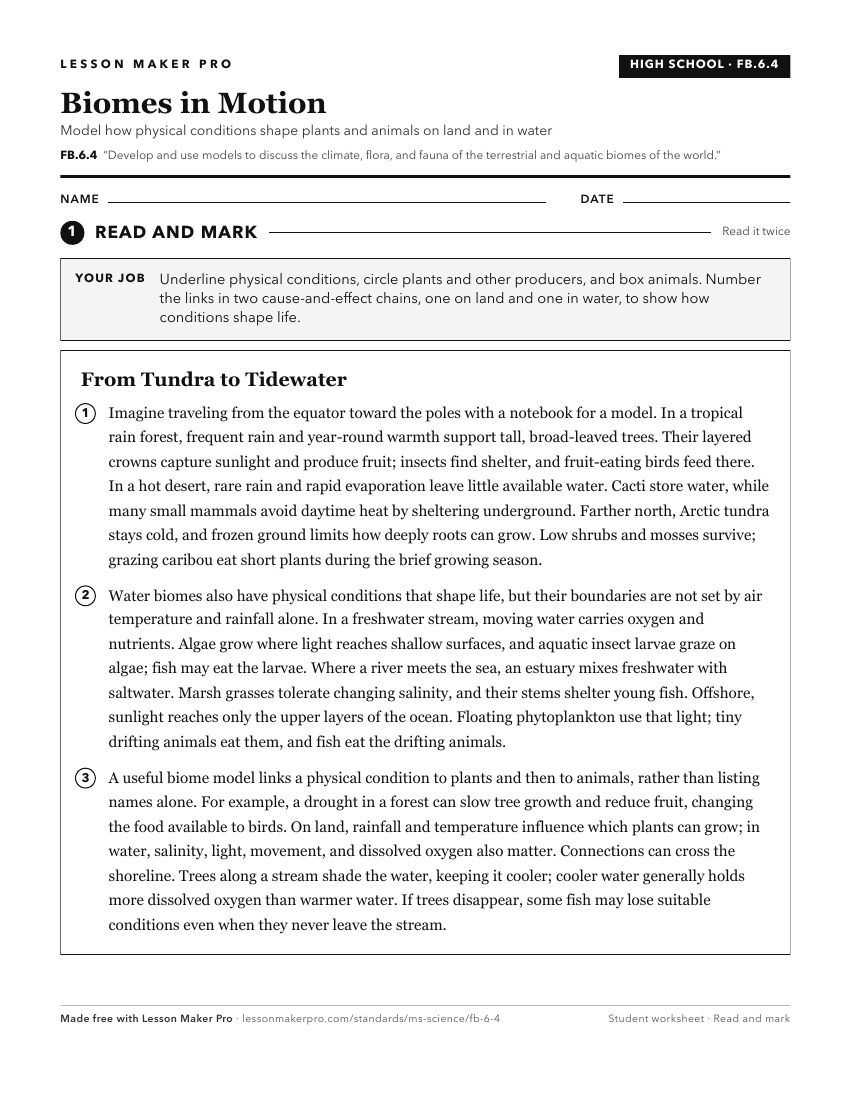
A ready-to-print activity worksheet aligned to FB.6.4, with an answer key for the teacher on its own page. No account needed.
PDF, US Letter, prints cleanly in black and white.
Download the worksheetKeep exploring
Related Standards
- ENV.1.5
Develop and use models to diagram the flow of nitrogen, carbon, and phosphorus through the environment.
- E.3.9.1
Develop models to communicate the characteristics of the Earth's major systems, including the geosphere, hydrosphere, atmosphere, and biosphere (e.g., digital m...
- L.6.3.2
Develop and use models to describe the levels of organization within ecosystems (species, populations, communities, ecosystems, and biomes).
- L.4.2.2
Develop and use models to explain the unique and diverse life cycles of organisms other than humans (e.g., flowering plants, frogs, or butterflies) including co...
Turn this exact standard into a lesson
Grade, subject, topic, and the complete standard are prefilled. Create one free, no account needed.
Also for this standard:Make a WorksheetMake a QuizMake a Sub Lesson