Mississippi Science L.3.4
Standard Cluster
Students will demonstrate an understanding of how adaptations allow animals to satisfy life needs and respond both physically and behaviorally to their environment. Obtain data from informational text to explain how changes in habitats (both those that occur naturally and those caused by organisms) can be beneficial or harmful to the organisms that live there. Ask questions to predict how natural or human-caused changes in a habitat cause plants and animals to respond in different ways, including hibernating, migrating, responding to light, death, or extinction (e.g., sea turtles, the dodo bird, or nocturnal species). Analyze and interpret data to explain how variations in characteristics among organisms of the same species may provide advantages in surviving, finding mates, and reproducing (e.g., plants with larger thorns being less likely to be eaten by predators or animals with better camouflage colorations being more likely to survive and bear offspring). Define and improve a solution to a problem created by environmental changes and any resulting impacts on the types of density and distribution of plant and animal populations living in the environment (e.g., replanting sea oats in coastal areas or developing or preserving wildlife corridors and green belts). Use an engineering design process to define the problem, design, construct, evaluate, and improve the environment. * Construct scientific arguments using evidence from fossils of plants and animals that lived long ago to infer the characteristics of early environments (e.g., marine fossils on dry land, tropical plant fossils in arctic areas, or fossils of extinct organisms in any environment).
2026 Mississippi College- and Career-Readiness Standards for Science · Adaptation and Diversity
Cluster contents
Standards in This Cluster
L.3.4 is a cluster heading. These are the individual standards under it.
- L.3.4.1
Obtain data from informational text to explain how changes in habitats (both those that occur naturally and those caused by organisms) can be beneficial or harm...
- L.3.4.2
Ask questions to predict how natural or human-caused changes in a habitat cause plants and animals to respond in different ways, including hibernating, migratin...
- L.3.4.3
Analyze and interpret data to explain how variations in characteristics among organisms of the same species may provide advantages in surviving, finding mates, ...
- L.3.4.4
Define and improve a solution to a problem created by environmental changes and any resulting impacts on the types of density and distribution of plant and anim...
- L.3.4.5
Construct scientific arguments using evidence from fossils of plants and animals that lived long ago to infer the characteristics of early environments (e.g., m...
Teacher's field guide
What This Cluster Means
What Students Need to Do
- Students use texts and simple data to explain how habitat changes help or harm living things. They predict how plants and animals might respond and compare traits that help some survive and have young. They use fossils to describe past habitats, then test and improve a model solution to a habitat problem.
What Mastery Looks Like
- Given a short report about a drought, a student predicts which animals might move or die and points to evidence in the report. They use moth counts to explain why one color may survive and have more young. They use a shell fossil to describe a past habitat and improve a paper wildlife crossing after testing it.
Common Misconceptions
- Students may think a moth changes its color because it needs to hide, or that all moths have the same color. They may assume every animal can move away when a habitat changes, or that every change harms every species. A shell fossil on dry land may make them think the shell animal lived on land.
How to Assess It
- Write on the board: "Before a road, 8 of 10 rabbits reached food; afterward, 2 of 10 did." Ask students to draw a crossing and say how they would test whether it helps.
Lesson moves
Ways to Teach It
Place paper animal counters on a forest grid, add a paper road, then build and test a bridge that lets them reach food.
Show a photo of a shell fossil on dry land and ask, "What was this place like long ago, and what is your evidence?"
Hide two colors of paper moths on dark and light sheets, count those found, and predict which moths might have more young.
Read a short news article about land clearing, then have students map lost shelter and predict where animals might go.
Free download
Printable L.3.4 Worksheet
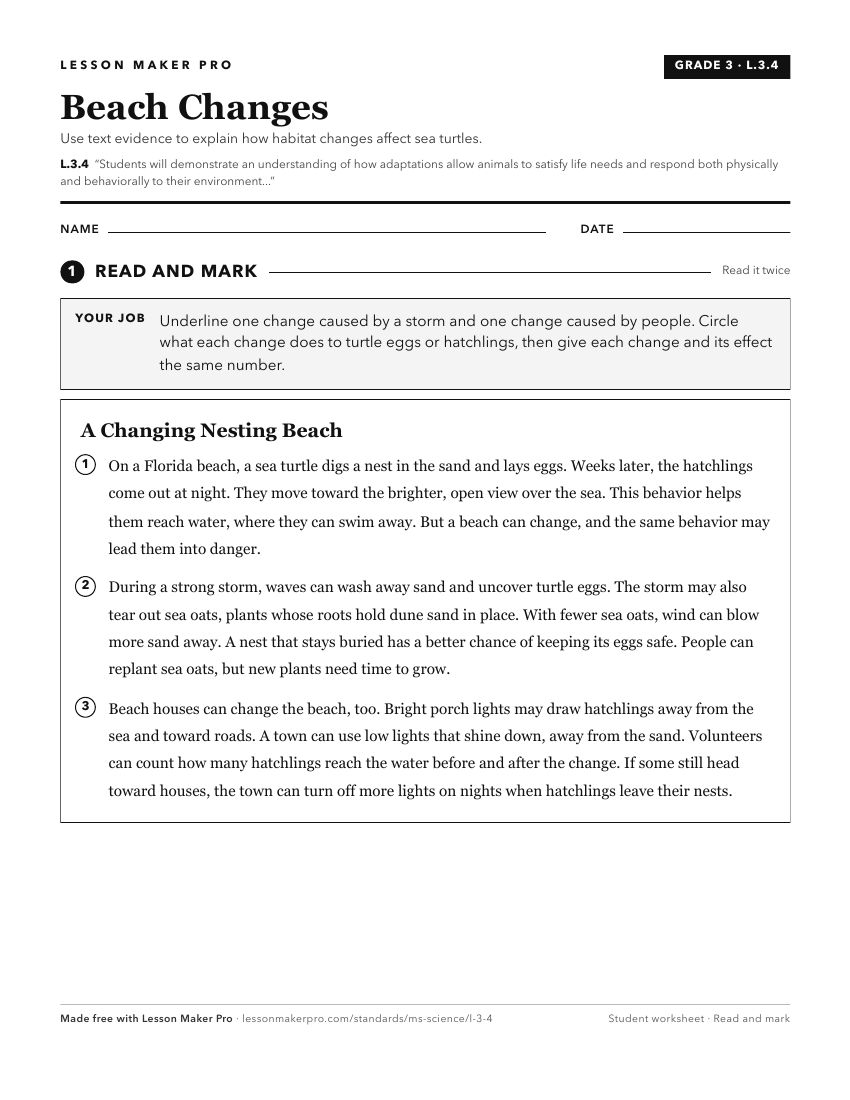
A ready-to-print activity worksheet aligned to L.3.4, with an answer key for the teacher on its own page. No account needed.
PDF, US Letter, prints cleanly in black and white.
Download the worksheetKeep exploring
Related Standards
- L.K.3A
Students will demonstrate an understanding of what animals and plants need to live and grow.
- L.K.1B
Students will demonstrate an understanding of how animals (including humans) use their physical features and their senses to learn about their environment.
- L.1.4
Students will demonstrate an understanding of the ways plants adapt to their environment in order to survive.
- L.2.4
Students will demonstrate an understanding of the ways animals adapt to their environment in order to survive.
Turn this cluster into a lesson
Grade, subject, topic, and the complete cluster are prefilled. Create one free, no account needed.
Also for this cluster:Make a WorksheetMake a QuizMake a Sub Lesson