Mississippi Science L.K.1B
Standard Cluster
Students will demonstrate an understanding of how animals (including humans) use their physical features and their senses to learn about their environment. Develop and use models to exemplify how animals use their body parts to (a) obtain food and other resources, (b) protect themselves, and (c) move from place to place. Identify and describe examples of how animals use their sensory body parts (eyes to detect light and movement, ears to detect sound, skin to detect temperature and touch, tongue to taste, and nose to detect smell).
2026 Mississippi College- and Career-Readiness Standards for Science · Hierarchical Organization
Cluster contents
Standards in This Cluster
L.K.1B is a cluster heading. These are the individual standards under it.
- L.K.1B.1
Develop and use models to exemplify how animals use their body parts to (a) obtain food and other resources, (b) protect themselves, and (c) move from place to ...
- L.K.1B.2
Identify and describe examples of how animals use their sensory body parts (eyes to detect light and movement, ears to detect sound, skin to detect temperature ...
Teacher's field guide
What This Cluster Means
What Students Need to Do
- Students make a simple animal model and use it to show how the animal eats, stays safe, and gets around. They point to sense organs and tell what each one helps them notice.
What Mastery Looks Like
- A child moves a paper turtle's legs to show walking, points to its mouth for eating, and folds its head under a shell flap for safety. They match light and movement to eyes, sound to ears, warmth and touch to skin, flavor to tongue, and smells to nose.
Common Misconceptions
- Children may think a turtle's shell helps it walk. They may confuse smelling a snack with tasting it, or think only fingers can feel warmth.
How to Assess It
- Give each child a paper turtle with movable legs and a shell flap. Ask them to show how it moves, eats, and hides, then point to their own eyes, ears, skin, tongue, and nose and name what each detects.
Lesson moves
Ways to Teach It
Build a paper turtle with movable legs, a mouth, and a shell flap; act out walking, eating paper lettuce, and hiding.
Show a photo of a dog at a water bowl; ask what it could learn using its eyes, ears, nose, tongue, and skin.
Match cards showing a lamp, rolling ball, bell, ice cube, sandpaper, lemon, and flower to eyes, ears, skin, tongue, or nose.
At recess, ask children how their eyes track a rolling ball, legs chase it, and skin feels the wind.
Free download
Printable L.K.1B Worksheet
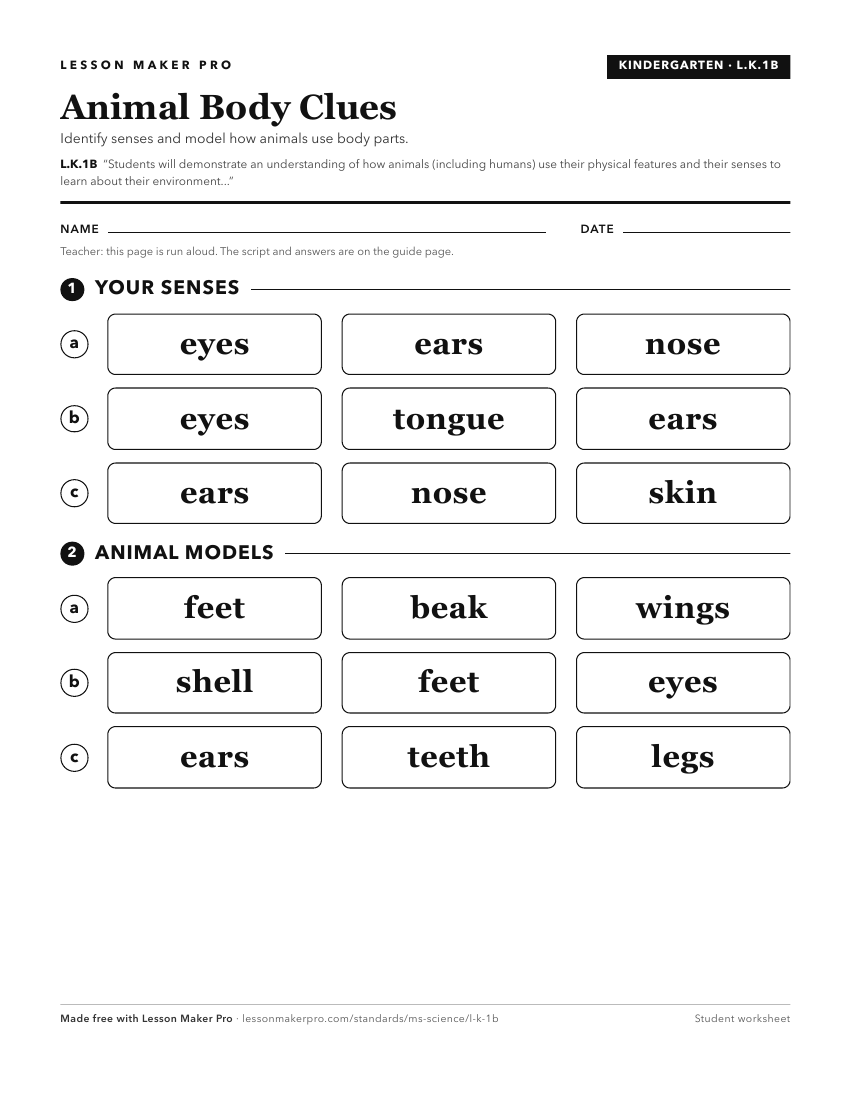
A ready-to-print activity worksheet aligned to L.K.1B, with an answer key for the teacher on its own page. No account needed.
PDF, US Letter, prints cleanly in black and white.
Download the worksheetKeep exploring
Related Standards
- L.3.4
Students will demonstrate an understanding of how adaptations allow animals to satisfy life needs and respond both physically and behaviorally to their environm...
- L.2.4
Students will demonstrate an understanding of the ways animals adapt to their environment in order to survive.
- L.K.1A
Students will demonstrate an understanding of living and non-living things.
- L.2.1
Students will demonstrate an understanding of the classification of animals based on physical characteristics.
Turn this cluster into a lesson
Grade, subject, topic, and the complete cluster are prefilled. Create one free, no account needed.
Also for this cluster:Make a WorksheetMake a QuizMake a Sub Lesson