Mississippi Science L.2.1
Standard Cluster
Students will demonstrate an understanding of the classification of animals based on physical characteristics. Compare and sort groups of animals with backbones (vertebrates) from groups of animals without backbones (invertebrates). Classify vertebrates (mammals, fish, birds, amphibians, and reptiles) based on their physical characteristics. Compare and contrast physical characteristics that distinguish between classes of vertebrates (i.e., reptiles compared to amphibians). Construct a scientific argument for classifying vertebrates that have unusual characteristics, such as bats, penguins, snakes, salamanders, dolphins, and duck-billed platypuses (i.e., bats have wings, yet they are mammals).
2026 Mississippi College- and Career-Readiness Standards for Science · Hierarchical Organization
Cluster contents
Standards in This Cluster
L.2.1 is a cluster heading. These are the individual standards under it.
- L.2.1.1
Compare and sort groups of animals with backbones (vertebrates) from groups of animals without backbones (invertebrates).
- L.2.1.2
Classify vertebrates (mammals, fish, birds, amphibians, and reptiles) based on their physical characteristics.
- L.2.1.3
Compare and contrast physical characteristics that distinguish between classes of vertebrates (i.e., reptiles compared to amphibians).
- L.2.1.4
Construct a scientific argument for classifying vertebrates that have unusual characteristics, such as bats, penguins, snakes, salamanders, dolphins, and duck-b...
Teacher's field guide
What This Cluster Means
What Students Need to Do
- Students sort animals by whether they have a backbone. They group animals with backbones as mammals, fish, birds, amphibians, or reptiles. They use body traits to explain where unusual animals belong.
What Mastery Looks Like
- Given pictures of a snail, trout, frog, snake, penguin, and bat, a student identifies the snail as having no backbone and places the others in the correct groups. They explain that a bat is a mammal because it has fur and nurses its young, even though it flies.
Common Misconceptions
- Students may call a dolphin a fish because it swims or say a penguin is not a bird because it cannot fly. They may think a snake has no backbone because it bends, or mistake a salamander for a reptile because it looks like a lizard.
How to Assess It
- Show pictures of a snail, bat, penguin, frog, snake, and trout. Ask students to circle the animal without a backbone, label the other five groups, and write why the bat is a mammal.
Lesson moves
Ways to Teach It
Give pairs animal photo cards with short trait notes, then have them sort by backbone and label the five backbone groups.
Have students answer on paper why a penguin is still a bird even though it cannot fly, using one body clue.
Play mystery animal with clue cards such as 'moist skin, backbone,' and have teams name the group before revealing the picture.
Use photos and backbone facts for a park snail, robin, and squirrel, then have students label each for a park wildlife sign.
Free download
Printable L.2.1 Worksheet
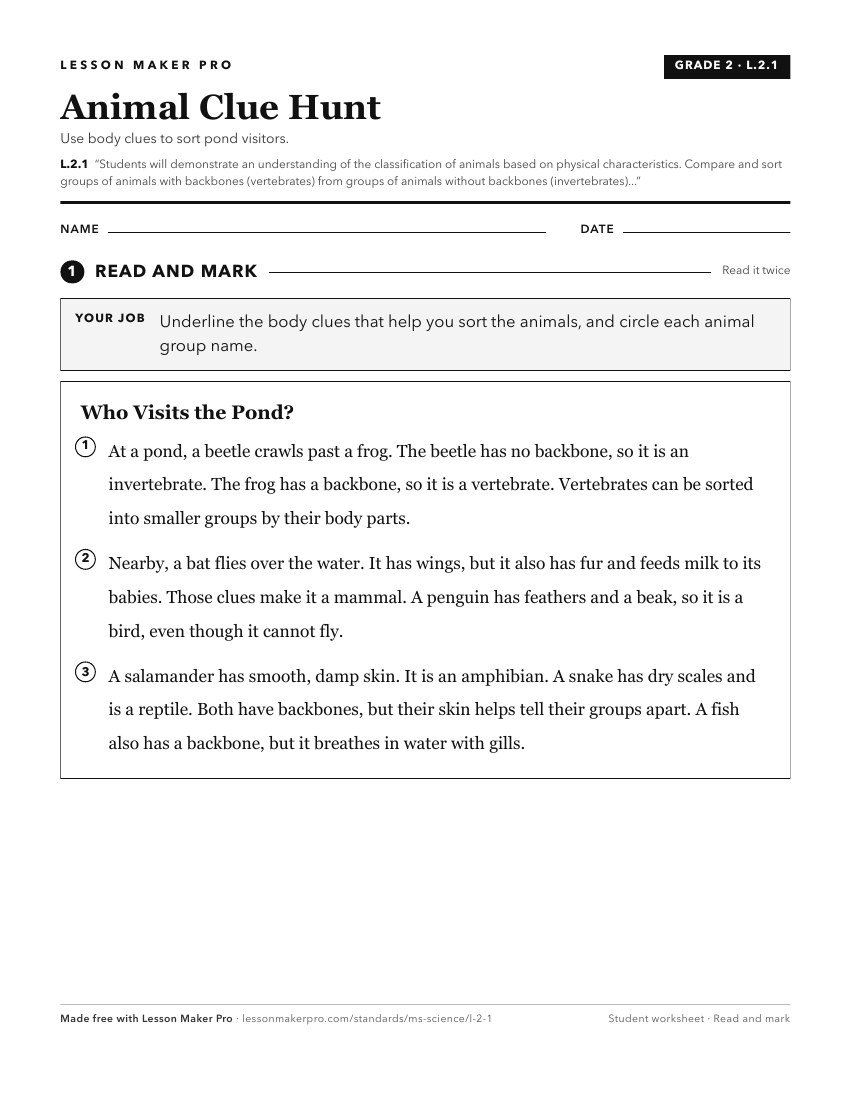
A ready-to-print activity worksheet aligned to L.2.1, with an answer key for the teacher on its own page. No account needed.
PDF, US Letter, prints cleanly in black and white.
Download the worksheetKeep exploring
Related Standards
- L.6.4
Students will demonstrate an understanding of classification tools and models such as dichotomous keys to classify representative organisms based on the charact...
- L.K.1B
Students will demonstrate an understanding of how animals (including humans) use their physical features and their senses to learn about their environment.
- BIO.1A
Students will demonstrate an understanding of the characteristics of life and biological organization.
- L.2.4
Students will demonstrate an understanding of the ways animals adapt to their environment in order to survive.
Turn this cluster into a lesson
Grade, subject, topic, and the complete cluster are prefilled. Create one free, no account needed.
Also for this cluster:Make a WorksheetMake a QuizMake a Sub Lesson