Mississippi Science L.2.1.2
The Standard
- L.2.1
- Students will demonstrate an understanding of the classification of animals based on physical characteristics.
Classify vertebrates (mammals, fish, birds, amphibians, and reptiles) based on their physical characteristics.
2026 Mississippi College- and Career-Readiness Standards for Science · Hierarchical Organization
Teacher's field guide
What This Standard Means
What Students Need to Do
- Students sort animals with backbones into five groups. They use body traits such as hair, feathers, fins and gills, moist skin, and dry scales to explain each choice.
What Mastery Looks Like
- A student sorts a bat as a mammal and a penguin as a bird, despite how they move. They use hair and feathers as evidence, then sort a frog, trout, and lizard by their body traits.
Common Misconceptions
- Students may call a bat a bird because it flies or a whale a fish because it swims. They may group frogs with reptiles because both lay eggs, rather than checking their skin.
How to Assess It
- On an exit ticket, list cat (hair), trout (fins and gills), robin (feathers), frog (moist skin), and lizard (dry scales). Have students name each animal’s group and circle the clue they used.
Lesson moves
Ways to Teach It
Hand pairs animal photo cards and trait labels; have them match each animal to a trait, then sort the pairs into five groups.
Show a penguin and a seal. Ask, “Why is one a bird and the other a mammal, even though both swim?”
Play animal clue bingo: call out “feathers” or “dry scales,” then have students cover a matching animal and name its group.
Use a pet store flyer; have students circle a fish, bird, and reptile and write one body trait for each.
Free download
Printable L.2.1.2 Worksheet
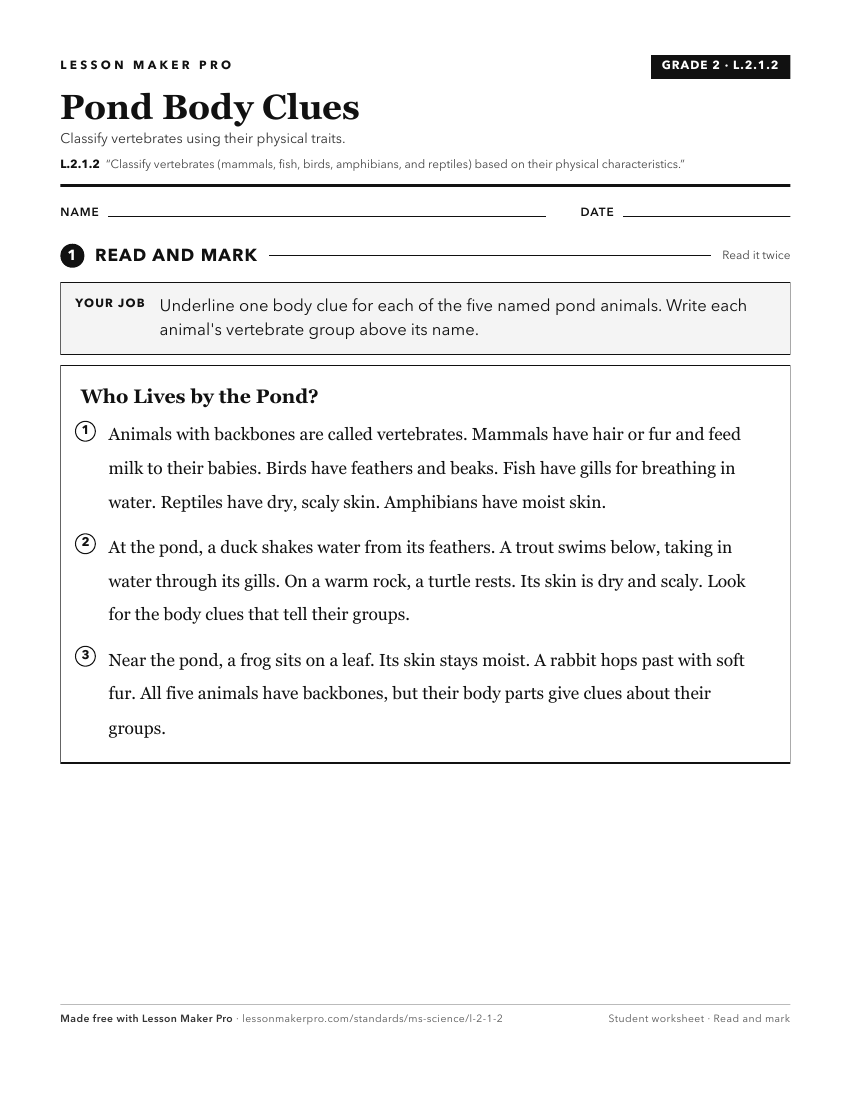
A ready-to-print activity worksheet aligned to L.2.1.2, with an answer key for the teacher on its own page. No account needed.
PDF, US Letter, prints cleanly in black and white.
Download the worksheetKeep exploring
Related Standards
- MAQ.7.1
Characterize aquatic representatives of the following taxa: Hemichordata, Urochordata, Cephalochordata, and Vertebrata (including Agnatha, Chondrichthyes, Ostei...
- L.2.1
Students will demonstrate an understanding of the classification of animals based on physical characteristics.
- L.2.1.3
Compare and contrast physical characteristics that distinguish between classes of vertebrates (i.e., reptiles compared to amphibians).
- L.2.1.4
Construct a scientific argument for classifying vertebrates that have unusual characteristics, such as bats, penguins, snakes, salamanders, dolphins, and duck-b...
Turn this exact standard into a lesson
Grade, subject, topic, and the complete standard are prefilled. Create one free, no account needed.
Also for this standard:Make a WorksheetMake a QuizMake a Sub Lesson