Mississippi Science MAQ.7.1
The Standard
- MAQ.7
- Students will investigate characteristics of aquatic chordates.
Characterize aquatic representatives of the following taxa: Hemichordata, Urochordata, Cephalochordata, and Vertebrata (including Agnatha, Chondrichthyes, Osteichthyes, Amphibia, Reptilia, Aves, and Mammalia).
2026 Mississippi College- and Career-Readiness Standards for Science · Vertebrate Consumers
Teacher's field guide
What This Standard Means
What Students Need to Do
- Students identify acorn worms, sea squirts, lancelets, and vertebrates by their body structures. They sort aquatic vertebrates into jawless fish, cartilaginous fish, bony fish, amphibians, reptiles, birds, and mammals, then explain their choices.
What Mastery Looks Like
- A student can explain that an acorn worm lacks a notochord, a sea squirt larva has one in its tail, and a lancelet keeps one throughout life. They can place lampreys, sharks, salmon, frogs, sea turtles, penguins, and seals in the right groups and name a supporting trait.
Common Misconceptions
- Students may call an acorn worm a chordate because it has gill slits, even though it lacks a notochord. They may miss the sea squirt's larval notochord because adults lack a tail. They may call penguins and seals fish because they swim, or classify sharks as bony fish.
How to Assess It
- Give students photos of an acorn worm, sea squirt larva, lancelet, lamprey, shark, salmon, frog, sea turtle, penguin, and seal. Have them name each group and write one trait that supports each choice.
Lesson moves
Ways to Teach It
Sort printed acorn worm, sea squirt, lancelet, lamprey, shark, salmon, frog, sea turtle, penguin, and seal photos using trait cards.
Write two sentences explaining why a sea squirt larva belongs with lancelets but an acorn worm does not; name the body part.
Play Name That Vertebrate: read a clue such as 'jaws and a cartilage skeleton,' then have teams name the group and an animal.
Print aquarium species pages for shark, salmon, sea turtle, and seal; mark which animals breathe air and which use gills.
Free download
Printable MAQ.7.1 Worksheet
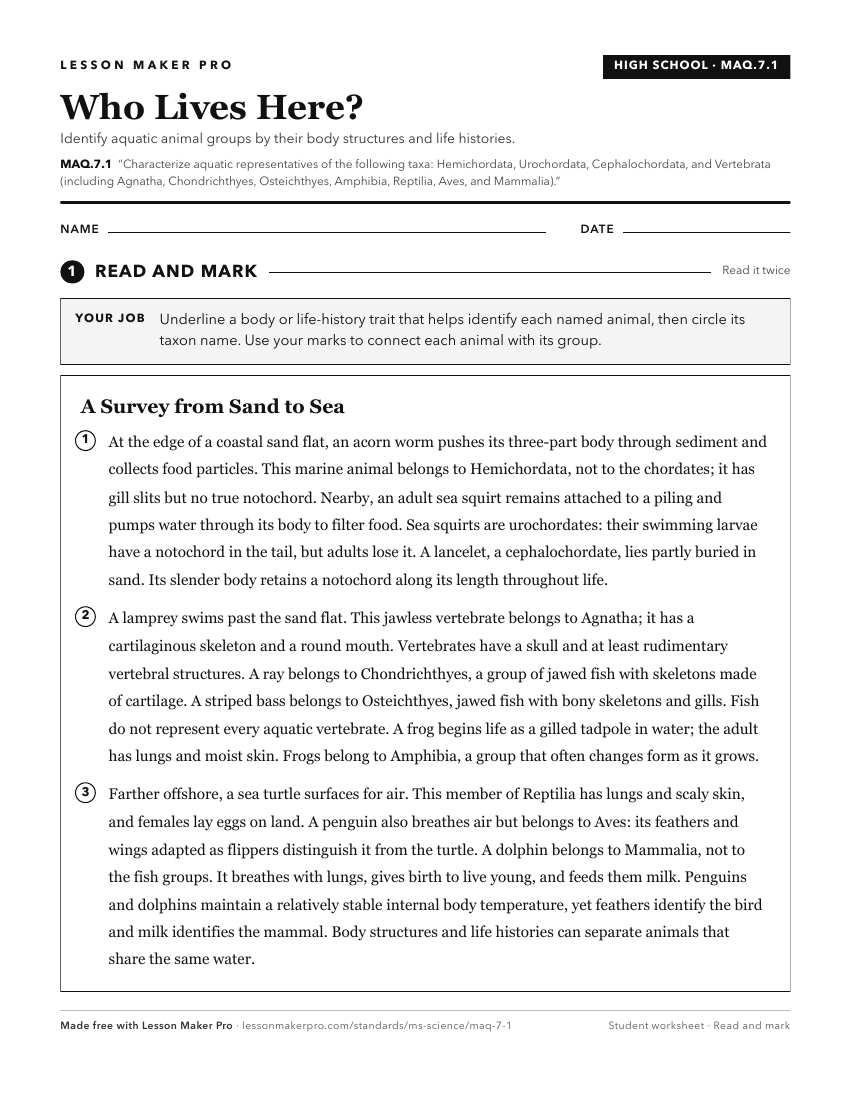
A ready-to-print activity worksheet aligned to MAQ.7.1, with an answer key for the teacher on its own page. No account needed.
PDF, US Letter, prints cleanly in black and white.
Download the worksheetKeep exploring
Related Standards
- MAQ.7
Students will investigate characteristics of aquatic chordates.
- L.2.1.2
Classify vertebrates (mammals, fish, birds, amphibians, and reptiles) based on their physical characteristics.
- MAQ.6.1
Characterize aquatic representatives of the following taxa: Protozoa (e.g., foraminiferans, radiolarians, amoeba, and paramecium), Porifera, Cnidaria, Platyhelm...
- ZOO.8
Students will understand the structure and function of phylum Chordata, classes Amphibia and Reptilia, and how they demonstrate the characteristics of living th...
Turn this exact standard into a lesson
Grade, subject, topic, and the complete standard are prefilled. Create one free, no account needed.
Also for this standard:Make a WorksheetMake a QuizMake a Sub Lesson