Mississippi Science MAQ.6.1
The Standard
- MAQ.6
- Students will investigate characteristics of aquatic invertebrates.
Characterize aquatic representatives of the following taxa: Protozoa (e.g., foraminiferans, radiolarians, amoeba, and paramecium), Porifera, Cnidaria, Platyhelminthes, Nematoda, Annelida, Rotifera, Mollusca, Arthropoda, Bryozoa, Brachiopoda, and Echinodermata.
2026 Mississippi College- and Career-Readiness Standards for Science · Invertebrate Consumers
Teacher's field guide
What This Standard Means
What Students Need to Do
- Students describe aquatic organisms by features they can observe, such as body shape, symmetry, segments, shells, and feeding parts. They use those features to place single-celled consumers and invertebrates in the correct groups.
What Mastery Looks Like
- Given photos or specimens, students can name the group for each organism and point to a feature that supports their choice. They can tell a segmented worm from a roundworm and a clam from a brachiopod.
Common Misconceptions
- Students may call every shelled animal a mollusk, including brachiopods. They may mistake coral for a plant or put all aquatic worms in one group.
How to Assess It
- Show sketches of a roundworm, a segmented marine worm, a clam, a brachiopod, coral, and a bryozoan colony. Ask students to name each group and write one difference for each pair.
Lesson moves
Ways to Teach It
Give pairs organism photo cards to sort by symmetry, segmentation, shells, and other visible features, then have them explain two choices.
Show clam and brachiopod shell diagrams and ask students to write where the line of symmetry runs on each.
Run a matching relay in which students pair twelve organism photos with group names and trait cards.
Show photos from an oyster cage and have students identify a barnacle, sponge, and bryozoan by visible clues.
Free download
Printable MAQ.6.1 Worksheet
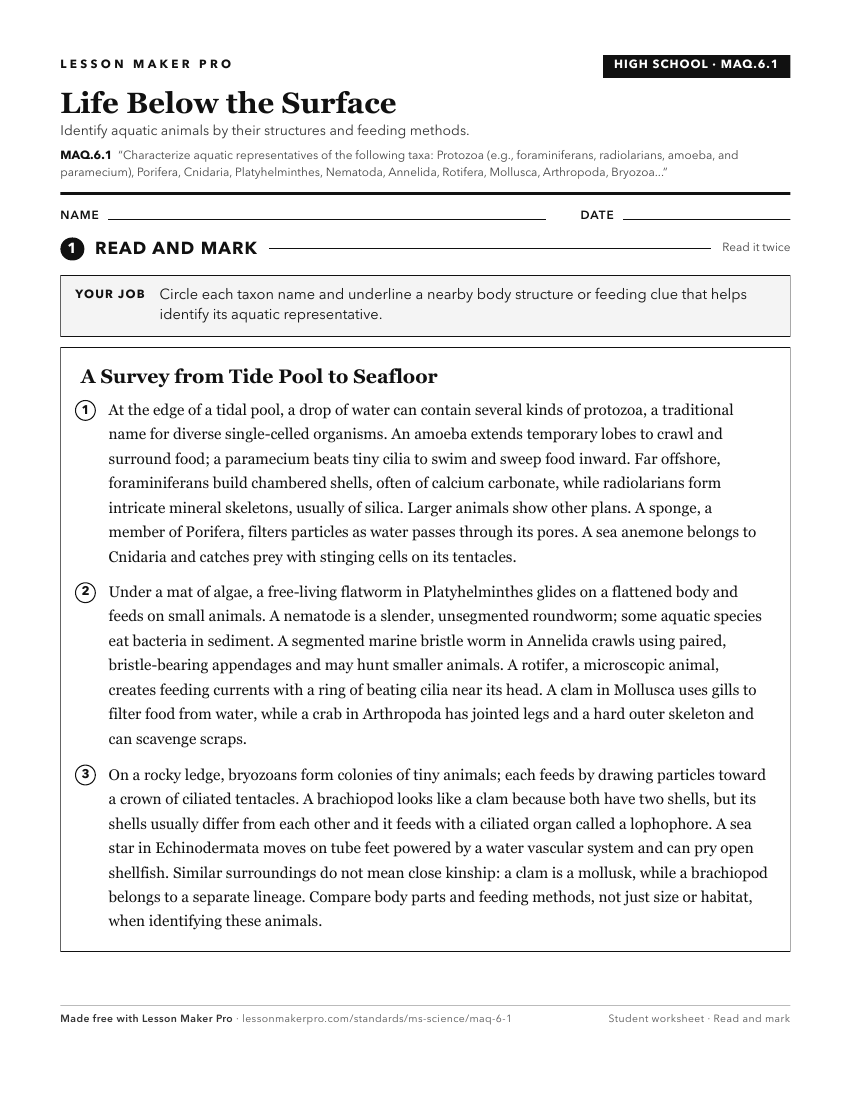
A ready-to-print activity worksheet aligned to MAQ.6.1, with an answer key for the teacher on its own page. No account needed.
PDF, US Letter, prints cleanly in black and white.
Download the worksheetKeep exploring
Related Standards
- MAQ.6.6
Dissect representative taxa (e.g., clam and squid), collect data, compare their internal and external anatomy, analyze, explain, and communicate results.
- MAQ.7.1
Characterize aquatic representatives of the following taxa: Hemichordata, Urochordata, Cephalochordata, and Vertebrata (including Agnatha, Chondrichthyes, Ostei...
- MAQ.5.2
List and describe common autotrophs that may be found in particular aquatic ecosystems, including prokaryotes (e.g., Cyanobacteria and Archaebacteria), protists...
- ZOO.4
Students will describe the evolution of structure and function of phylum Platyhelminthes, phylum Nematoda, and phylum Annelida.
Turn this exact standard into a lesson
Grade, subject, topic, and the complete standard are prefilled. Create one free, no account needed.
Also for this standard:Make a WorksheetMake a QuizMake a Sub Lesson