Mississippi Science MAQ.5.2
The Standard
- MAQ.5
- Students will explore the biodiversity and interactions among aquatic life.
List and describe common autotrophs that may be found in particular aquatic ecosystems, including prokaryotes (e.g., Cyanobacteria and Archaebacteria), protists (e.g., diatoms, dinoflagellates, green algae, kelp, sargassum, and red algae), and plants (e.g., cord grasses, reeds, seagrasses, and mangroves).
2026 Mississippi College- and Career-Readiness Standards for Science · Primary Producers
Teacher's field guide
What This Standard Means
What Students Need to Do
- Students name producers found in open water, salt marshes, rocky shores, and shallow coastal waters. They sort cyanobacteria and archaea, algae, and flowering plants into groups. They describe where each lives and whether it uses sunlight or chemical energy.
What Mastery Looks Like
- A student can place diatoms in plankton, cordgrass in salt marshes, kelp on rocky coasts, and seagrass in shallow coastal water. They can explain why seagrass is a flowering plant but kelp is an alga. They know some archaea make food using chemical energy.
Common Misconceptions
- Students may call kelp and seagrass the same kind of plant because both grow underwater. They may think every producer needs sunlight, overlooking archaea that use chemical energy.
How to Assess It
- Exit ticket: For a diatom, seagrass, and an ammonia-oxidizing archaeon, name each group, one likely habitat, and its energy source.
Lesson moves
Ways to Teach It
Give pairs organism cards for ammonia-oxidizing archaea, cyanobacteria, diatoms, kelp, seagrass, and mangroves to sort by group and habitat.
Ask students: Why is seagrass a flowering plant while kelp is an alga, even though both grow underwater?
Play habitat match with cordgrass, diatom, kelp, and mangrove cards against four matching ecosystem cards.
Read a printed cyanobacteria bloom warning, circle the affected water body, and explain why swimming is restricted.
Free download
Printable MAQ.5.2 Worksheet
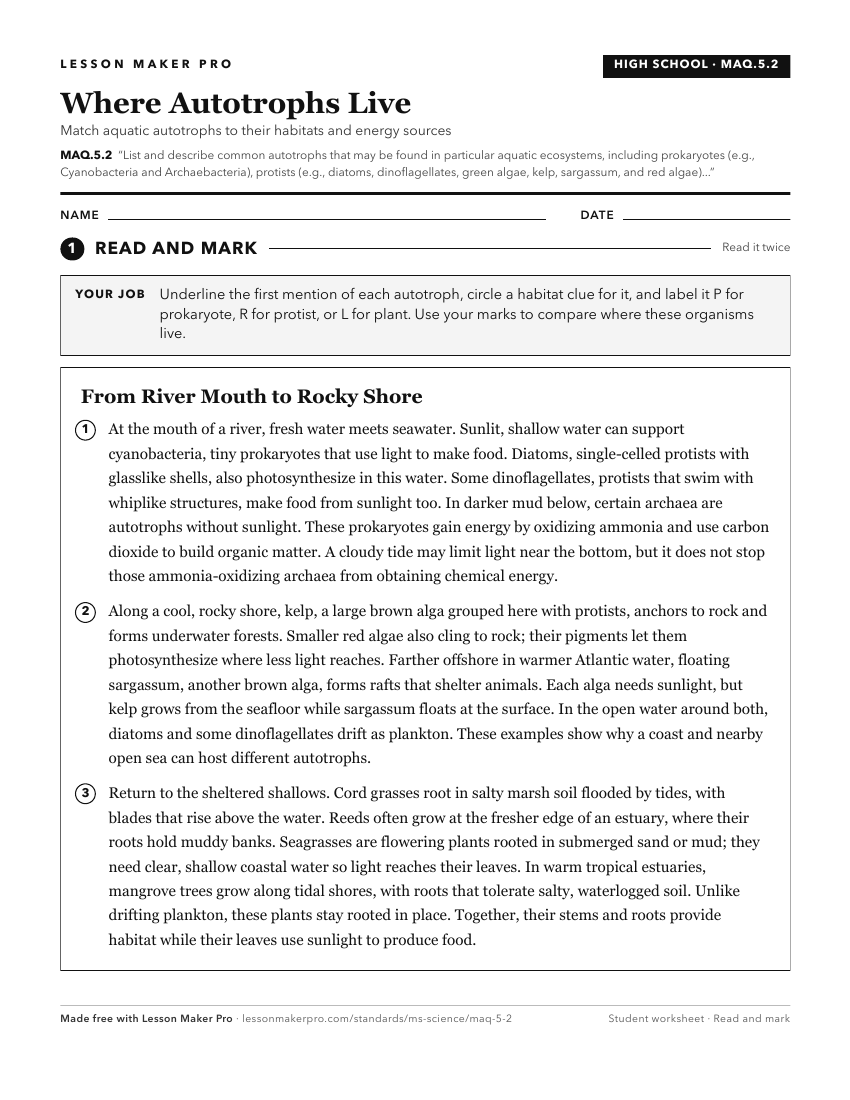
A ready-to-print activity worksheet aligned to MAQ.5.2, with an answer key for the teacher on its own page. No account needed.
PDF, US Letter, prints cleanly in black and white.
Download the worksheetKeep exploring
Related Standards
- MAQ.4.1
Compare and contrast the unique biotic and abiotic characteristics of the following selected aquatic ecosystems: intertidal zone, wetlands/estuaries, coral reef...
- MAQ.5.1
Survey common primary producers and their roles in primary production in relation to geographical distribution within various aquatic ecosystems.
- MAQ.6.1
Characterize aquatic representatives of the following taxa: Protozoa (e.g., foraminiferans, radiolarians, amoeba, and paramecium), Porifera, Cnidaria, Platyhelm...
- MAQ.4.2
Recognize representative examples of plants and animals that would be specifically adapted to the aquatic ecosystems and identify adaptations necessary to survi...
Turn this exact standard into a lesson
Grade, subject, topic, and the complete standard are prefilled. Create one free, no account needed.
Also for this standard:Make a WorksheetMake a QuizMake a Sub Lesson