Mississippi Science MAQ.5.1
The Standard
- MAQ.5
- Students will explore the biodiversity and interactions among aquatic life.
Survey common primary producers and their roles in primary production in relation to geographical distribution within various aquatic ecosystems.
2026 Mississippi College- and Career-Readiness Standards for Science · Primary Producers
Teacher's field guide
What This Standard Means
What Students Need to Do
- Students identify phytoplankton, seaweeds, seagrasses, and freshwater plants as producers. They locate where these organisms grow and explain how they use sunlight to make biomass that supports food webs.
What Mastery Looks Like
- Given a habitat map, students place kelp on cool rocky coasts, seagrass in shallow coastal water, and duckweed in freshwater. They explain where phytoplankton grow and use light, nutrients, and salinity to defend their choices.
Common Misconceptions
- Students may think all plankton are producers, even though zooplankton eat other organisms. They may place kelp in deep water or duckweed in saltwater, overlooking light and salinity.
How to Assess It
- Exit ticket: Place kelp, seagrass, and duckweed on a map showing a rocky coast, a shallow saltwater bay, and a freshwater pond. Name one condition each needs to grow.
Lesson moves
Ways to Teach It
Give groups a printed habitat map and producer cards; have them place each card and mark the light or salinity clue they used.
Ask students to compare a sunny, nutrient-rich coastal bay with deep offshore water: Where could producers grow, and why?
Play habitat match: read a location card aloud, then students hold up a producer card and explain their choice.
Show a photo of algae in a nearby pond; students draw arrows from algae to insect larvae to fish.
Free download
Printable MAQ.5.1 Worksheet
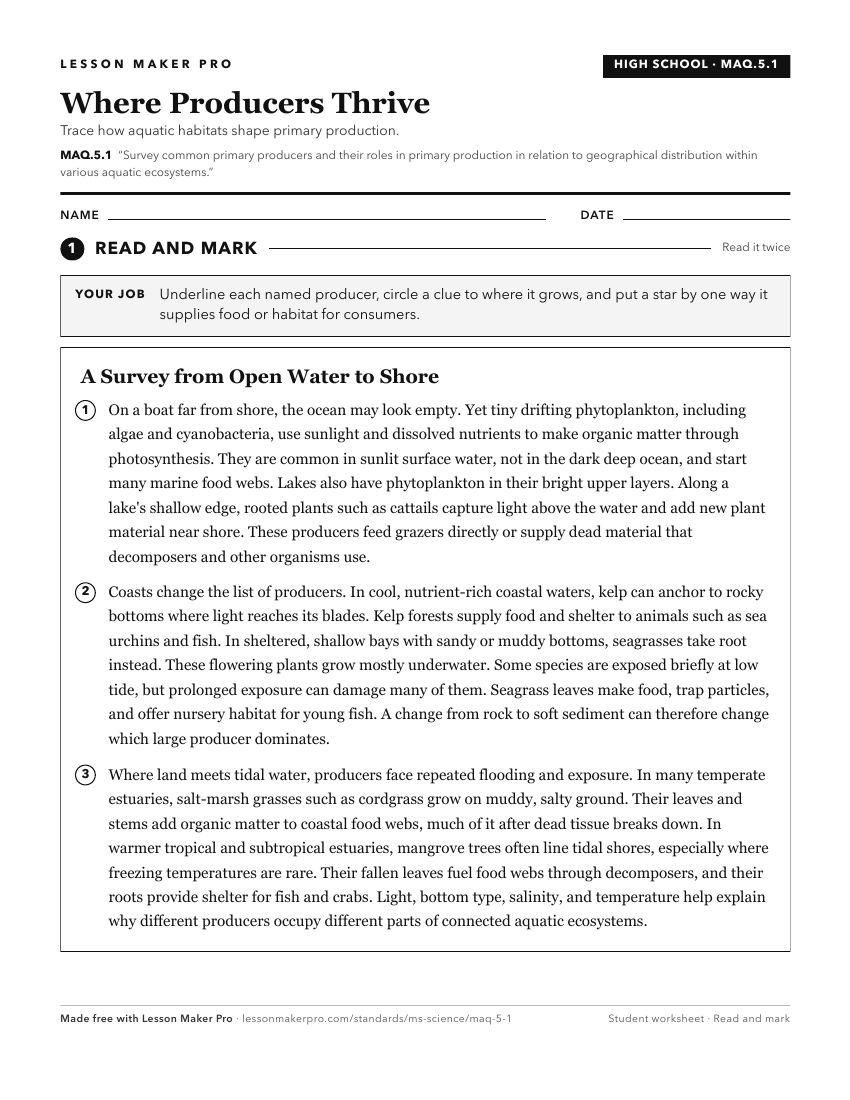
A ready-to-print activity worksheet aligned to MAQ.5.1, with an answer key for the teacher on its own page. No account needed.
PDF, US Letter, prints cleanly in black and white.
Download the worksheetKeep exploring
Related Standards
- L.5.3B
Students will demonstrate an understanding of a healthy ecosystem with a stable web of life and the roles of living things within a food chain and/or food web, ...
- MAQ.5.2
List and describe common autotrophs that may be found in particular aquatic ecosystems, including prokaryotes (e.g., Cyanobacteria and Archaebacteria), protists...
- MAQ.5.4
Use dichotomous keys to identify sample producers within an aquatic ecosystem.
- MAQ.7.6
Using key morphological and physiological adaptations found within aquatic vertebrate taxa, assess how animals interact with their environment to determine thei...
Turn this exact standard into a lesson
Grade, subject, topic, and the complete standard are prefilled. Create one free, no account needed.
Also for this standard:Make a WorksheetMake a QuizMake a Sub Lesson