Mississippi Science ZOO.4
Standard Cluster
Students will describe the evolution of structure and function of phylum Platyhelminthes, phylum Nematoda, and phylum Annelida. Define and describe the closed circulatory system of an annelid. Differentiate between parasitic and free living. Compare and contrast the characteristics and lifestyles of flatworms, roundworms, and segmented worms. Create a model comparing acoelomate, pseudocoelomate, and eucoelomate body plans of Platyhelminthes, Nematoda, and Annelida. Describe the evolutionary importance of the segmented body plans of annelids. Dissect representative taxa and compare their internal and external anatomy and complexity. Enrichment: Design, conduct, and communicate results of an experiment demonstrating the importance of flatworms, roundworms, and annelids for human use (e.g., the earthworm in agriculture and the leech in medicine). Enrichment: Use an engineering design process to design and construct a system to utilize flatworms, roundworms, or annelids to meet a human need. *
2026 Mississippi College- and Career-Readiness Standards for Science · Phyla Platyhelminthes, Nematoda, and Annelida
Cluster contents
Standards in This Cluster
ZOO.4 is a cluster heading. These are the individual standards under it.
- ZOO.4.1
Define and describe the closed circulatory system of an annelid.
- ZOO.4.2
Differentiate between parasitic and free living.
- ZOO.4.3
Compare and contrast the characteristics and lifestyles of flatworms, roundworms, and segmented worms.
- ZOO.4.4
Create a model comparing acoelomate, pseudocoelomate, and eucoelomate body plans of Platyhelminthes, Nematoda, and Annelida.
- ZOO.4.5
Describe the evolutionary importance of the segmented body plans of annelids.
- ZOO.4.6
Dissect representative taxa and compare their internal and external anatomy and complexity.
- ZOO.4.7
Enrichment: Design, conduct, and communicate results of an experiment demonstrating the importance of flatworms, roundworms, and annelids for human use (e.g., t...
- ZOO.4.8
Enrichment: Use an engineering design process to design and construct a system to utilize flatworms, roundworms, or annelids to meet a human need. *
Teacher's field guide
What This Cluster Means
What Students Need to Do
- Students compare flatworms, roundworms, and segmented worms by body cavity, segments, and lifestyle. They distinguish parasites from free-living worms and explain how blood stays inside an earthworm’s vessels. They build body-plan models and compare structures in an earthworm dissection.
What Mastery Looks Like
- A student can identify each worm group from a body diagram and explain why a tapeworm is parasitic but a planarian is free-living. They can point out the gut, segments, and blood vessels in an earthworm dissection. They can explain how segments help it move.
Common Misconceptions
- Students may think all worms are parasites or that all worms have the same body cavity. They may think an earthworm’s blood flows freely around its organs instead of staying in vessels. Some see segments as surface markings rather than parts that help control movement.
How to Assess It
- On an exit ticket, have students label three worm cross sections as having no body cavity, a partly lined cavity, or a fully lined cavity. Ask where an earthworm’s blood flows.
Lesson moves
Ways to Teach It
Make clay cross sections with a straw gut and colored dough layers to show no cavity, a partly lined cavity, and a fully lined cavity.
Ask pairs, “How do segments and circular muscles help an earthworm move differently from a roundworm?”
Give teams planarian, tapeworm, pinworm, free-living nematode, and earthworm cards; award points for correct body plan and lifestyle labels.
Fill two clear jars with equal soil, add an earthworm to one, and compare tunnels the next day to discuss garden soil.
Free download
Printable ZOO.4 Worksheet
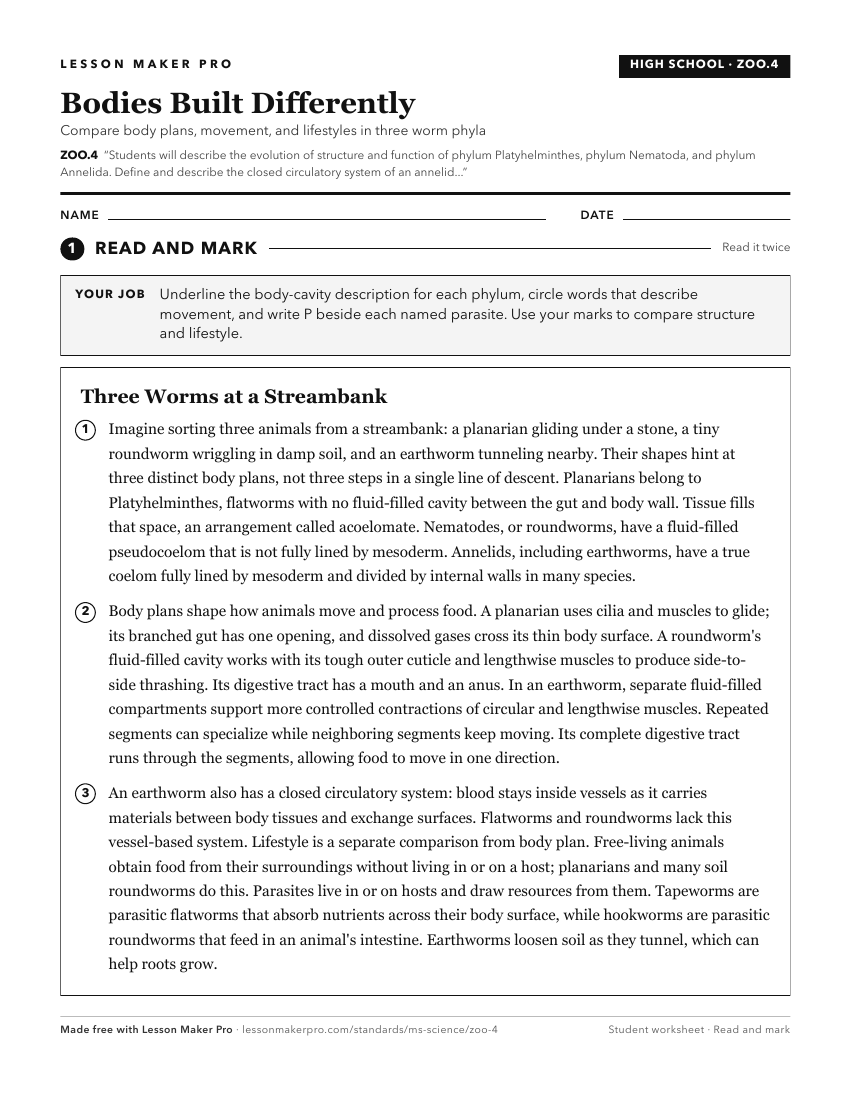
A ready-to-print activity worksheet aligned to ZOO.4, with an answer key for the teacher on its own page. No account needed.
PDF, US Letter, prints cleanly in black and white.
Download the worksheetKeep exploring
Related Standards
- ZOO.3
Students will understand the structure and function of phylum Mollusca, and how they adapt to their environments.
- ZOO.6
Students will understand the structure and function of phylum Echinodermata, and how they demonstrate the characteristics of living things.
- ZOO.5
Students will understand the basic structure and function of phylum Arthropoda, and how they demonstrate the characteristics of living things.
Turn this cluster into a lesson
Grade, subject, topic, and the complete cluster are prefilled. Create one free, no account needed.
Also for this cluster:Make a WorksheetMake a QuizMake a Sub Lesson