Mississippi Science ZOO.6
Standard Cluster
Students will understand the structure and function of phylum Echinodermata, and how they demonstrate the characteristics of living things. Recognize that the echinoderms have spines on their skin that are extensions of plates that form from the endoskeleton. Explain how the starfish inverts its stomach for external digestion of food. Describe sea urchins’ and sea cucumbers’ defense structures and behaviors. Describe the sexual and asexual reproduction of starfish. Describe how the water vascular system is used for locomotion, feeding, and gas exchange. Research, analyze, and communicate implications of applying the regeneration of starfish to human medicine. Dissect representative taxa and compare their internal and external anatomy and complexity. Enrichment: Use an engineering design process to model the water vascular system in hydraulic systems to meet a societal need. *
2026 Mississippi College- and Career-Readiness Standards for Science · Phylum Echinodermata
Cluster contents
Standards in This Cluster
ZOO.6 is a cluster heading. These are the individual standards under it.
- ZOO.6.1
Recognize that the echinoderms have spines on their skin that are extensions of plates that form from the endoskeleton.
- ZOO.6.2
Explain how the starfish inverts its stomach for external digestion of food.
- ZOO.6.3
Describe sea urchins’ and sea cucumbers’ defense structures and behaviors.
- ZOO.6.4
Describe the sexual and asexual reproduction of starfish.
- ZOO.6.5
Describe how the water vascular system is used for locomotion, feeding, and gas exchange.
- ZOO.6.6
Research, analyze, and communicate implications of applying the regeneration of starfish to human medicine.
- ZOO.6.7
Dissect representative taxa and compare their internal and external anatomy and complexity.
- ZOO.6.8
Enrichment: Use an engineering design process to model the water vascular system in hydraulic systems to meet a societal need. *
Teacher's field guide
What This Cluster Means
What Students Need to Do
- Students identify the skeletal plates, spines, and tube feet of echinoderms. They explain how sea stars feed, move, exchange gases, and reproduce. They compare urchin and sea cucumber defenses and examine what sea star regrowth might mean for medicine.
What Mastery Looks Like
- A student can label those structures on a dissection sketch and explain how water pressure moves tube feet. They can describe a sea star turning its stomach out onto prey, and distinguish spawning from body division followed by regrowth. They can compare urchin spines with sea cucumber evisceration and explain why human regrowth may differ.
Common Misconceptions
- Students may think spines are attached to an outer shell rather than skeletal plates beneath the skin. They may think tube feet are ordinary legs or that sea stars swallow prey before digesting it. They may assume every lost arm grows into a new sea star, though many species need part of the central disc.
How to Assess It
- Give students a sea star diagram. Ask them to label a plate, spine, tube foot, and stomach, then explain how tube feet move the animal and how its stomach feeds.
Lesson moves
Ways to Teach It
Dissect a preserved sea star and sea urchin, then draw their internal organs and compare their plates, spines, and tube feet.
Read two short research summaries on sea star regrowth, then write one possible medical use and one reason human results might differ.
Play a card match: pair spawning, fission, spines, evisceration, stomach eversion, and tube feet with their functions; allow multiple matches.
Build a litter grabber with two water-filled syringes, tubing, and cardboard jaws, then compare its movement with sea star tube feet.
Free download
Printable ZOO.6 Worksheet
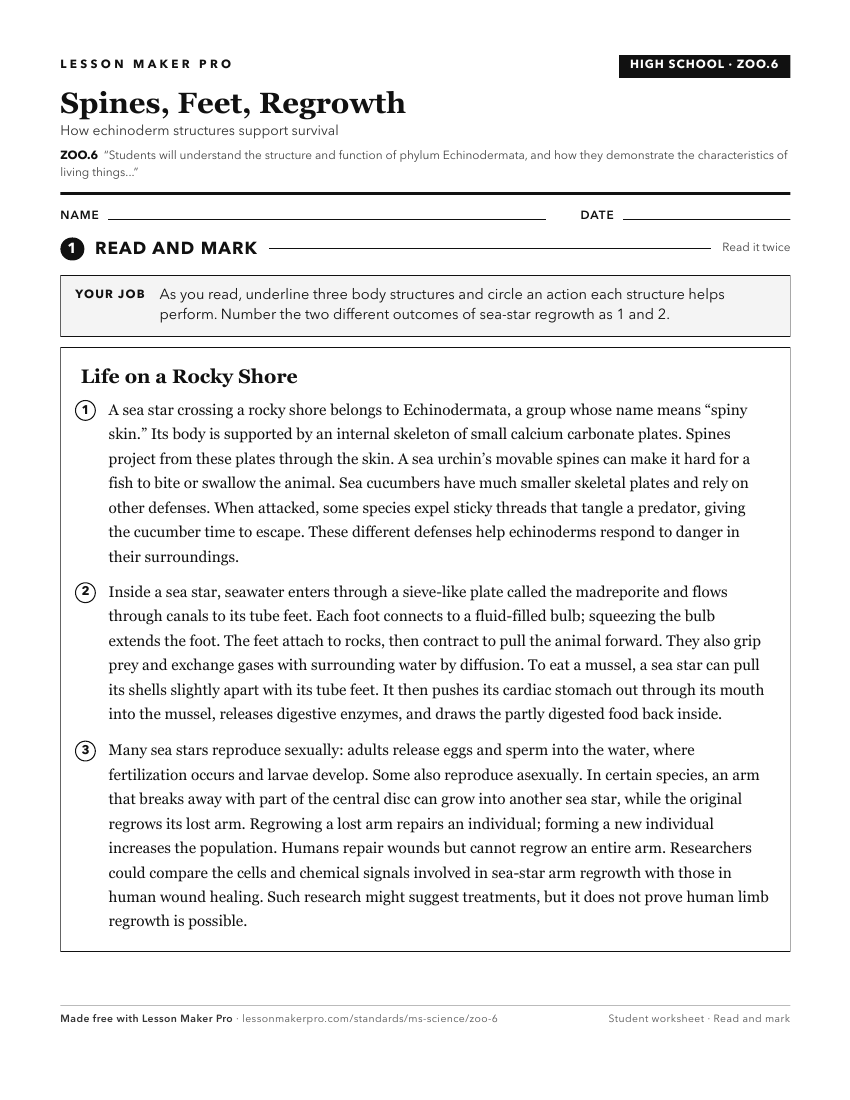
A ready-to-print activity worksheet aligned to ZOO.6, with an answer key for the teacher on its own page. No account needed.
PDF, US Letter, prints cleanly in black and white.
Download the worksheetKeep exploring
Related Standards
- ZOO.7
Students will understand the structure and function of phylum Chordata, classes Chondrichthyes and Osteichthyes, and how they demonstrate the characteristics of...
- ZOO.10
Students will understand the structure and function of phylum Chordata, class Mammalia, and how they demonstrate the characteristics of living things.
- ZOO.9
Students will understand the structure and function of phylum Chordata, class Aves, and how they demonstrate the characteristics of living things.
- ZOO.5
Students will understand the basic structure and function of phylum Arthropoda, and how they demonstrate the characteristics of living things.
Turn this cluster into a lesson
Grade, subject, topic, and the complete cluster are prefilled. Create one free, no account needed.
Also for this cluster:Make a WorksheetMake a QuizMake a Sub Lesson