Mississippi Science ZOO.5
Standard Cluster
Students will understand the basic structure and function of phylum Arthropoda, and how they demonstrate the characteristics of living things. Describe the evolutionary advantages of segmented bodies, hard exoskeletons, and jointed appendages to arthropods and how they contribute to arthropods being the largest phyla in species diversity and the most geographically diverse. Explain how exoskeletons are used in locomotion, protection, and development. Enrichment: Use an engineering design process to develop a biomimicry of an arthropod’s exoskeleton to meet a human need. * Identify organisms and characteristics of chelicerates, crustaceans, and insects. Describe the importance of toxins for arachnids, (i.e., spiders and scorpions). Describe the importance of chela for decapods, (i.e., lobsters and crabs). Differentiate between complete and incomplete metamorphosis in insects’ life cycles. Explain the importance of eusociality in insects, such as ants, bees, and termites. Dissect representative taxa and compare their internal and external anatomy and complexity.
2026 Mississippi College- and Career-Readiness Standards for Science · Phylum Arthropoda
Cluster contents
Standards in This Cluster
ZOO.5 is a cluster heading. These are the individual standards under it.
- ZOO.5.1
Describe the evolutionary advantages of segmented bodies, hard exoskeletons, and jointed appendages to arthropods and how they contribute to arthropods being th...
- ZOO.5.2
Explain how exoskeletons are used in locomotion, protection, and development.
- ZOO.5.3
Enrichment: Use an engineering design process to develop a biomimicry of an arthropod’s exoskeleton to meet a human need. *
- ZOO.5.4
Identify organisms and characteristics of chelicerates, crustaceans, and insects.
- ZOO.5.5
Describe the importance of toxins for arachnids, (i.e., spiders and scorpions).
- ZOO.5.6
Describe the importance of chela for decapods, (i.e., lobsters and crabs).
- ZOO.5.7
Differentiate between complete and incomplete metamorphosis in insects’ life cycles.
- ZOO.5.8
Explain the importance of eusociality in insects, such as ants, bees, and termites.
- ZOO.5.9
Dissect representative taxa and compare their internal and external anatomy and complexity.
Teacher's field guide
What This Cluster Means
What Students Need to Do
- Students sort insects, crustaceans, and chelicerates by legs and body parts. They explain how segments, jointed appendages, and hard outer skeletons help arthropods move, stay safe, and live in many habitats. They compare insect life cycles and explain how molting, venom, claws, and colony roles help different arthropods survive.
What Mastery Looks Like
- Students identify a spider, crab, and beetle from visible body parts and explain how each uses its appendages. They compare crayfish gills with grasshopper air tubes and explain why both animals molt. They distinguish beetle and grasshopper life cycles from stage cards and describe how worker bees support a colony.
Common Misconceptions
- Students may call spiders insects because both have legs. They may think an outer skeleton stretches as an animal grows or that a grasshopper forms a pupa. Some think spiders use venom only for defense, though many also use it to catch prey.
How to Assess It
- For an exit ticket, show pictures of a spider, crab, and beetle beside beetle and grasshopper life cycle diagrams. Ask students to name each animal's group, explain why the crab molts, and circle the life cycle with a pupa.
Lesson moves
Ways to Teach It
Dissect a preserved crayfish and grasshopper; sketch their legs, body segments, breathing structures, and digestive organs side by side.
Ask, 'How do spider venom, crab claws, and worker bee roles help survival?' Have pairs support answers with pictures of each animal.
Sort spider, crab, beetle, and grasshopper photo cards by body parts, then sequence beetle and grasshopper life stage cards.
Sketch a bike knee guard based on pill bug plates; label where hard panels block impact and gaps allow bending.
Free download
Printable ZOO.5 Worksheet
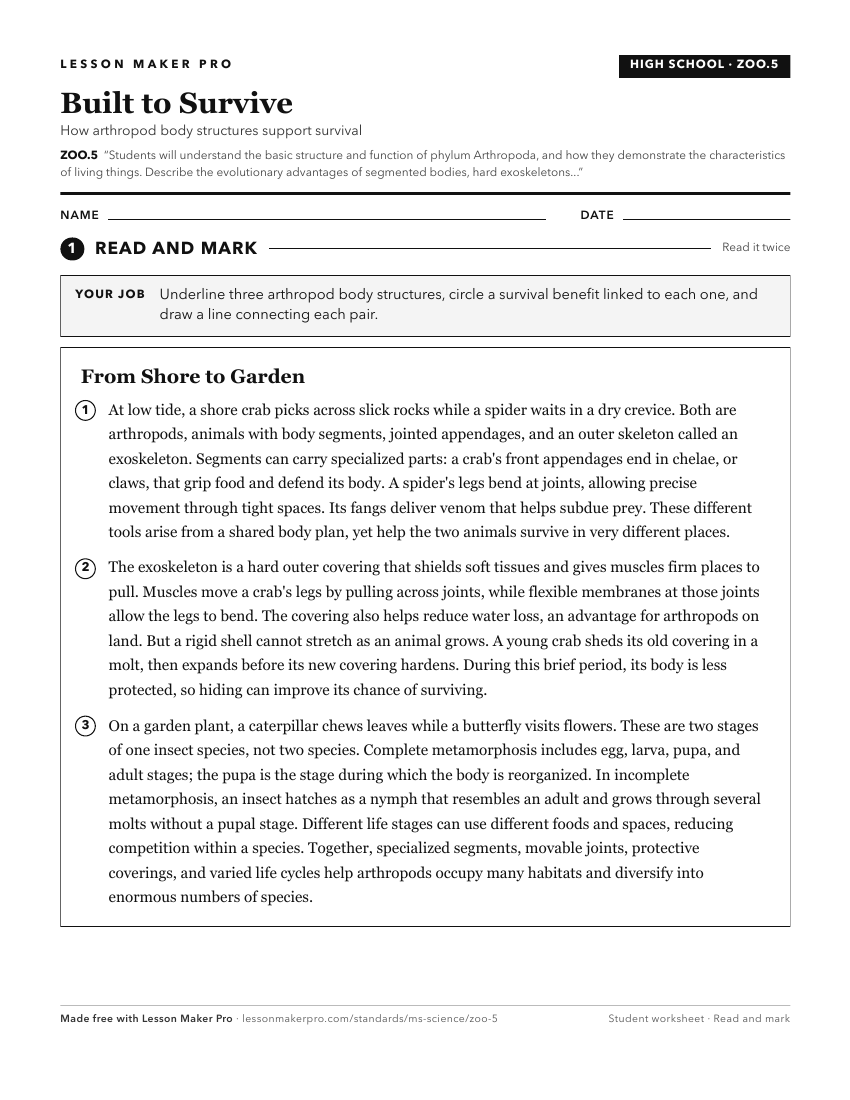
A ready-to-print activity worksheet aligned to ZOO.5, with an answer key for the teacher on its own page. No account needed.
PDF, US Letter, prints cleanly in black and white.
Download the worksheetKeep exploring
Related Standards
- ZOO.10
Students will understand the structure and function of phylum Chordata, class Mammalia, and how they demonstrate the characteristics of living things.
- ZOO.8
Students will understand the structure and function of phylum Chordata, classes Amphibia and Reptilia, and how they demonstrate the characteristics of living th...
- ZOO.9
Students will understand the structure and function of phylum Chordata, class Aves, and how they demonstrate the characteristics of living things.
- ZOO.6
Students will understand the structure and function of phylum Echinodermata, and how they demonstrate the characteristics of living things.
Turn this cluster into a lesson
Grade, subject, topic, and the complete cluster are prefilled. Create one free, no account needed.
Also for this cluster:Make a WorksheetMake a QuizMake a Sub Lesson