Mississippi Science ZOO.5.1
The Standard
- ZOO.5
- Students will understand the basic structure and function of phylum Arthropoda, and how they demonstrate the characteristics of living things.
Describe the evolutionary advantages of segmented bodies, hard exoskeletons, and jointed appendages to arthropods and how they contribute to arthropods being the largest phyla in species diversity and the most geographically diverse.
2026 Mississippi College- and Career-Readiness Standards for Science · Phylum Arthropoda
Teacher's field guide
What This Standard Means
What Students Need to Do
- Students explain how body segments allow different parts to do different jobs, how an exoskeleton protects the body and slows water loss, and how jointed appendages help with movement and feeding. They connect these advantages to the many habitats arthropods occupy and the many species in the group.
What Mastery Looks Like
- Given diagrams of a crab and a beetle, a student can point to each feature and explain how it helps that animal survive. They can explain how different uses of these features help arthropods live in many places and use different food sources.
Common Misconceptions
- Students may think an exoskeleton grows with the animal instead of being shed during molting. They may think jointed appendages are only walking legs, overlooking claws, antennae, and mouthparts. They may also assume every body segment has the same job.
How to Assess It
- Show diagrams of a beetle and a crab. Ask: "How do body segments, exoskeletons, and jointed appendages help each animal survive, and how might those advantages help arthropods live in many habitats?"
Lesson moves
Ways to Teach It
Build a paper beetle with three body sections, brass-fastener legs, and foil plates; test its bends and drip water on the plates.
Compare a crab and a butterfly: how do their appendages help them feed and move in different habitats?
Sort photos of spiders, crabs, and beetles by appendage function, then match each animal to a habitat card.
Use photos of a house cockroach and a pond beetle to explain how their legs help each live in its habitat.
Free download
Printable ZOO.5.1 Worksheet
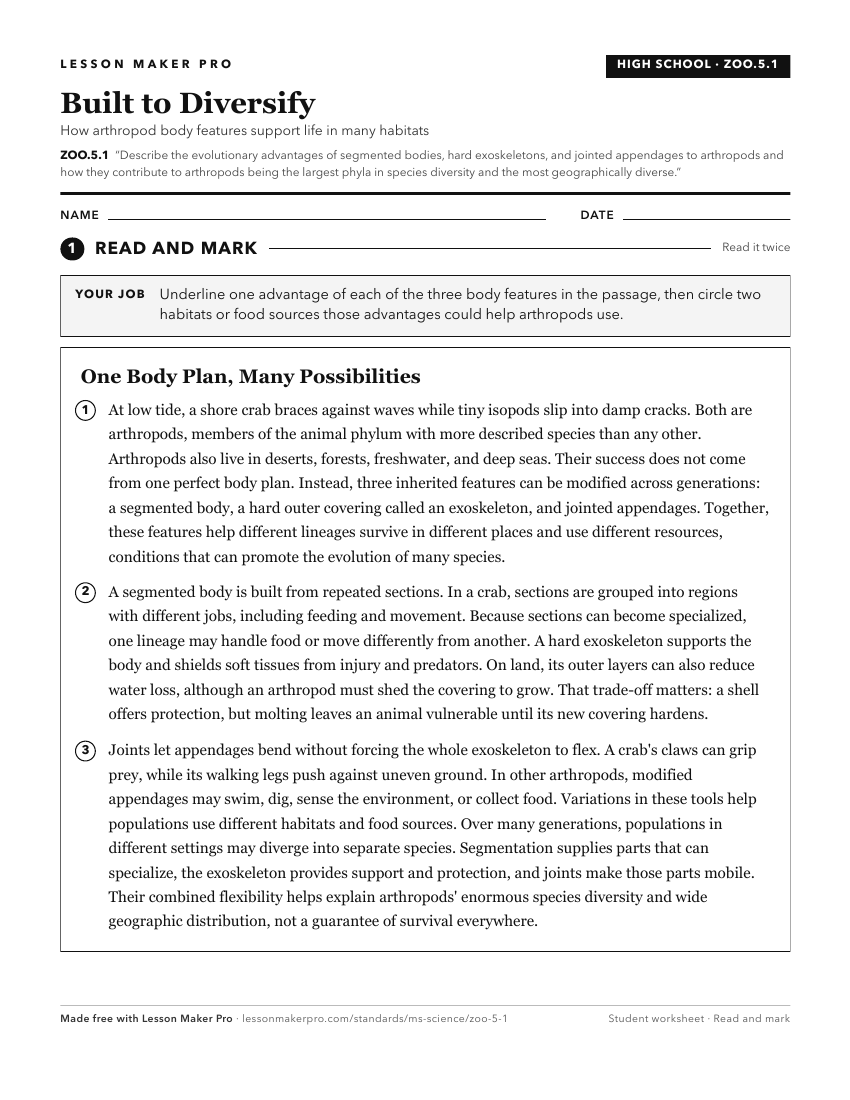
A ready-to-print activity worksheet aligned to ZOO.5.1, with an answer key for the teacher on its own page. No account needed.
PDF, US Letter, prints cleanly in black and white.
Download the worksheetKeep exploring
Related Standards
- ZOO.8.1
Understand the evolution of tetrapods and the development of the structure and function of body systems and life cycles.
- ZOO.4.5
Describe the evolutionary importance of the segmented body plans of annelids.
- ZOO.8.8
Explain the importance of tetrapod evolution.
- ZOO.5
Students will understand the basic structure and function of phylum Arthropoda, and how they demonstrate the characteristics of living things.
Turn this exact standard into a lesson
Grade, subject, topic, and the complete standard are prefilled. Create one free, no account needed.
Also for this standard:Make a WorksheetMake a QuizMake a Sub Lesson