Mississippi Science ZOO.8.8
The Standard
- ZOO.8
- Students will understand the structure and function of phylum Chordata, classes Amphibia and Reptilia, and how they demonstrate the characteristics of living things.
Explain the importance of tetrapod evolution.
2026 Mississippi College- and Career-Readiness Standards for Science · Phylum Chordata, Classes Amphibia, and Reptilia
Teacher's field guide
What This Standard Means
What Students Need to Do
- Students trace how early four-limbed vertebrates arose from lobe-finned fish ancestors. They explain how limbs and air breathing helped vertebrates use shallow water and land. They distinguish these changes from the later evolution of the amniotic egg.
What Mastery Looks Like
- A student can compare a lobe-finned fish fin with an early tetrapod limb and identify matching bones. They can explain how limbs opened new habitats, while early tetrapods still needed water for reproduction.
Common Misconceptions
- Students may think modern frogs turned into reptiles. They may assume the first tetrapods had shelled eggs and could reproduce far from water. Some picture limbs appearing suddenly when fish reached dry land.
How to Assess It
- Exit ticket: Put a lobe-finned fish, an early tetrapod, and an early reptile in order. Label limbs and the later amniotic egg, then explain how each change helped vertebrates use land.
Lesson moves
Ways to Teach It
Build a lobe-finned fish fin and an early tetrapod forelimb from paper bone cutouts, then circle the shared bones.
Ask: How did limbs help early tetrapods reach a muddy bank, and why would they still need nearby water?
Give pairs fin, digit, and amniotic egg cards; have them race to place each on a lobe-finned fish to reptile timeline.
Show bullfrog and fence lizard photos; students compare their egg-laying sites and explain which can reproduce farther from water.
Free download
Printable ZOO.8.8 Worksheet
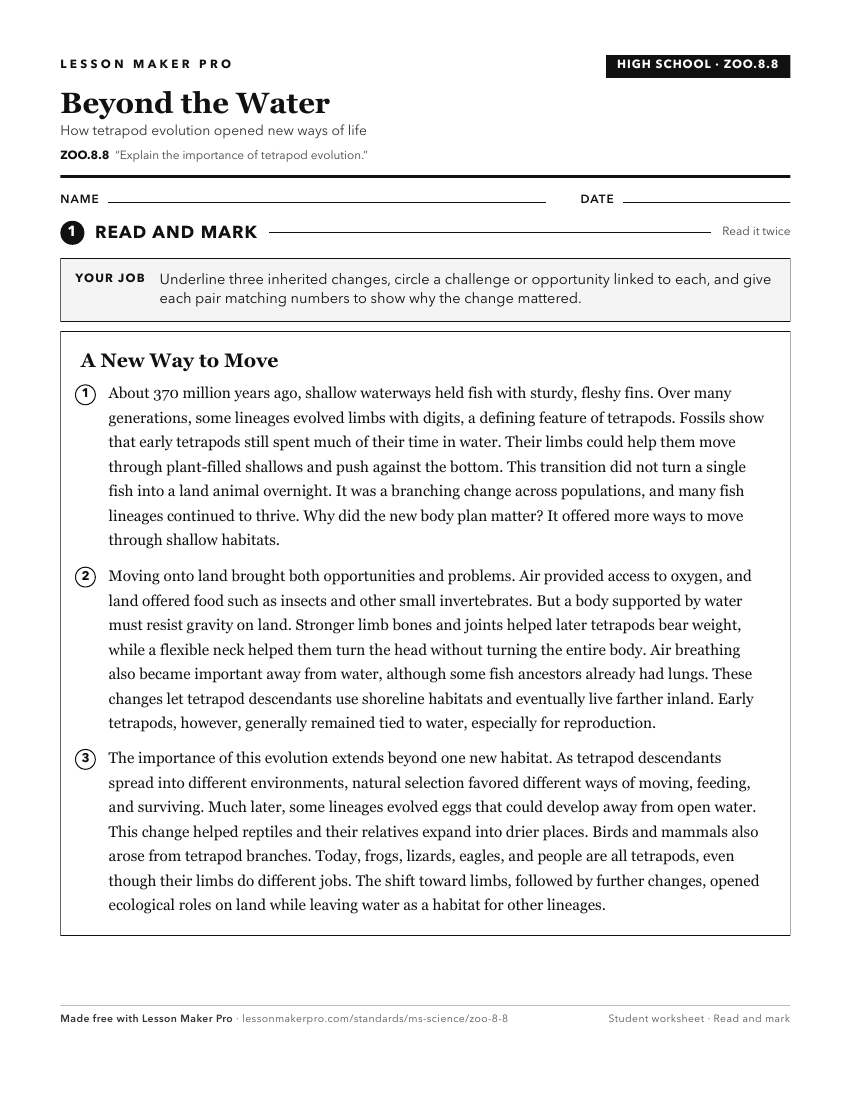
A ready-to-print activity worksheet aligned to ZOO.8.8, with an answer key for the teacher on its own page. No account needed.
PDF, US Letter, prints cleanly in black and white.
Download the worksheetKeep exploring
Related Standards
- ZOO.8.1
Understand the evolution of tetrapods and the development of the structure and function of body systems and life cycles.
- ZOO.8.9
Identify the amniotic egg as the major derived characteristic of reptiles.
- ZOO.5.1
Describe the evolutionary advantages of segmented bodies, hard exoskeletons, and jointed appendages to arthropods and how they contribute to arthropods being th...
- ZOO.8.3
Describe adaptations that have led to reptiles living on land successfully.
Turn this exact standard into a lesson
Grade, subject, topic, and the complete standard are prefilled. Create one free, no account needed.
Also for this standard:Make a WorksheetMake a QuizMake a Sub Lesson